Wall Art for Living Room: Sizes, Styles and 12 Ideas That Work
Wall art for living room walls works when it spans about two-thirds of the sofa below and hangs with its center at 57–60 in (145–152 cm). Here are size charts, 12 styles, typical prices and the mistakes we fix most.
Part of our guide: How to Hang Art and Build a Gallery Wall: Heights, Spacing, Layouts
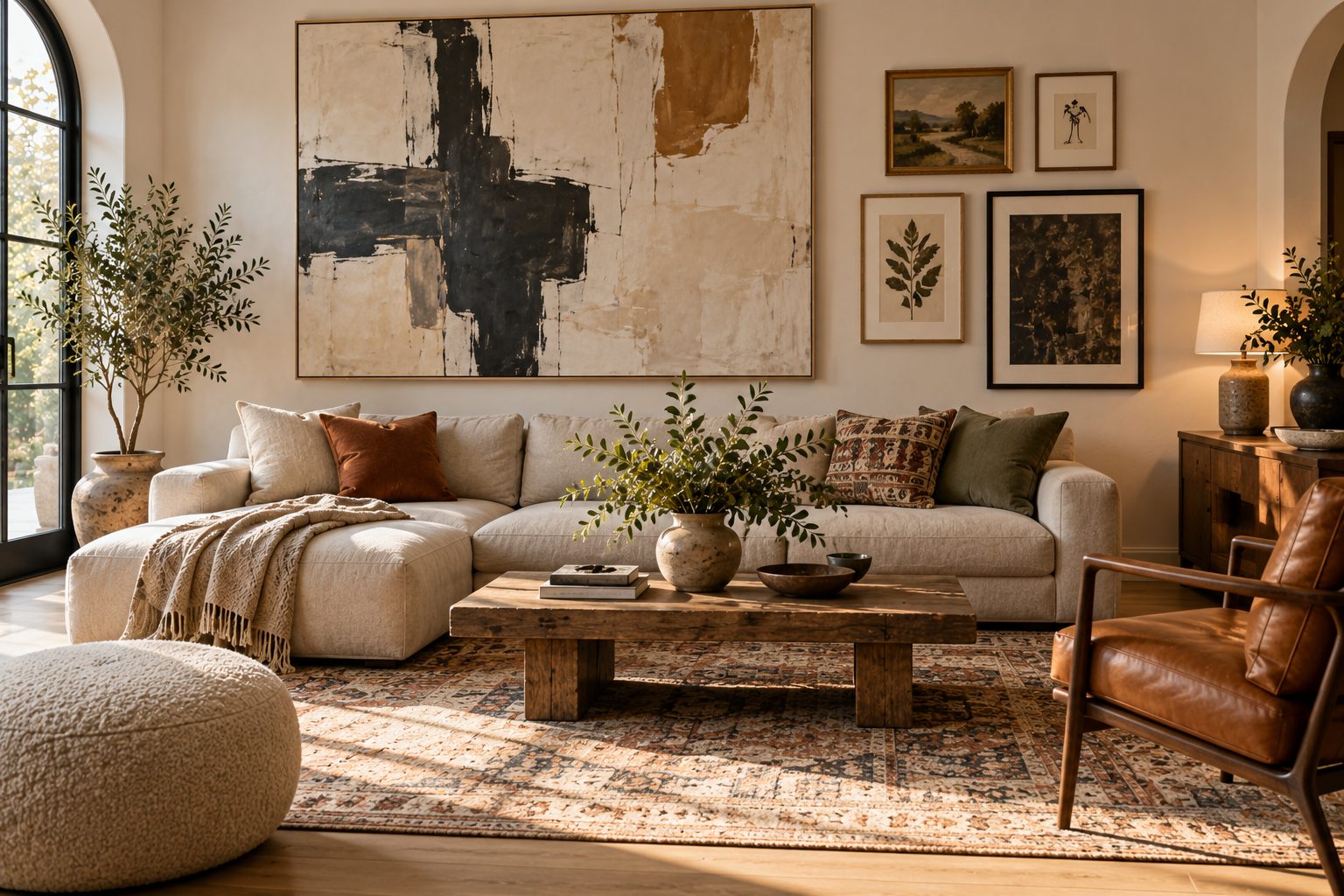
Key takeaways
- Size art to roughly 57–75 percent of the width of the furniture beneath it; above an 84 in sofa that means 48–63 in of art
- Hang so the center of the art or group sits at 57–60 in (145–152 cm) from the floor, with 8–10 in (20–25 cm) above a sofa back
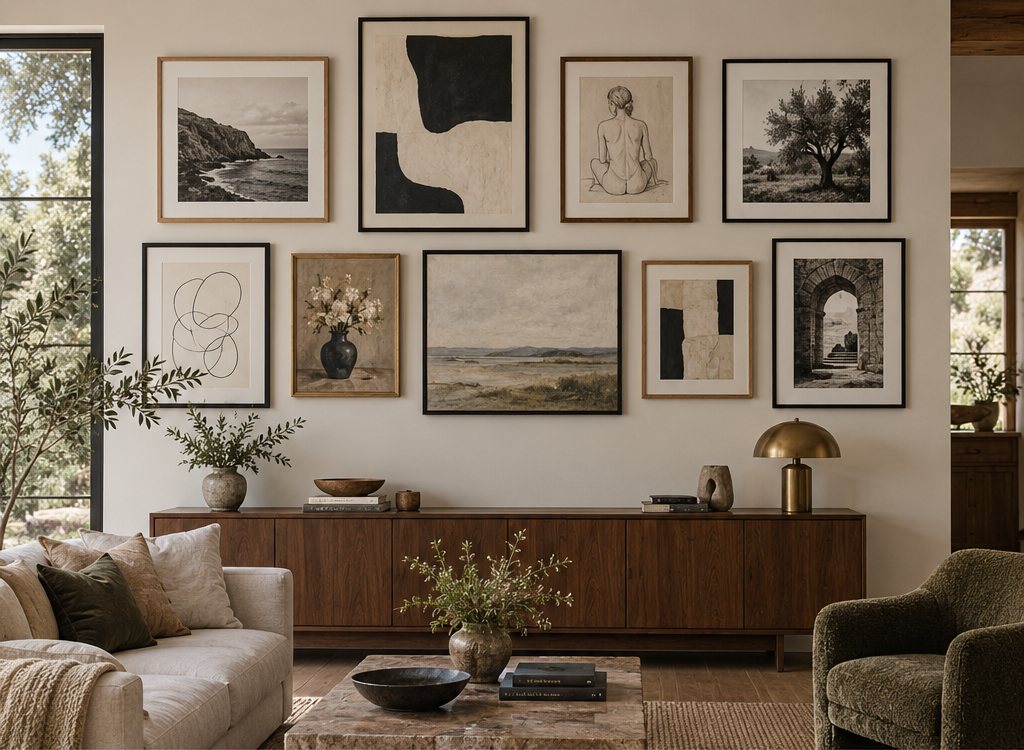
- One large piece reads calmer than many small ones; small prints only work grouped with 2–3 in (5–8 cm) gaps
- Pick art last: let it pull one or two accent colors from the room rather than matching everything
The right wall art for living room walls covers about two-thirds of the furniture beneath it and hangs with its center at 57–60 in (145–152 cm) from the floor. Above a standard 84 in (213 cm) sofa that means one piece or group roughly 48–63 in (122–160 cm) wide, with its lower edge 8–10 in (20–25 cm) above the sofa back.
Get size and height right and almost any style looks intentional; get them wrong and expensive art looks like an afterthought. If you are planning several pieces, our guide on how to hang an art gallery wall covers layouts, spacing templates and hardware in detail. This page focuses on choosing living room art: which walls, what size, which style and what to pay.
- Width rule: 57–75 percent of the furniture below, or of the wall if nothing sits beneath.
- Height rule: center at 57–60 in (145–152 cm), 8–10 in (20–25 cm) above sofa backs and consoles.
- Grouping gap: 2–3 in (5–8 cm) between frames in a cluster.
- Typical prices: $50–$300 for prints and canvas, $300–$3,000 for original paintings by emerging artists.
What to put on living room walls
Put one strong focal piece on the wall you see first, then let the other walls stay quieter with mirrors, textiles, shelving or smaller framed work. Not every wall needs art, and a living room usually looks best with one or two finished walls rather than four busy ones.
Start with the sight lines: the wall facing the entry, the wall behind the sofa and the chimney breast if there is one. Those three are where wall art for walls earns its keep. Side walls next to windows often work better with a tall mirror, a sconce pair or a slim shelf. If your main wall holds a TV, see our guide to decorating around a TV, which covers framing the screen with art without creating a cluttered media wall.
Good living room wall ideas beyond paintings include large woven wall hangings, a single oversized mirror, framed textiles, a plate or ceramic arrangement, a picture ledge for rotating prints and architectural paneling with one piece centered on it.
What size wall art for a living room?
Choose art that spans 57–75 percent of the furniture below it; for a bare wall, fill roughly 60–75 percent of the open width. The most common error is art that is too small, so when torn between two sizes, buy the larger.
| Furniture or wall width | Single piece width | Pair (each) | Trio (each) |
|---|---|---|---|
| Loveseat 60 in (152 cm) | 34–45 in (86–114 cm) | 16–20 in (41–51 cm) | 11–13 in (28–33 cm) |
| Sofa 72 in (183 cm) | 41–54 in (104–137 cm) | 19–25 in (48–64 cm) | 12–16 in (30–41 cm) |
| Sofa 84 in (213 cm) | 48–63 in (122–160 cm) | 22–30 in (56–76 cm) | 14–19 in (36–48 cm) |
| Sofa 96 in (244 cm) | 55–72 in (140–183 cm) | 26–34 in (66–86 cm) | 16–22 in (41–56 cm) |
| Bare wall 10 ft (305 cm) | 72–90 in (183–229 cm) | 34–43 in (86–109 cm) | 22–28 in (56–71 cm) |
Pair and trio widths assume 2–3 in (5–8 cm) gaps. For height, a landscape piece above a sofa is usually 24–40 in (61–102 cm) tall; in a room with 9 ft (274 cm) ceilings or more, a portrait piece or vertical stack can go to 48–60 in (122–152 cm) tall to use the extra height.
Large wall art for living room walls
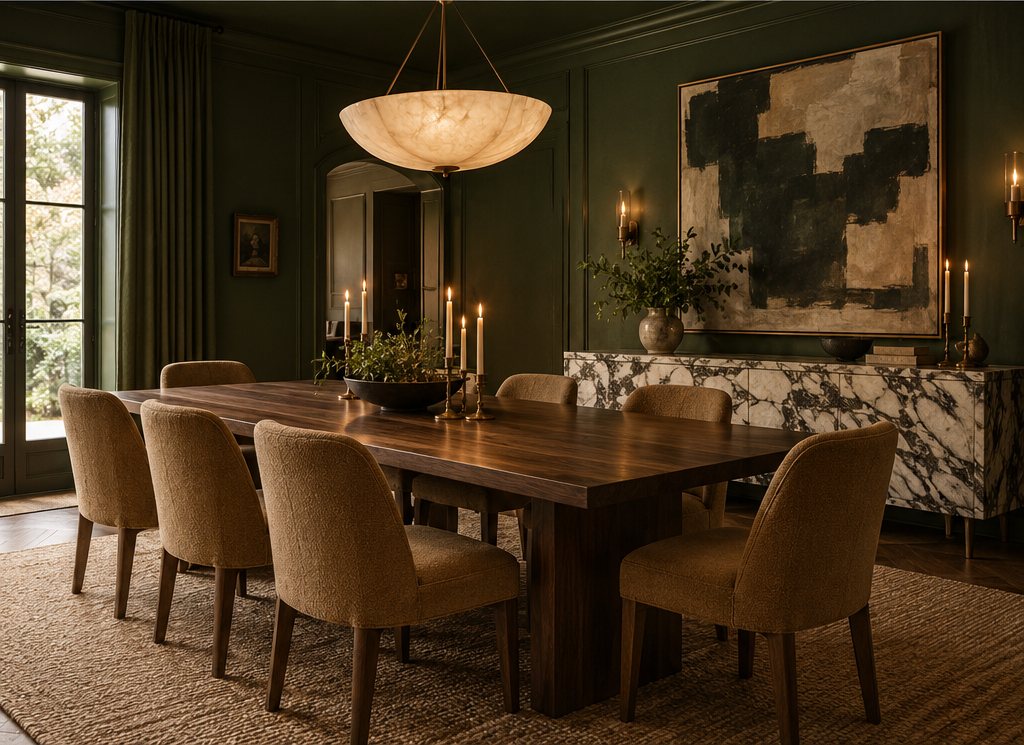
Large wall art for living room walls, anything over about 40 in (102 cm) on its long side, gives a room one clear focal point and usually looks calmer and more expensive than a cluster of small frames. It is the single most effective upgrade for a sparse room.
Large paintings for living room walls are heavy: a framed 48 × 60 in (122 × 152 cm) canvas can weigh 15–35 lb (7–16 kg), and glazed frames far more. Hang anything over 20 lb (9 kg) on two hooks rated for at least double the weight, into studs or with heavy-duty drywall anchors, and use a level across both. Unglazed canvas is lighter and avoids reflections from windows opposite. If budget rules out an original at this scale, a large-format print on canvas or a framed textile delivers the same impact for $150–$600 (typical 2026 range).
What style of artwork for the living room?
Choose artwork for the living room that suits the room's era and mood but is not a perfect match; a little contrast, such as abstract art in a traditional room, keeps it lively. Here are 12 directions we use, grouped by look.
Modern wall art for living room spaces
- Large abstract canvas: loose color fields that pick up one accent from cushions or rug.
- Minimal line drawings: black ink on white, framed with wide mats, best in pairs.
- Textural plaster or relief art: tone-on-tone, ideal in warm minimal rooms.
- Black-and-white photography: architecture or landscape, in thin black or oak frames.
Mid century modern wall art
- Geometric prints: circles, arcs and blocks in mustard, teal, orange and olive.
- Exhibition-style posters: typographic layouts in simple frames.
- Vintage abstract originals: mid century artwork from estate sales and auctions.
Mid century modern art pairs naturally with walnut and teak furniture; see our mid-century modern guide for the wider look, and keep frames slim so the art reads as period-appropriate rather than reproduction.
Unique wall art for living room walls
- Woven wall hangings for living room walls: wool or cotton tapestry, 36–60 in (91–152 cm) wide, softening echo.
- Framed textiles: a vintage rug fragment, scarf or kilim in a shadow box.
- Ceramic or plate wall: handmade pieces in a loose grid.
- Oversized mirror with art beside it: doubles the light in a dark room.
- Personal collection: maps, botanical studies or children's drawings framed uniformly.
Canvas, framed prints or paintings for living room walls?
Original paintings for living room walls give the most depth, framed prints give the most choice per dollar, and canvas wall art for living room walls gives large scale cheaply. The best rooms often mix two of the three.
| Type | Typical price (US 2026) | Best size range | Pros | Watch for |
|---|---|---|---|---|
| Canvas print | $60–$400 | 30–72 in (76–183 cm) | Light, no glare, big scale cheaply | Low-resolution images, thin stretcher bars |
| Framed art print | $50–$600 | 16–40 in (41–102 cm) | Huge choice, easy to rotate | Cheap glazing, no mat |
| Limited-edition print | $150–$1,500 | 16–36 in (41–91 cm) | Archival inks, signed, numbered | Edition size over a few hundred |
| Original painting | $300–$3,000+ | Any | One of a kind, texture, appreciates | Shipping and framing costs |
| Textile wall hanging | $80–$900 | 24–60 in (61–152 cm) | Softens acoustics, warm | Fading in direct sun |
Ranges are typical for US buyers in 2026. For prints, ask for archival pigment inks on 200–310 gsm cotton rag or matte paper; for framing, UV-filtering acrylic is lighter and safer than glass on large pieces.
How do you choose colors for living room art?
Choose art that repeats one or two colors already in the room and adds one that is not, so it connects without disappearing. Matching every hue to the sofa makes art look like a showroom accessory.
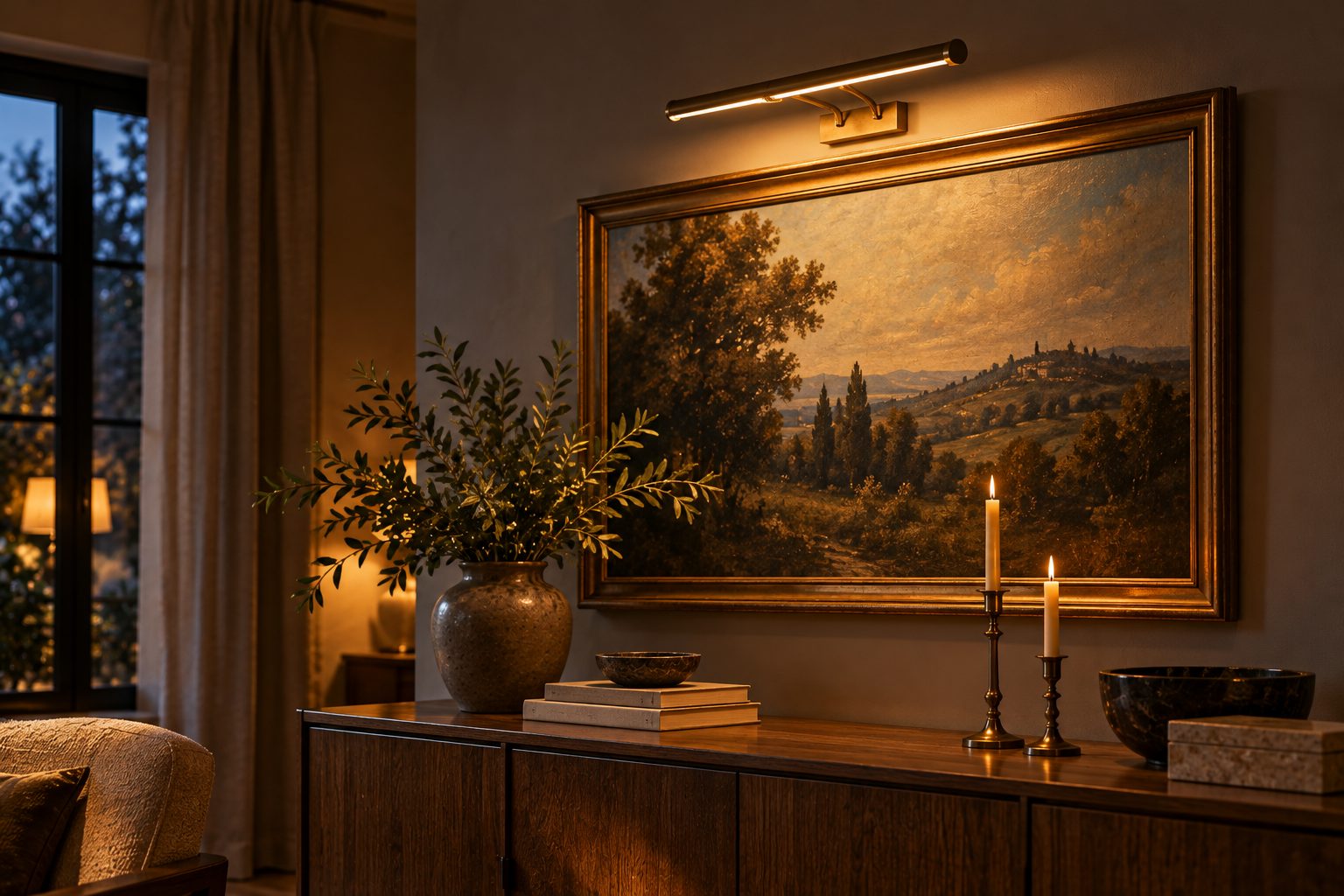
#7A2E2A#C68B3E#3F5A4C#E6DCCB#22303AIn a neutral room, art is the cheapest place to bring in saturated color. Against dark walls, art with lighter grounds or bright frames stands out; against white walls, deeper tones and thin black frames read best. Lighting matters as much as color: a picture light at 2700–3000 K with CRI 90 or above shows paint colors truthfully, and our guide to picture lights covers widths and placement.
How to hang wall pictures for living room walls
Hang wall pictures for living room walls so the center of the piece or group sits at 57–60 in (145–152 cm) from the floor, then adjust down to 8–10 in (20–25 cm) above furniture. Follow these steps.
- Measure the furniture width and multiply by 0.57 and 0.75 to get your art width range.
- Template it. Cut kraft paper to the frame sizes and tape them up for a day.
- Mark the center at 57–60 in (145–152 cm), or 8–10 in above the sofa back.
- Find the hanging point. Measure from the top of the frame to the taut wire or D-ring and mark the hook position.
- Use two hooks for anything wider than 24 in (61 cm) so it stays level.
- Check from the seat and from the doorway before you call it done.
For a gallery cluster, lay the frames on the floor first in the arrangement you want, keeping the outer edges aligned to an imaginary rectangle, then transfer the paper templates to the wall one by one, starting from the center piece and working outward. Use a laser level or a strip of painter's tape as a horizontal guide line so the tops or centers stay consistent. Heavy frames over 20 lb (9 kg) go into studs or rated anchors, and small frames benefit from a dot of removable putty at the lower corners to stop them tilting. Lounge room wall art follows exactly the same rules; "lounge" is simply the more common term in Australia and the UK. If you also have a fireplace wall, our fireplace mantel decor guide covers art above a mantel, where the lower edge should sit 4–8 in (10–20 cm) above the shelf.
Mistakes we see with living room wall art
The mistake we see most is art that is too small and hung too high, floating like a postage stamp above a long sofa. Almost every other problem is a variation of that one.
- Too small: a 24 in (61 cm) print above a 96 in (244 cm) sofa. Go bigger or group.
- Too high: lower edges 20 in (51 cm) or more above the sofa disconnect art from the seating.
- Scattered singles: small frames spread across a wall instead of grouped tightly.
- Mismatched frames without intent: either repeat one finish or vary deliberately across a gallery.
- Glare: glass opposite a big window; use non-glare acrylic or canvas.
- Buying art first and the room second: art should be the last layer, chosen once the palette is fixed.
Our verdict: spend on one large piece for the main wall, even if it is a good canvas print rather than an original, and fill secondary walls slowly with things you genuinely like. A room collected over two or three years always looks better than one bought in a weekend.
Furnishing several rooms, rentals or a hospitality project? Send sizes and quantities through our decor sourcing desk for quotes on canvas, framed prints and wall hangings made to your dimensions.
Free toolRug Size CalculatorFind the right rug size for your room and furniture.Shop & source the look
Buy it today — or have it made
Retail links are affiliate links: we may earn a commission at no extra cost to you (disclosure). “Get it made” sends the item to our sourcing desk for factory quotes in custom sizes and finishes.
Frequently asked questions
What size wall art should go above a couch?
Wall art above a couch should be about 57–75 percent of the couch width. For an 84 in (213 cm) sofa that is roughly 48–63 in (122–160 cm) of art, either one piece or a group with 2–3 in gaps. Hang the lower edge 8–10 in (20–25 cm) above the sofa back.
What to put on living room walls?
Put one large focal piece of art on the wall you see first, usually behind the sofa or facing the entry, and keep other walls quieter with a mirror, woven wall hanging, shelving or sconces. Not every wall needs art; one or two finished walls usually look better than four busy ones.
How high should wall art be hung in a living room?
Hang living room wall art so its center sits 57–60 in (145–152 cm) from the floor, which is roughly average eye level. Above furniture, drop it so the lower edge is 8–10 in (20–25 cm) above the sofa back or console. Treat a group of frames as one unit when measuring.
Is one large piece or several small pieces better for a living room?
One large piece is usually better for a living room because it creates a clear focal point and looks calmer. Several small pieces work only when grouped tightly, with 2–3 in (5–8 cm) gaps, so they read as a single block of the right overall size. Scattered small frames look accidental.
How much should I spend on living room wall art?
Typical US 2026 prices are $60–$400 for canvas prints, $50–$600 for framed prints, $150–$1,500 for limited editions and $300–$3,000 or more for original paintings by emerging artists. Spend the most on the main wall's focal piece and add less expensive work to secondary walls over time.
Some links may be affiliate links. Regulations and specifications change — always confirm with suppliers and qualified professionals.