California Casual Interior Design: Style Guide, Materials and Layouts
California casual interior design pairs relaxed, deep seating with natural materials, a sun-washed palette of 3–4 colors and an easy link between indoor and outdoor rooms. Here is how to spec it.
Part of our guide: Interior Design Styles: 24 Decorating Styles Explained for 2027
Key takeaways
- California casual is a relaxed, light-filled style built on natural materials, washable slipcovered seating and a strong indoor outdoor connection
- Keep the palette to warm white walls plus two or three sun-faded accents such as sand, sage and denim blue
- Specify performance linen or cotton blends at 25,000+ Martindale and deep seats of 23–26 in (58–66 cm)
- Match flooring tones and sightlines between the living room and the patio so both read as one indoor outdoor room
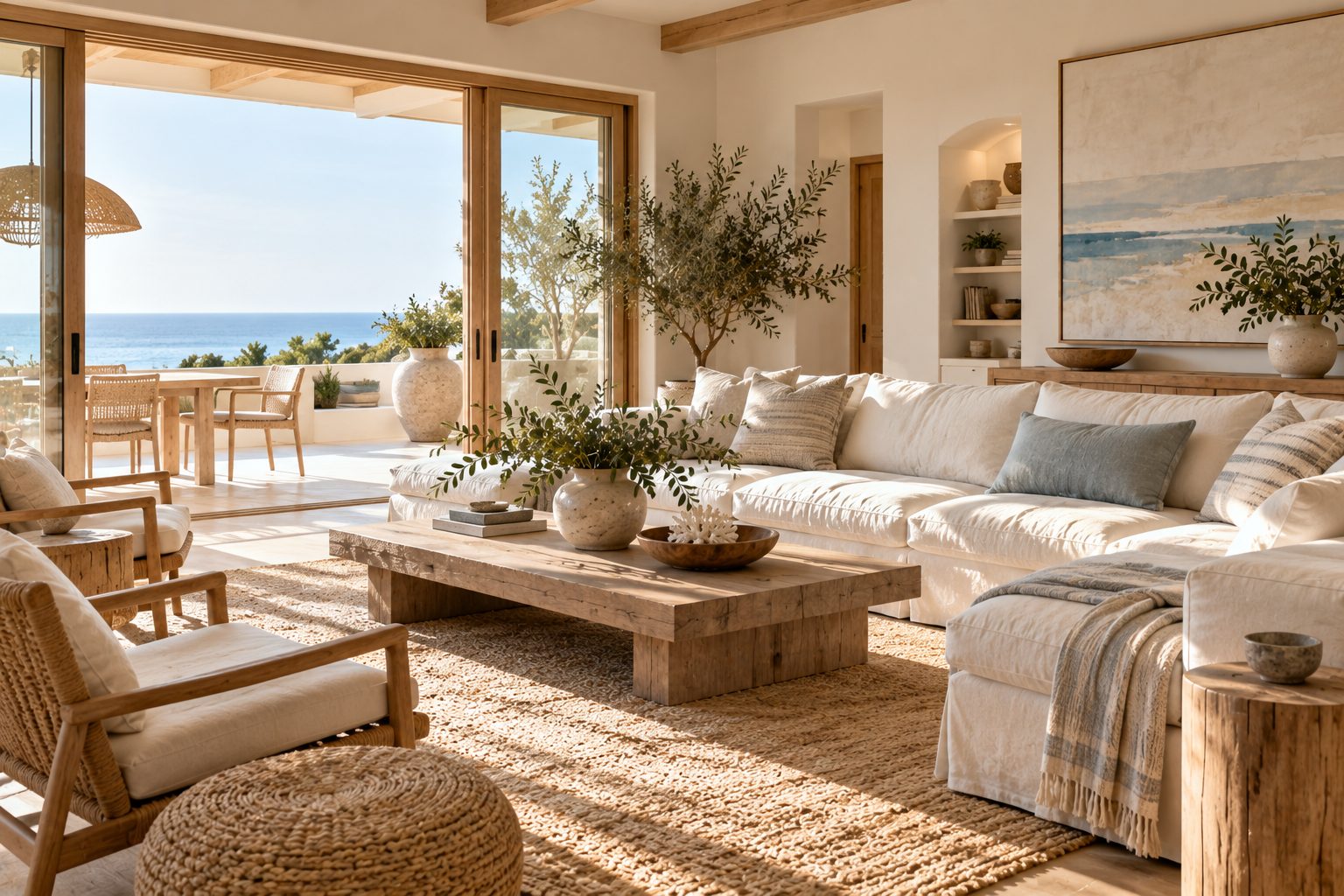
California casual interior design is a relaxed, light-filled style that mixes deep, washable seating, natural materials such as white oak, linen, rattan and stone, and a soft palette of warm white with sand, sage and faded blue. Its defining move is the indoor outdoor link: wide openings, matching floors and furniture that works on both sides of the glass.
Think of it as coastal style grown up and moved slightly inland: less nautical, more sculptural, with the comfort of a beach house and the editing of a modern home. It sits within our wider guide to interior design styles, where it overlaps with organic modern and modern farmhouse.
- Palette: warm white walls at LRV 80–88, plus two or three sun-faded accents.
- Materials: white oak, linen, cotton, jute, rattan, terracotta, limestone and plaster.
- Seating: deep, low and slipcovered, with seat depths of 23–26 in (58–66 cm).
- Layout: furniture oriented toward the view or the patio rather than the TV.
- Budget: a full california casual living room typically costs $8,000–25,000 in mid-market furniture.
What is California casual style?
California casual style is an easygoing interior look that pairs comfortable, family-proof furniture with natural textures and abundant daylight, so a home feels like a well-kept beach house rather than a showroom. The shorthand "cali casual" appears in listings and design boards, but the principles are the same: nothing precious, nothing fussy, everything easy to live with.
Three ideas separate it from neighboring styles. First, it is livable: slipcovers can be washed, rugs are flatweaves that shrug off sand, and wood is oiled rather than lacquered. Second, it is warm: unlike Scandinavian rooms, California casual uses honey oak, tan leather and terracotta to keep white walls from feeling cold. Third, it looks outward: the inside of a house is planned around light, views and the route to the garden.
Compared with coastal interior design, California casual drops the stripes, rope and shell motifs and swaps navy for duller, grayed blues. Compared with organic modern style, it is looser and more colorful, with more pattern and vintage pieces. And compared with strict modern interior design, it trades crisp lines and lacquer for softer edges, slipcovers and wood you can scuff.
Which natural materials define California casual decor?
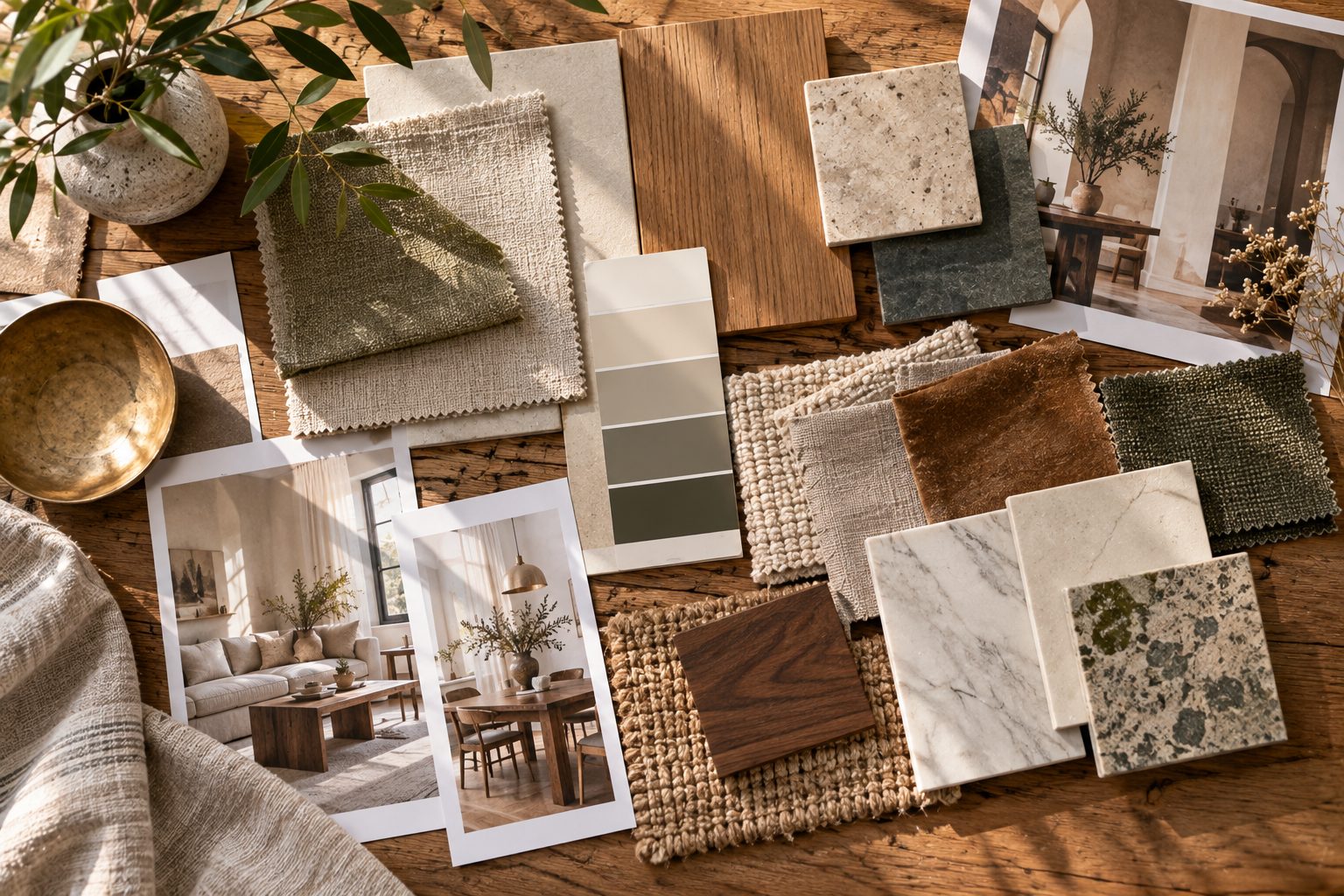
California casual decor relies on five or six natural materials repeated across the room: pale wood, washed linen, woven fiber, clay, stone and plaster. A useful natural materials definition for interiors is anything grown, quarried or fired with minimal synthetic processing, left visibly itself rather than painted or laminated.
| Material | Where to use it | Spec to ask for | Typical US price (2026) |
|---|---|---|---|
| White oak | Floors, dining tables, open shelving | Rift or plain sawn, matte hardwax oil, 3/4 in (19 mm) engineered or solid | $8–16 per sq ft installed |
| Linen and linen-cotton | Slipcovers, curtains, bedding | Prewashed, 25,000+ Martindale for seating, 200–300 gsm for curtains | $40–120 per yard |
| Rattan, cane, seagrass | Lounge chairs, headboards, baskets | Solid rattan poles, not wicker over steel; UV-protected for patios | $300–1,200 per chair |
| Jute and sisal | Area rugs, stair runners | Tight flatweave or jute-wool blend; add a rug pad | $4–12 per sq ft |
| Terracotta and zellige | Entry floors, kitchen backsplashes, pots | Sealed terracotta, DCOF 0.42+ for wet areas | $6–25 per sq ft material |
| Limestone and travertine | Coffee tables, fireplace surrounds, patio pavers | Honed, filled and sealed | $12–40 per sq ft material |
Natural materials examples beyond the big six include leather that is allowed to patina, cork, raw brass, wool and reclaimed timber. Natural objects and natural items finish the look: a branch in a stoneware jug, a bowl of driftwood, a stack of river stones on a mantel. Use three or four such pieces per room, not thirty. A good natural fiber rug guide compares jute, sisal, seagrass and wool blends for foot comfort and wear.
What colors work in a California casual palette?
The California casual palette is warm white walls with sand, sage, faded indigo and a terracotta or ochre accent, all slightly sun-bleached rather than saturated. Avoid bright whites with blue undertones: under strong western light they turn stark and clinical.
#F3EEE4#D8C6A8#A9B39A#6E8197#B86F4CThe swatch values are screen references; always test paint on a 2 × 2 ft (60 × 60 cm) board in your own light. A good ratio is 70 percent warm white and natural wood, 20 percent sand and stone tones in textiles, and 10 percent of one stronger accent in cushions, a vintage rug or ceramics. Matte or eggshell sheens keep walls soft; reserve satin for trim and doors.
How do you create indoor outdoor living?
Indoor outdoor living works when the floor, the furniture and the sightlines continue across the threshold, so the patio reads as a second living room rather than an afterthought. This is the heart of California casual interior design, and it does not require a mild climate, only a few deliberate choices.
- Widen the opening. Sliding or folding doors of 8–16 ft (2.4–4.9 m) do more than any decor. If replacing glass is out of budget, remove heavy curtains and frame a single French door.
- Match the floor tone. Choose an indoor tile or wood and an outdoor paver within one or two shades of each other, with a flush or near-flush threshold of under 1/2 in (13 mm).
- Align the furniture. Place the sofa so it faces or flanks the doors, and echo its shape outside with an outdoor sofa or a pair of lounge chairs.
- Repeat two materials. Teak, rattan, terracotta or limestone used both inside and out stitches the indoor outdoor room together.
- Light both sides. Warm 2700K lamps indoors and 2700K wall lights outdoors keep the glass from turning into a black mirror at night.
- Shade the patio. A pergola, awning or 10–11 ft (3–3.4 m) umbrella makes the outdoor living area usable at midday.
- Edit the clutter. Keep the path between rooms at least 36 in (91 cm) clear so the eye and feet move through easily.
An indoor patio or sunroom is the compromise for colder states: a glazed room with tile floors, rattan and plants that behaves like an indoor outdoor patio all year. Specify porcelain or terracotta floors, low-E glazing and fade-resistant fabrics so the room survives strong sun.
How do you design a California casual living room?
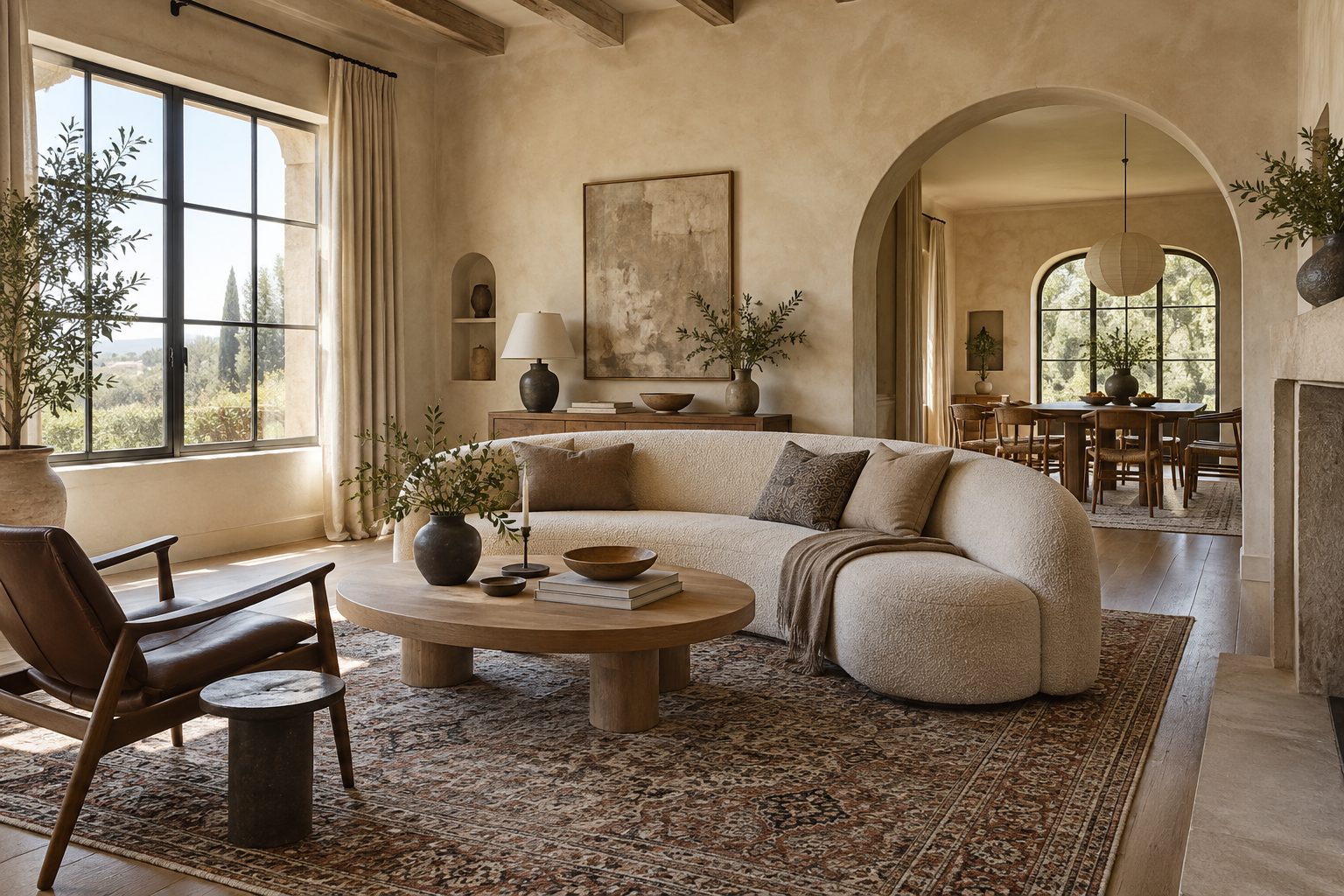
A California casual living room centers on one deep slipcovered sofa, two contrasting chairs, a natural stone or wood coffee table and a large flatweave rug, arranged around light rather than the television.
Seating
Choose a sofa 84–96 in (213–244 cm) wide with a seat depth of 23–26 in (58–66 cm) and a seat height of 17–18 in (43–46 cm). A loose, washable slipcover in a linen-cotton blend at 25,000–35,000 Martindale is the classic choice; a performance weave suits homes with dogs and children. Add one woven rattan chair and one leather sling or upholstered chair so the seating looks collected rather than bought as a set.
Tables and storage
A round travertine or oak coffee table of 36–42 in (91–107 cm) softens traffic paths. Keep 16–18 in (41–46 cm) between sofa and table. A low oak console or a pair of baskets beats a glossy media wall.
Rug and textiles
An 8 × 10 ft (244 × 305 cm) rug suits most living rooms of 12 × 15 ft (3.7 × 4.6 m); every front leg should sit on it. Layer two or three cushion textures, such as linen, a vintage kilim and a nubby wool, and stop there.
Outdoor living room ideas that match the interior
The best outdoor living room ideas copy the indoor layout: a sofa or pair of chairs, a coffee table, a rug and a lamp, all scaled to the space and built from weather-tolerant materials. Backyard living spaces feel finished when they have the same three layers a living room does: seating, a surface and soft light.
- Furniture: grade-A teak, powder-coated aluminum or resin wicker with quick-dry foam cushions in solution-dyed acrylic.
- Rug: polypropylene or PET flatweave sized so the front legs of all seating sit on it, typically 6 × 9 or 8 × 10 ft (183 × 274 or 244 × 305 cm).
- Lighting: wall lights rated IP44 or higher, plus rechargeable lanterns at 100–300 lumens.
- Planting: olive, citrus, rosemary and grasses in terracotta or concrete planters of 20–30 in (51–76 cm) diameter.
When you design outdoor living around a single focal point, such as a fire bowl, a dining table under a pergola or a view, the space gets used. Outdoor room designs that try to fit a lounge, a bar and a dining set into 200 sq ft (19 m²) end up as storage for cushions. Our outdoor living trends 2027 report has more layouts for every yard size.
Mistakes we see in California casual interiors
The mistake we see most often is buying a theme instead of a feeling: surfboards, "beach" signs and blue-and-white everything turn California casual into a rental cottage. The style should read as relaxed and natural without a single literal coastal reference.
- Too much white. All-white sofas, walls and floors look cold; anchor the room with mid-tone oak, leather and terracotta.
- Matching sets. A sofa, loveseat and chair in the same fabric look like a showroom. Mix materials.
- Spindly furniture. Thin, pale pieces float in large open plans; choose generous, grounded shapes.
- Cool lighting. 4000K bulbs flatten natural materials. Use 2700K with a CRI of 90 or higher.
- Ignoring the patio. Spending everything inside and nothing on the indoor outdoor house link wastes the style's best feature.
Our verdict: get the sofa, the floor and the opening right and the rest of California casual style takes care of itself. Spend on the slipcovered sofa and solid oak, save on cushions and accessories, and buy vintage for the pieces that give the room age. If you are unsure whether this or a neighboring look suits you, our style quiz takes about two minutes.
Many people searching for CA interior designers want exactly this look; you can achieve it without a full-service designer if you follow the specs above and source carefully. Furnishing a whole home or a rental in California casual decor? Send your room list to our furniture sourcing desk for factory quotes on slipcovered sofas, rattan seating and solid oak pieces.
Free toolTile CalculatorWork out tiles, boxes, grout and adhesive with the right wastage.Shop & source the look
Buy it today — or have it made
Retail links are affiliate links: we may earn a commission at no extra cost to you (disclosure). “Get it made” sends the item to our sourcing desk for factory quotes in custom sizes and finishes.
Frequently asked questions
What is California casual style?
California casual style is a relaxed interior look built on comfortable slipcovered seating, natural materials such as white oak, linen, rattan and stone, and a soft warm-white palette with sand, sage and faded blue accents. It emphasizes daylight and an easy indoor outdoor connection, and it avoids literal beach themes or fussy, precious pieces.
What is the difference between coastal and California casual?
California casual is less themed than coastal. Coastal decor often uses navy, stripes, rope and shell motifs, while California casual relies on warmer neutrals, grayed blues, mid-tone wood, leather and terracotta. Both value light and natural textures, but California casual reads more modern and works well away from the beach.
What colors are used in California casual decor?
California casual decor uses warm white walls, typically with an LRV of 80–88, plus sand, oatmeal, dry sage, faded denim blue and one terracotta or ochre accent. Colors should look slightly sun-bleached. A practical split is 70 percent white and wood, 20 percent sand and stone, and 10 percent accent color.
How do I make my living room California casual?
Start with a deep slipcovered sofa in washable linen-cotton, a large jute or flatweave rug and a stone or oak coffee table. Paint walls warm white, swap cool bulbs for 2700K, add one rattan chair and a few natural objects, and arrange seating toward windows or the patio rather than the television.
Does California casual work in cold climates?
Yes. The style depends on light, natural materials and comfort, not on weather. In colder regions add wool throws, a thicker wool-jute rug and warmer wood tones, and use a glazed sunroom or indoor patio as the indoor outdoor room. Keep the palette warm white rather than bright white so winter light stays soft.
Some links may be affiliate links. Regulations and specifications change — always confirm with suppliers and qualified professionals.