Natural Fiber Rugs & Carpet: Jute, Sisal, Wool & Seagrass
Natural fiber rugs are made from seven plant and animal fibers: jute, sisal, seagrass, coir, hemp, cotton and wool. They cost $2–15 per sq ft for plant fibers and $8–40 for wool, and this guide compares them by softness, wear, stain resistance, room and care.
Key takeaways
- Seven natural rug fibers cover the market: jute, sisal, seagrass, coir, hemp and cotton from plants, and wool from animals; wool is the only one that is soft, resilient and stain-resistant at once
- Plant fiber rugs cost $2–15 per sq ft and wool $8–40 per sq ft; a 8 × 10 ft (244 × 305 cm) jute rug runs $250–700 and the same size in wool $700–3,000
- Jute is the softest plant fiber and the least durable; sisal and seagrass are the hardest wearing; none of the plant fibers tolerates standing water, so keep them out of bathrooms and uncovered outdoor spaces
- Natural fiber carpet installed wall to wall costs $8–25 per sq ft for sisal or seagrass and $10–40 for wool, and needs a felt or rubber-and-felt pad underneath
- The 2027 look is layered: a large flatweave jute or sisal base with a smaller wool or cotton rug on top, in natural, undyed tones that sit with clay, olive and oak
Natural fiber rugs and carpet are woven from seven plant and animal fibers: jute, sisal, seagrass, coir, hemp, cotton and wool. Plant fiber rugs cost $2–15 per sq ft and wool $8–40. Jute is soft but wears fast, sisal and seagrass are hard-wearing but coarse, and wool is soft and resilient but costs the most. This guide compares all seven and matches each to a room.
Natural rug fibers have moved from the budget corner of the market to its center, partly because the warm, undyed texture suits the clay-and-oak palettes of the moment and partly because they are the lowest-impact floor covering available: renewable, biodegradable and usually free of the synthetic latex and dyes in a machine-made polypropylene rug. The trade-off is that each fiber has a weakness, and buying the wrong one for the room is the most common natural fiber rug mistake. The sections below give the fiber profiles, the room-by-room picks, the wall-to-wall option and the care rules.
- Seven fibers: jute, sisal, seagrass, coir, hemp, cotton (plant) and wool (animal); blends of two fibers are common.
- Price per sq ft: jute $2–8, seagrass $3–8, sisal $4–12, coir $3–10, hemp $6–15, cotton $3–10, wool $8–40.
- Softest to hardest: wool, cotton, jute, hemp, seagrass, sisal, coir.
- Most durable: wool and sisal for traffic; seagrass and coir for grit and entries; jute only in low-traffic rooms.
- Water: no plant fiber rug belongs in a bathroom, a laundry or under a leaking plant pot; wool handles damp better but still needs drying flat.
What are natural fiber rugs made of?
Natural fiber rugs are made of fibers harvested from plants or animals and spun or twisted into yarn before being woven, braided or tufted into a rug: jute from the stalk of a tropical plant, sisal from the leaves of an agave, seagrass from a marsh grass, coir from coconut husks, hemp from the stalk of the hemp plant, cotton from the seed boll, and wool from sheep. Each fiber's structure, its length, its oil content and its cell shape, sets how the finished rug feels and behaves.
| Fiber | Source | Feel underfoot | Durability (traffic) | Stain and water resistance | Typical cost per sq ft | Best rooms |
|---|---|---|---|---|---|---|
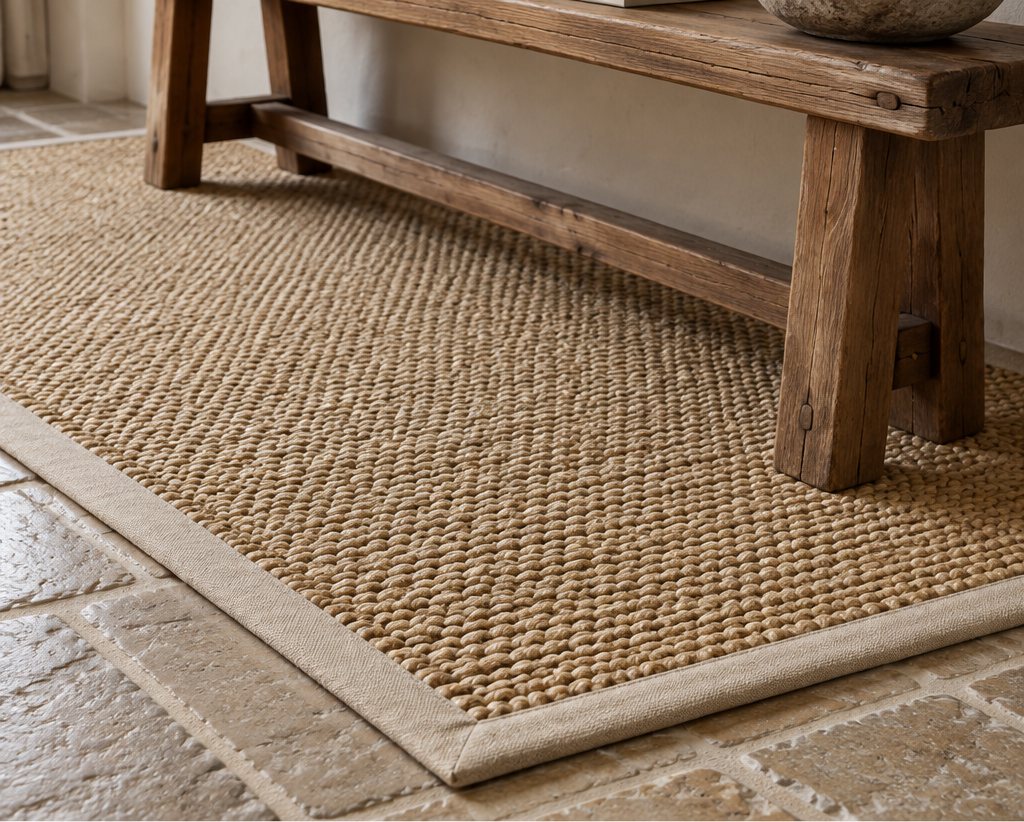
| Jute | Plant stalk | Soft, slightly springy | Low–moderate; sheds and flattens | Poor; absorbs water, browns if wet | $2–8 | Bedrooms, living rooms, under layered rugs |
| Sisal | Agave leaf | Coarse, firm | High; the hardest-wearing plant fiber | Poor to stains; moderate to dry dirt | $4–12 | Halls, stairs, living rooms, offices |
| Seagrass | Marsh grass | Smooth, waxy, firm | High | Good to stains (waxy coat); poor to standing water | $3–8 | Dining rooms, kitchens, family rooms, sunrooms |
| Coir | Coconut husk | Rough, bristly | Very high | Good; dries fast | $3–10 | Entry mats, covered porches, mudrooms |
| Hemp | Plant stalk | Firm, smoother than sisal | High | Moderate; resists mildew better than jute | $6–15 | Living rooms, halls, offices |
| Cotton | Seed fiber | Soft, flat, light | Low–moderate | Poor to stains but washable | $3–10 | Kitchens, baths (washable), kids' rooms, layering |
| Wool | Sheep fleece | Soft, dense, resilient | Very high; recovers from crushing | Good; lanolin repels spills for a few minutes | $8–40 | Living rooms, bedrooms, dining rooms, stairs |
Two fibers deserve their own guides because they carry most of the market: jute rugs for the soft, affordable end and wool rugs for the premium end. The hard-wearing plant fibers are covered in sisal rugs, and the weaves these fibers are made into, flatweave, braided, boucle-loop, herringbone, basketweave, in woven rugs.
What is the difference between jute, sisal and seagrass rugs?
Jute is the softest and least durable of the three, sisal is the coarsest and most durable, and seagrass sits between them with a smooth, waxy surface that resists stains better than either. They are often confused because all three are sold as "natural rugs" in similar tan tones and similar flat weaves, and the differences only show up after a year on the floor.
Jute
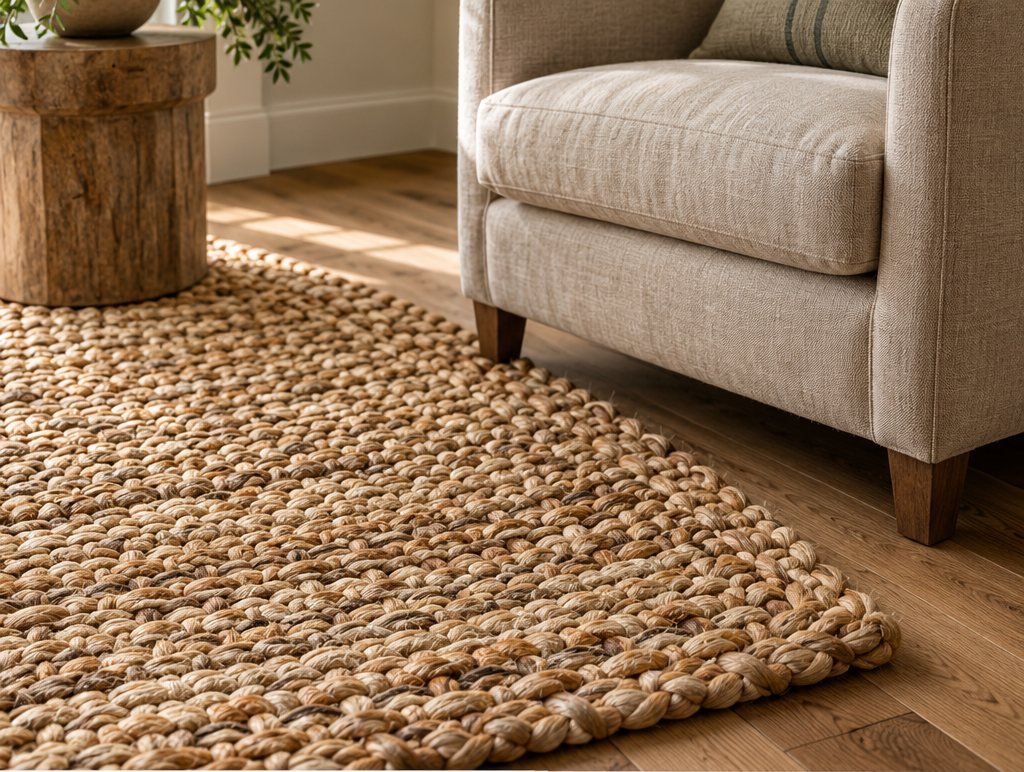
Jute fibers are long, soft and golden-brown; the rug feels closest to a coarse wool and is the one people reach for in bedrooms. Its weaknesses are shedding (a jute rug sheds fibers for the first 3–6 months), crushing (the chunky braided weaves flatten in traffic lanes) and water (jute absorbs it, browns and can rot). A good jute rug is a 5–8 year rug in a bedroom and a 2–4 year rug in a hallway.
Sisal
Sisal fibers are stiff, pale and strong; the rug feels like a doormat to bare feet and lasts 10–15 years in a hall. It is the fiber for stairs, home offices with rolling chairs, and any room that gets dragged furniture. The weakness is stains: sisal is absorbent, and a red wine spill wicks in and sets, so it needs an immediate blot and should not be the choice under a dining table. Sisal also stretches and shrinks slightly with humidity, which matters for wall-to-wall installations.
Seagrass
Seagrass is grown in paddies, which gives it a waxy, water-shedding cuticle; it is greener when new and ages to a khaki tan. The surface is smooth and the weave is usually a tight basketweave on a latex or cotton backing. It is the best plant fiber for a dining room or kitchen because spills sit on the surface for a minute, but it cannot be dyed, so the only colors are its own, and it will mildew if it stays wet.
Is wool a natural fiber rug, and is it worth the price?
Wool is a natural fiber rug, the only animal fiber in common use, and it is worth the price in any room where comfort and longevity both matter, because it is soft, springs back from furniture and foot traffic, holds dye in deep colors, resists stains for long enough to blot them and lasts 20–30 years in a good weave. A wool rug costs two to four times what a jute rug of the same size costs, and it outlasts it by three to five times.
| Wool rug type | Construction | Cost per sq ft | 8 × 10 ft (244 × 305 cm) price | Notes |
|---|---|---|---|---|
| Flatweave (dhurrie, kilim) | Hand or machine woven, no pile | $6–20 | $500–1,600 | Reversible, thin, good under dining tables |
| Hand-loomed or hand-tufted pile | Yarn punched through a backing, latexed | $8–25 | $650–2,000 | Soft, affordable pile; backing can degrade in 8–12 years |
| Machine-woven pile | Power loom, often wool blend | $6–18 | $500–1,500 | Consistent, hard wearing, limited texture |
| Hand-knotted | Knots tied by hand on a warp | $20–60+ | $1,600–5,000+ | 50-year rug; heirloom territory |
| Wool-jute or wool-sisal blend | Flatweave or loop, mixed yarn | $5–15 | $400–1,200 | Softer than plain plant fiber, cheaper than wool |
Wool sheds for the first few months, like jute, and a cheap wool rug can shed for years; look for a dense, tightly twisted yarn and a pile height of 0.3–0.6 in (8–15 mm) for everyday rooms. Weaves, sizes and the knot-count question are in the wool rug guide.
Which natural fiber rug is best for each room?
The best natural fiber rug for each room follows the room's traffic, spills and bare-foot time: wool or jute where feet are bare and spills are rare, seagrass or a washable cotton where food is eaten, sisal where traffic and rolling chairs are heavy, coir where grit comes in from outside, and nothing plant-based where water stands. The table below is the version we hand to clients.
| Room | First choice | Second choice | Avoid | Size to buy |
|---|---|---|---|---|
| Living room | Wool flatweave or low pile; jute under a wool layer | Sisal or hemp | Coir, loose chunky jute in a busy room | 8 × 10 ft (244 × 305 cm) or 9 × 12 ft (274 × 366 cm) with front legs of seating on the rug |
| Bedroom | Wool or soft jute | Cotton flatweave | Sisal and coir beside the bed | Extends 24–36 in (61–91 cm) past the sides of the bed |
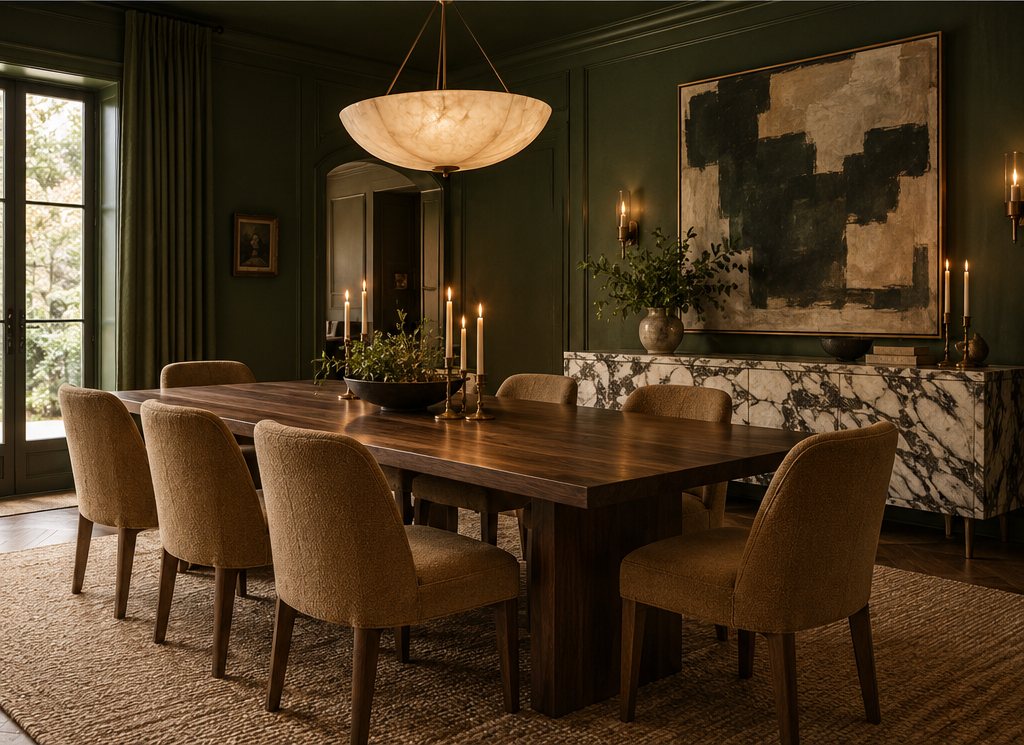
| Dining room | Seagrass or wool flatweave | Washable cotton | Jute (stains and crushes under chairs) | 24 in (61 cm) beyond the table on all sides |
| Kitchen | Washable cotton runner | Seagrass | Jute, sisal near the sink | Runner leaving 6 in (15 cm) of floor each side |
| Hall and stairs | Sisal, hemp or a wool-sisal blend | Wool runner | Jute, chunky braided weaves | Runner 4–6 in (10–15 cm) narrower than the hall; stair runner 27–32 in (69–81 cm) wide |
| Home office | Sisal or seagrass (chair casters) | Low wool loop | Any high pile | Covers desk and full chair travel |
| Entry and mudroom | Coir mat; seagrass inside | Sisal | Jute, cotton | 3 × 5 ft (91 × 152 cm) or a runner |
| Bathroom and laundry | Washable cotton | Wool (dried flat) | All other plant fibers | Bath mat 21 × 34 in (53 × 86 cm) or larger |
| Covered porch | Coir or seagrass under a roof | Hemp | Jute, wool, anything in direct rain | Front legs of seating on the rug |
Size is the decision people get wrong most often, and it is not fiber-specific: the rules are in how to choose a rug size and dining room rugs, and the rug size calculator gives a size from the room and furniture dimensions. Washable rugs, which in natural fibers means cotton, are compared in washable rugs.
Can you install natural fiber carpet wall to wall?
Yes: sisal, seagrass, coir, jute and wool are all sold as broadloom for wall-to-wall installation, at $8–25 per sq ft installed for the plant fibers and $10–40 for wool, and natural fiber carpet has become the quiet alternative to synthetic carpet in bedrooms, studies and stairs. The rolls are typically 13 ft 2 in (4 m) wide, which sets where seams fall, and the plant fibers need an experienced installer because they stretch with humidity and cannot be power-stretched like a tufted synthetic.
What installation involves
Plant fiber broadloom is glued down directly or over a felt underlay, never stretched over gripper alone, because sisal in particular relaxes by up to 1 percent in humid months and would ripple. The rug is acclimatized flat in the room for 48 hours, cut with 2–3 in (5–8 cm) of excess, glued with a pressure-sensitive adhesive, rolled and trimmed, with seams taped and glued rather than heat-bonded. Wool broadloom installs conventionally over gripper and pad. Expect $3–6 per sq ft of the installed price to be labor on plant fiber jobs.
Where it works and where it does not
Natural wall to wall carpet suits bedrooms (jute, wool), studies and libraries (sisal, hemp), stairs and landings (sisal, wool-sisal) and sunrooms (seagrass). It does not suit kitchens, baths, basements with any damp, or rooms with underfloor heating set above 80 °F (27 °C), which dries plant fibers until they crack. A bound area rug cut from the same broadloom, with a 1.25–2 in (3–5 cm) cotton, linen or leather binding, is the usual compromise for living and dining rooms and costs $4–10 per linear ft of binding on top of the carpet.
Do natural fiber rugs need a rug pad?
Yes: every natural fiber rug needs a pad, and the plant fibers need one more than wool does, because the backing on a jute, sisal or seagrass rug is thin, slightly abrasive and prone to sliding on hardwood and tile. A pad adds 1–3 years to a rug's life by stopping the backing grinding against the floor, keeps the rug flat, and makes a hard flatweave feel 30–50 percent more cushioned.
- On hardwood and tile: a felt-and-natural-rubber pad at 1/4 in (6 mm) for area rugs; rubber side down, felt side to the rug. Avoid PVC and plastic foam pads, which can mark finished wood.
- On carpet: a firm, dense felt pad with a textured face that grips the carpet; thin rubber pads slide on carpet.
- Under runners: a 1/8 in (3 mm) rubber pad so the runner stays below door clearance.
- For layered rugs: the pad goes under the base rug only; a thin non-slip underlay between the two rugs stops the top one creeping.
- Size: cut the pad 1–2 in (2.5–5 cm) smaller than the rug on every side so the edges taper to the floor.
Pad types, thicknesses and the carpet-on-carpet problem are covered in the rug pad guide.
How do you clean and care for a natural fiber rug?
Clean a natural fiber rug with regular vacuuming on a suction-only setting, immediate blotting of spills with a dry white cloth, and dry-cleaning methods only; the single rule is to keep water to a minimum, because jute, sisal and seagrass absorb it, swell, brown and can mildew. Wool tolerates damp cleaning but still needs drying flat and fast.
- Vacuum weekly with the beater bar off or raised; a beater bar pulls fibers out of a flatweave and frays a jute braid. Vacuum both sides of a flatweave twice a year.
- Blot spills in the first minute. Press with a dry white cloth or paper towel from the outside in; never rub. On seagrass and wool, most spills lift completely if caught this fast.
- Treat stains dry. Sprinkle a dry absorbent powder (baking soda or a dry carpet cleaning compound) over a greasy or liquid stain, leave 30–60 minutes, vacuum. Repeat before trying anything wet.
- Spot-clean with minimal moisture. For a set stain on jute or sisal, a cloth barely dampened with a mild soap solution, blotted, then dried with a fan or hair dryer on cool within 15 minutes. Test a corner first; some jute browns on contact with water.
- Dry fully and fast. Lift the rug onto a chair or rail if it gets soaked; a damp jute rug on a hardwood floor stains both.
- Rotate every 6–12 months so the traffic lanes and sun fade even out; plant fibers lighten noticeably in direct sun over a year.
- Professional clean every 2–3 years for wool (hot water extraction or immersion washing by a rug specialist) and dry-compound cleaning only for plant fibers.
Shedding is normal: a jute or wool rug loses loose fibers for 3–6 months, and vacuuming more often in that period, not less, shortens it. Sprouting loops on a sisal or wool loop rug should be trimmed level with scissors, never pulled.
What do natural colored rugs and nature-inspired rugs look like in 2027?
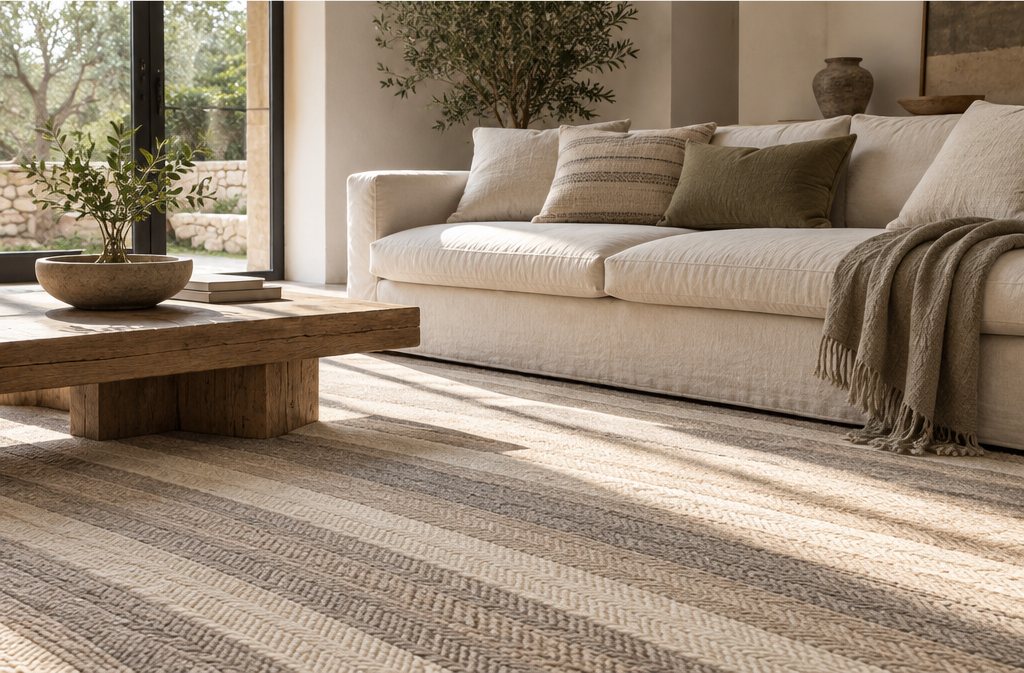
Natural colored rugs in 2027 are undyed and tonal, in the straw, oatmeal, khaki and taupe of the fibers themselves, and nature-inspired rugs lean on texture rather than motif: chunky jute braids, basketweave seagrass, herringbone sisal, wool with visible slubs and an occasional stripe or border in olive, rust or charcoal. The look sits with the clay, cocoa and butter palettes and the oak and travertine surfaces that define current rooms; see the 2027 color palettes and trending materials for the context.
Layering a natural fiber base with a softer top rug
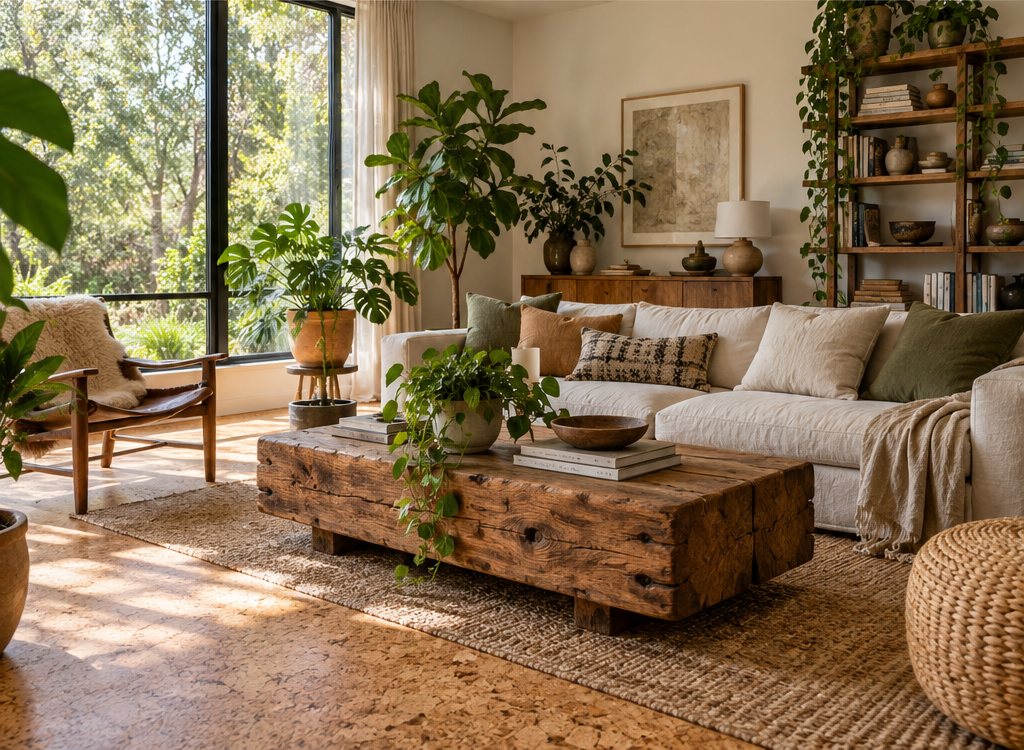
The layered rug is the defining natural fiber rug idea of the moment: a large flatweave jute, sisal or seagrass base at 9 × 12 ft (274 × 366 cm) or 10 × 14 ft (305 × 427 cm), with a smaller wool, cotton or vintage rug at 5 × 8 ft (152 × 244 cm) or 6 × 9 ft (183 × 274 cm) on top, centered under the coffee table or angled slightly. It solves the two problems of plant fiber rugs, coarseness underfoot and plainness, by putting the soft, patterned rug where feet and eyes land and the hard-wearing one where the furniture sits, and it lets a large room take a large rug for $400–700 instead of $2,000.
Natural fiber mats and small rugs
Natural fiber mats, coir doormats at 18 × 30 in (46 × 76 cm) to 24 × 36 in (61 × 91 cm), seagrass and jute bath-adjacent mats, braided jute rounds at 4–6 ft (122–183 cm) in a reading corner, carry the material into small spaces. Coir at the door takes grit better than any synthetic; a cotton or wool round beside the bath is the only natural choice that survives water. Nature-inspired patterns, leaves, pebbles, rippled textures, work best as weave structure in a single tone rather than as printed motifs.
Why natural fibers are the low-impact choice
Natural rug fibers are renewable, biodegradable and, in the case of jute, seagrass and hemp, grown with little irrigation or chemical input on land that is often unsuited to food crops. A plant fiber rug at the end of its life can be cut up and composted; a polypropylene rug cannot. The caveats are the backing and the finish: a natural latex or cotton backing keeps the rug compostable, while a synthetic latex backing does not, and some stain-resist coatings add fluorinated chemistry that the fiber itself never had. Ask for an undyed or vegetable-dyed rug with a cotton or natural latex backing if the low-impact case is part of your reason for buying, and expect to pay 10–20 percent more for it. Wool carries a larger footprint per sq ft than plant fibers but lasts three to five times longer, which evens the comparison over the life of the rug.
How do you choose the right natural fiber rug?
Choose a natural fiber rug by ranking the room's three demands, bare-foot comfort, spill risk and traffic, then picking the fiber that handles the highest-ranked demand, and only then the weave, size and color. Working from the look backward is how a chunky jute ends up under a dining table.
- Comfort first (bedrooms, living rooms with bare feet): wool, then jute, then a wool-jute blend. Avoid sisal and coir.
- Spills first (dining rooms, kitchens, kids' rooms): seagrass or washable cotton, then wool flatweave. Avoid jute and sisal.
- Traffic first (halls, stairs, offices): sisal, hemp or wool-sisal, then wool loop. Avoid jute and cotton.
- Grit and weather first (entries, porches): coir, then seagrass. Avoid everything else.
- Budget under $500 for an 8 × 10 ft: jute, seagrass or sisal; layer a smaller wool rug on top later.
- Budget over $1,000 for an 8 × 10 ft: hand-loomed or hand-knotted wool, which outlasts the furniture around it.
- Check the backing and the binding. A latex backing cracks in 8–12 years; a cotton-backed or backless flatweave lasts longer. A serged or wide cotton binding resists fraying at the corners, which is where plant fiber rugs fail first.
- Buy a pad with the rug and cut it 1–2 in (2.5–5 cm) smaller all round.
If the choice comes down to jute or wool for a living room, buy the wool if you will keep the rug more than five years and the jute if you will not; and if it is sisal or seagrass for a dining room, buy the seagrass. For a reading on how the rug fits into the rest of the room, living room trends 2027 shows the current pairings of rug, sofa and floor.
Free toolTile CalculatorWork out tiles, boxes, grout and adhesive with the right wastage.In this guide
- Sisal Rugs: Softness, Borders, Sizes & How to Buy the Best OneSisal rugs are woven from agave leaf fiber, cost about $4–12 per sq ft for a bound rug, and are the hardest-wearing natural fiber you can pu…
- Woven Rugs: Flat-Weave Types, Materials, Sizes & Buying GuideA woven rug is a flat rug with no pile, made by interlacing warp and weft on a loom; kilim, dhurrie, soumak and braided rugs are the main ty…
Frequently asked questions
What is the most durable natural fiber rug?
Sisal is the most durable plant fiber rug, lasting 10–15 years in halls and on stairs, and wool is the most durable natural fiber overall because it recovers from crushing and resists stains; a hand-knotted wool rug lasts 30–50 years. Coir is tougher than sisal but too rough for anything beyond entry mats and porches.
Which natural fiber rug is the softest?
Wool is the softest natural fiber rug, followed by cotton and then jute, which is the softest of the plant fibers. Hemp, seagrass and sisal are progressively firmer and coir is the roughest. For bedrooms and rooms where people sit on the floor, choose wool or jute, or layer a wool rug over a plant fiber base.
Are jute rugs good for high traffic areas?
No. Jute flattens in traffic lanes, sheds and wears through in 2–4 years in a hallway, and it stains and browns if wet. For high-traffic areas choose sisal, hemp, a wool-sisal blend or a wool loop. Keep jute for bedrooms, living rooms and as a base layer under a smaller wool rug.
Can natural fiber rugs get wet?
Plant fiber rugs (jute, sisal, seagrass, coir, hemp) should not get wet: they absorb water, swell, brown and can mildew, so keep them out of bathrooms, laundries and uncovered outdoor areas and blot spills within a minute. Coir and seagrass tolerate damp better and dry faster. Wool can be damp-cleaned but must be dried flat and fast.
How much do natural fiber rugs cost?
Plant fiber rugs cost $2–15 per sq ft, so an 8 × 10 ft jute or seagrass rug runs $250–700 and sisal $350–1,000. Wool costs $8–40 per sq ft, or $700–3,000 for an 8 × 10 ft flatweave or tufted rug and $1,600–5,000+ hand-knotted. Wall-to-wall natural fiber carpet installs at $8–25 per sq ft for plant fibers and $10–40 for wool.
Do natural fiber rugs shed?
Yes, jute and wool shed loose fibers for the first 3–6 months, and loosely spun or chunky braided jute can shed for longer. Sisal and seagrass shed very little. Vacuum more often in the first months with the beater bar off, and trim any sprouting loops with scissors rather than pulling them.
What is the best natural fiber rug for a dining room?
Seagrass is the best plant fiber for a dining room because its waxy surface holds spills on top long enough to blot, and a wool flatweave is the best overall because it cleans well and chairs slide on it. Avoid jute, which stains and crushes under chair legs. Size the rug 24 in (61 cm) beyond the table on every side.
Some links may be affiliate links. Regulations and specifications change — always confirm with suppliers and qualified professionals.