How to Make a Mood Board for Interior Design in 7 Steps
To make a mood board, pick one style direction, set a palette of 5–7 colors, add real finish samples and key furniture, then edit until every item earns its place. Here is our 7-step method for digital and physical boards.
Part of our guide: Interior Design Styles: 24 Decorating Styles Explained for 2027
Key takeaways
- A mood board is a single page that fixes a room's palette, materials and key furniture before you buy anything
- Limit it to 5–7 colors and 12–20 images or samples; more than that and it stops making decisions for you
- Digital boards are fastest for planning and sharing; a physical sample board is the only way to judge color and texture truthfully
- Test the board against your actual room light and floor before ordering paint, fabric or furniture
To make a mood board, choose one style direction, collect 12–20 images and samples, fix a palette of 5–7 colors, add the key furniture and finishes, and cut anything that does not fit. Learning how to make a mood board takes one afternoon: a good interior design mood board takes two to four hours and answers one question before you spend money: do these colors, materials and shapes belong in the same room?
A mood board is a single visual page, digital or physical, that collects the colors, materials, furniture and atmosphere planned for a room. Designers use it to agree a direction with clients; homeowners use it to stop impulse buys. Before you work out how to make a mood board for your own room, it helps to know which of the main interior design styles you are drawn to, because a board built around one style is far easier to edit than a board of everything you like.
- Time: 2–4 hours per room for a first version, plus a day of living with it.
- Content: 5–7 colors, 3–5 materials, 3–6 key furniture pieces, 2–4 atmosphere images.
- Format: a digital mood board for planning and sharing, a physical board for checking real color and texture.
- Cost: free with a free mood board creator, or $20–$60 for a foam board, samples and swatches.
What is an interior design mood board for?
An interior design mood board turns a vague feeling into specific decisions about palette, materials and silhouettes, so every later purchase can be checked against it. It is a filter, not a scrapbook.
On real projects the board does three jobs. It aligns everyone, whether that is a partner, a client or a contractor. It exposes clashes early, such as a cool gray tile next to a warm oak floor. And it becomes the reference when you shop: if a lamp does not look right next to the board, it does not go in the basket. A board also feeds directly into a remote brief, which is why services offering virtual interior design almost always start with one.
How to make a mood board in 7 steps
The fastest reliable method is to start from the room's fixed elements, set the palette, then layer materials, furniture and details in that order. This is how we build every interior mood board for client rooms.
- Record what stays. Photograph the floor, any kept furniture, fireplace, windows and the view. These go on the board first because you cannot change them.
- Pick one style direction. Write it in three words, such as "warm, earthy, low". Our style quiz can help you name it.
- Collect, then cut. Gather 40–60 images freely, then keep the 12–20 that share the same light, color temperature and mood.
- Set the palette. Choose 5–7 colors: one dominant wall color, two supporting neutrals, one or two accents and one dark anchor.
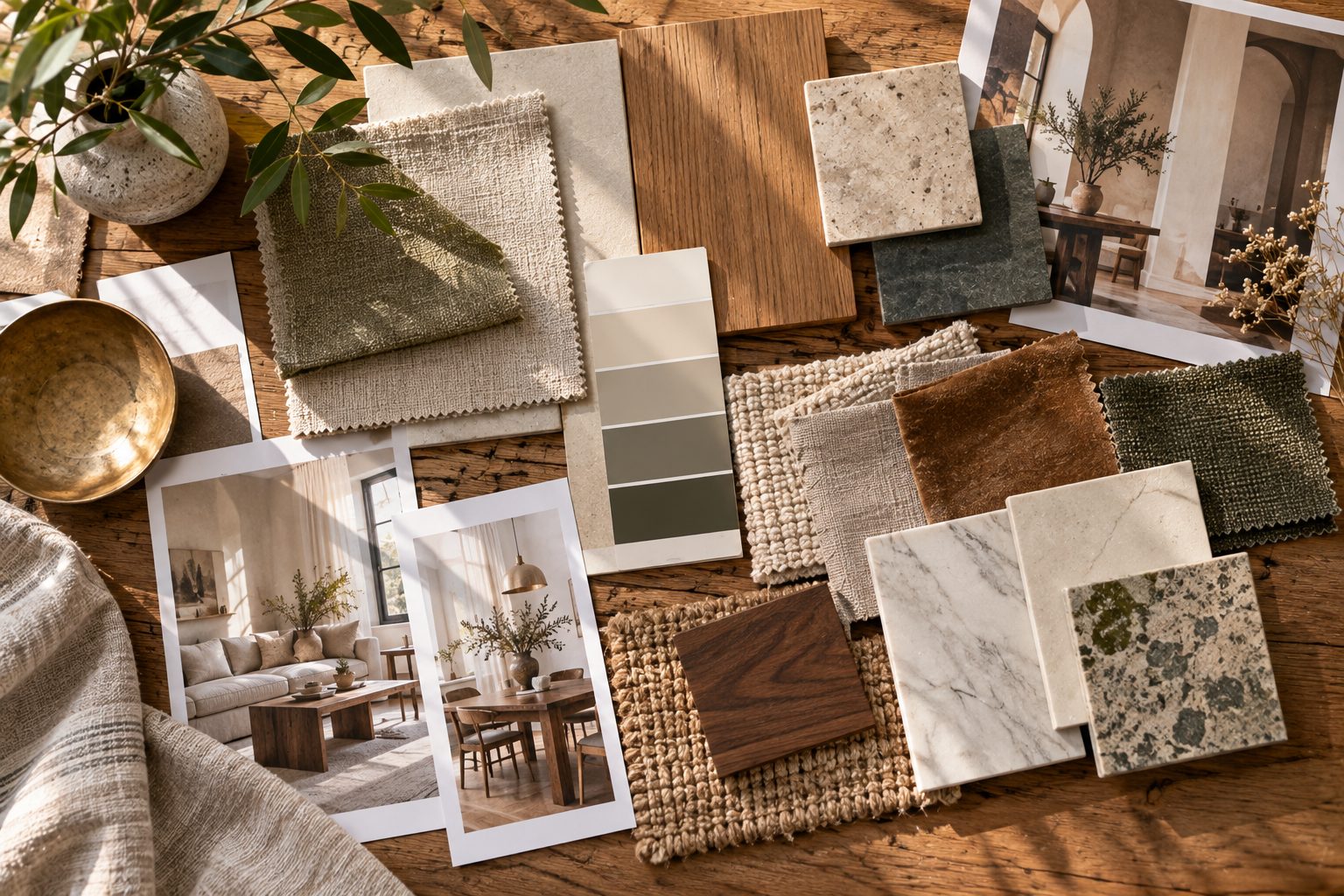
- Add materials. Wood tone, stone or tile, metal finish, and two or three fabrics, ideally as physical samples.
- Place the key furniture. Sofa or bed, rug, main lighting and one statement piece, with dimensions written beside each.
- Edit and test. Remove anything that pulls focus, then hold the board in the actual room in morning and evening light.
Whichever tool you use, how to make a mood board comes down to this order: fixed elements, palette, materials, furniture, edit. Step four is where most boards go wrong, so treat it seriously. Pull candidate colors from the floor and kept pieces, then test them against a ready palette from our palette library to see whether they hold together.
How many colors should a mood board have?
A mood board should have five to seven colors: enough to build a layered room, few enough that the palette still makes decisions for you. A useful split is 60 percent dominant, 30 percent secondary and 10 percent accent.
#E8E1D5#C9B79C#8A9A7B#B5643C#5B4636#2F3A40The swatches above are an example of a warm earthy board; the hex values are screen approximations, so confirm with real paint drawdowns. Check wall color light reflectance value (LRV) as well: 60–80 LRV keeps a north-facing room bright, while colors below 20 LRV read as near-black and suit accents or a cocooning den. If two colors fight, the color wheel explains why, and our color wheel guide shows how to fix it with analogous or split-complementary choices.
Digital mood board vs physical sample board
Use a digital mood board to plan, share and iterate quickly, then build a physical sample board before you buy, because screens cannot show true color, sheen or texture. Professionals almost always do both.
| Format | Typical cost | Time per room | Best for | Weakness |
|---|---|---|---|---|
| Online mood board in a browser | Free–$15/month | 1–2 hours | Fast layout, sharing, links to products | Screen color can be 10–20 percent off |
| Mood board application on a tablet | Free–$10/month | 1–2 hours | Collecting on the go, cutting out backgrounds | Small screen, hard to judge scale |
| Interior design collage in a slide or layout file | Free | 2–3 hours | Precise placement, printing to scale | Slower, manual |
| Physical sample board | $20–$60 in materials | 2–4 hours plus sample waits | True color, sheen and texture in real light | Samples take 3–10 days to arrive |
| Physical board plus digital copy | $20–$75 | 3–5 hours | Final decisions and sharing with trades | Most effort |
Typical cost and time ranges, US 2026. For a physical board, a 20 × 30 in (51 × 76 cm) foam board holds one room comfortably; use 4 × 4 in (10 × 10 cm) fabric cuttings at minimum and 8 × 10 in (20 × 25 cm) paint drawdowns so you can see the color at a meaningful size.
Do you need a moodboard maker or mood board creator?
You do not need a dedicated moodboard maker; any tool that lets you drag images onto a blank canvas, crop them and add text will do. What matters is the editing, not the software.
When comparing a mood board creator or free mood board creator, look for four things: a canvas you can export as a high-resolution PDF or PNG, background removal for furniture cut-outs, a color picker that shows hex values, and the ability to add notes with dimensions and prices. A moodboard generator that auto-fills a board from a prompt is handy for a first spark, but the result is generic by design; treat it as raw material to edit, never as the finished interior design board. Specialist interior design mood board creator tools add scaled furniture and floor plans, which is useful but optional for a single room.
What goes on a home decor mood board?
A home decor mood board should hold the palette, materials, key furniture, lighting and two or three atmosphere images, each one labeled with what it is and where it goes. Unlabeled pictures are the reason boards fail at the shopping stage.
Materials and finishes
Include the floor, one wood tone plus a contrast, one stone or tile, one metal finish and two to three fabrics. Note upholstery performance, for example 30,000+ Martindale or 15,000+ Wyzenbeek double rubs for a family sofa. For combining woods, see our guide on how to mix wood tones.
Furniture and lighting
Place the anchor pieces with sizes: an 84–96 in (213–244 cm) sofa, an 8 × 10 ft (244 × 305 cm) rug, a 2700 K floor lamp. Writing the sizes on the board stops you falling for a piece that will not fit.
Atmosphere
Two to four images of light, texture or a place that captures the mood. Keep them few; they are seasoning.
Mistakes we see on interior decorating mood boards
The mistake we see most often is a board with too many ideas and no hierarchy, closely followed by boards assembled entirely from screens and never tested in the room.
- Mixing color temperatures. Cool blue-gray photos beside warm golden ones make any palette look wrong.
- No dominant color. Seven colors in equal amounts read as noise; give one 60 percent of the board.
- Ignoring the floor. The floor is the largest surface you probably will not change; put it on the board first.
- Styled photos instead of products. A gorgeous room shot is not a sofa you can buy. Replace it with the actual piece.
- Skipping the light test. View the physical board at 9 am and 7 pm before ordering paint.
Our verdict on how to make a mood board that actually works: the moodboard interior design process works best as a two-stage habit. Build fast and loose digitally, cut ruthlessly to 12–20 items, then confirm with real samples. That combination prevents more expensive mistakes than any single tool.
How to use a design board once it is finished
Use the finished design board as a buying checklist: every new purchase must sit comfortably beside it, or it does not come home. Keep a printed copy in your bag and a digital copy on your phone.
Share it with painters and upholsterers so they can see context, and update it when a real piece replaces a placeholder. When the room is complete, the board becomes the starting point for the next room, which keeps a whole house consistent.
Prefer to start with real materials in hand? Our mood board kit includes a printable board template, palette cards and a sample checklist, so you can build a physical interior design mood board in an afternoon.
Free toolTile CalculatorWork out tiles, boxes, grout and adhesive with the right wastage.Shop & source the look
Buy it today — or have it made
Retail links are affiliate links: we may earn a commission at no extra cost to you (disclosure). “Get it made” sends the item to our sourcing desk for factory quotes in custom sizes and finishes.
Frequently asked questions
How do you make a mood board for interior design?
Start by photographing what stays in the room, pick one style direction, collect images and cut them to 12–20, then set a palette of five to seven colors. Add material samples and key furniture with dimensions, and test the board in the room's real light before you buy anything.
What should be included in an interior design mood board?
An interior design mood board should include five to seven colors, the floor and main wood tone, one stone or tile, one metal finish, two or three fabrics, the anchor furniture with sizes, lighting and a few atmosphere images. Label each item with what it is and where it goes so the board works as a shopping guide.
Is a digital or physical mood board better?
Both have a role: a digital mood board is faster for planning, layout and sharing, while a physical board is the only reliable way to judge true color, sheen and texture. Most designers build digitally first, then confirm final choices on a physical sample board viewed in daylight and evening light.
How many images should be on a mood board?
Aim for 12–20 images and samples on a single-room mood board. Collect 40–60 at first, then cut to the pieces that share the same light, color temperature and mood. Fewer than ten rarely shows enough materials; more than twenty usually means the direction has not been decided yet.
Can I make a mood board for free?
Yes, you can make a mood board for free using any browser-based canvas or slide tool that lets you place, crop and label images. Look for high-resolution export and a color picker showing hex codes. For a physical board, paint stores and fabric suppliers often provide small samples free or for a few dollars.
Some links may be affiliate links. Regulations and specifications change — always confirm with suppliers and qualified professionals.