Upholstered Dining Chairs: Sizes, Fabrics and Set-of-4 to 8 Costs
Upholstered dining chairs should have an 18 in (46 cm) seat height, a 17–20 in seat depth and fabric rated 30,000+ Martindale. Here are sizes, frames, fabrics and what sets of 2, 4, 6 and 8 typically cost.
Part of our guide: Dining Room Trends 2027: Dining Room Colors, Tables and Lighting
Key takeaways
- Standard upholstered dining chairs have an 18 in (46 cm) seat height, 17–20 in (43–51 cm) seat depth and 18–22 in (46–56 cm) width
- Leave 10–12 in (25–30 cm) between seat and tabletop and 24–26 in (61–66 cm) of table width per chair
- Choose 30,000+ Martindale or 50,000+ Wyzenbeek fabric with a W or WS cleaning code; performance velvet and wool blends wear best
- Buy solid hardwood frames with corner blocks and removable seat pads; a well-built set of 6 lasts 15–20 years
The right upholstered dining chairs have an 18 in (46 cm) seat height, a 17–20 in (43–51 cm) seat depth and fabric rated at least 30,000 Martindale or 50,000 Wyzenbeek double rubs, on a solid hardwood frame. Expect to pay $150–450 per chair for good mid-market sets and $500–1,200 per chair for custom or contract-grade pieces (US 2026 typical).
Upholstered chairs make a dining room quieter, warmer and more comfortable for long dinners, which is why they are one of the defining moves in our dining room trends 2027 forecast. They also pick up spills, pet hair and wear faster than wood, so the fabric and frame matter more than the shape. This guide covers sizes, fabrics, frames and what to expect when buying a dining chair set.
- Seat height: 18 in (46 cm), for a 29–30 in (74–76 cm) table.
- Width: 18–22 in (46–56 cm) for side chairs, 22–26 in (56–66 cm) for armchairs.
- Fabric: 30,000+ Martindale for daily use; 50,000+ for families and restaurants.
- Frame: solid hardwood, kiln-dried, glued and corner-blocked joints.
- Lifespan: 15–20 years for a good set, with one re-cover in between.
What size should upholstered dining chairs be?
Upholstered dining chairs should leave 10–12 in (25–30 cm) between the seat and the underside of the tabletop and need 24–26 in (61–66 cm) of table length each. Measure your table height and apron before buying chairs for dining table use, because cushioned seats sit higher than wood ones once you include the foam.
| Dimension | Side chair | Armchair | Why it matters |
|---|---|---|---|
| Seat height | 17–19 in (43–48 cm) | 17–19 in (43–48 cm) | 10–12 in (25–30 cm) below a 29–30 in table |
| Seat width | 17–20 in (43–51 cm) | 20–23 in (51–58 cm) | Affects how many fit along the table |
| Overall width | 18–22 in (46–56 cm) | 22–26 in (56–66 cm) | Plan 24–26 in (61–66 cm) per seat; 28–30 in for arms |
| Seat depth | 17–20 in (43–51 cm) | 18–21 in (46–53 cm) | Deeper than 20 in pushes diners away from the table |
| Back height | 32–40 in (81–102 cm) | 32–38 in (81–97 cm) | High backs over 38 in block sightlines in open plans |
| Arm height | n/a | 25–27 in (64–69 cm) | Must clear the table apron, often 24–26 in |
Arm height is where most people go wrong. If the table apron sits at 25 in (64 cm) and the chair arm at 26 in (66 cm), the chair will not slide under, and it will gouge the table edge for years. Our dining table size guide lists apron heights and seat counts for common tables.
How many dining room chairs fit your table?
A table fits one dining room chair per 24–26 in (61–66 cm) of edge length, after deducting the space taken by legs, so a 72 in (183 cm) table seats six side chairs and a 96 in (244 cm) table seats eight. Armchairs need 28–30 in (71–76 cm) each.
- Dining chairs set of 2: for a 30–36 in (76–91 cm) bistro or a nook table, or to add host chairs to an existing set.
- Dining room chairs set of 4: for a 36–48 in (91–122 cm) round, a 36 in square or a 48–60 in (122–152 cm) rectangle.
- Dining room chairs set of 6: for a 60–72 in (152–183 cm) rectangle or a 54–60 in (137–152 cm) round.
- Dining room chairs set of 8: for a 84–96 in (213–244 cm) rectangle, or 72 in with two end armchairs.
Leave 36 in (91 cm) behind each chair to a wall, 42–48 in (107–122 cm) where people walk past. Round tables are kinder to upholstered chairs because the chairs splay outward and arms clear legs more easily; see our round dining table guide for seat counts by diameter.
Which fabric is best for upholstered dining chairs?
The best fabric for upholstered dining chairs is a tightly woven performance fabric, wool blend or performance velvet rated at 30,000+ Martindale, with a W or WS cleaning code and a stain-resistant finish. Fabric dining chairs face more spills per hour of use than any sofa in the house.
| Fabric | Typical rub count | Stain resistance | Best for |
|---|---|---|---|
| Solution-dyed acrylic or polyester performance weave | 40,000–100,000 Martindale | Excellent, bleach-cleanable in many cases | Families, kids, pets, rentals |
| Performance velvet (polyester) | 40,000–80,000 Martindale | Very good; shows pressure marks | Formal rooms, rich color |
| Wool or wool blend | 30,000–60,000 Martindale | Good; naturally resists soiling | Quiet, warm rooms, adults |
| Linen or linen-cotton | 15,000–30,000 Martindale | Poor unless slipcovered | Washable slipcovered chairs |
| Top-grain leather | Not rated by rubs | Wipes clean, scratches show | Heavy use, pet hair |
| Faux leather (PU) | Varies widely | Wipes clean; can peel in 3–5 years | Budget, short-term use |
Martindale tests rubs on a European oscillating machine; Wyzenbeek is the US back-and-forth test. Roughly, 30,000 Martindale corresponds to heavy residential use and 50,000 Wyzenbeek to commercial use, though the two are not directly convertible. Loopy textured fabrics catch on rings, belt buckles and claws, so we avoid them on dining seats. Our upholstery fabric guide goes deeper into fibers and test results.
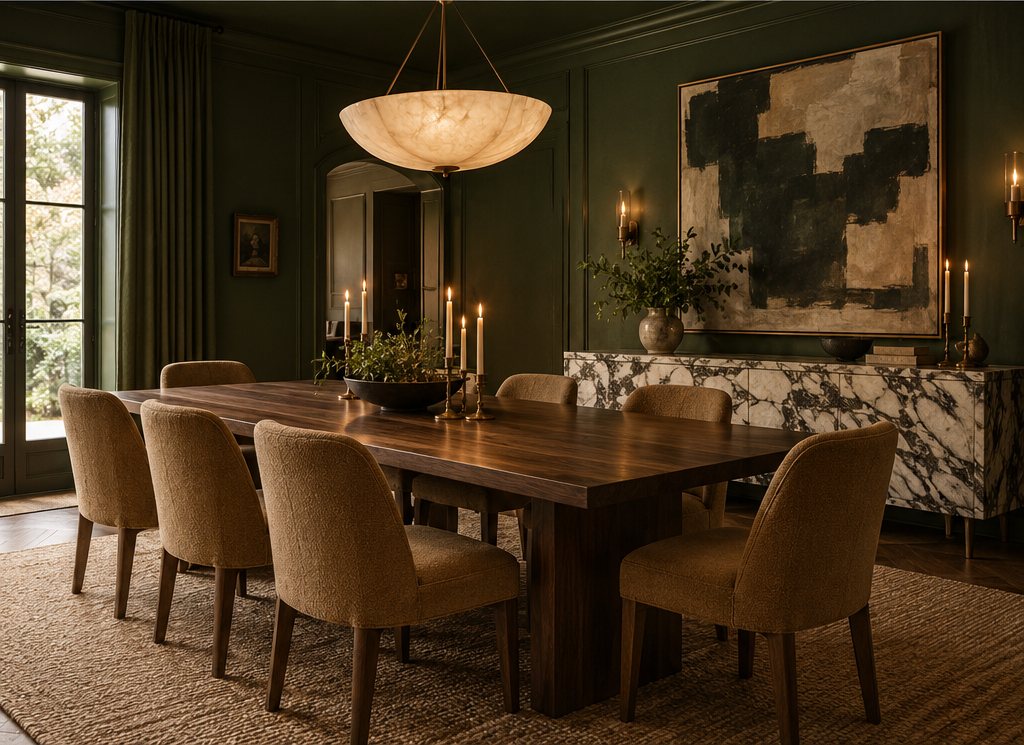
#7E8F78#C2A27C#6E3B37#D9D0C1#3B4148Mid-tones such as sage, camel and oxblood hide crumbs and pressure marks far better than white or black. For 2027 we like a sage or camel seat against a walnut or oak table, with darker ink or oxblood for host chairs.
Which upholstered dining chair styles are trending for 2027?
The upholstered dining chair styles trending for 2027 are curved barrel-back chairs, channel-stitched backs, skirted and slipcovered chairs, and simple parsons chairs with exposed wood legs. Softer outlines replace the tufted, nailhead-trimmed chairs of the last decade.
Barrel and curved-back chairs
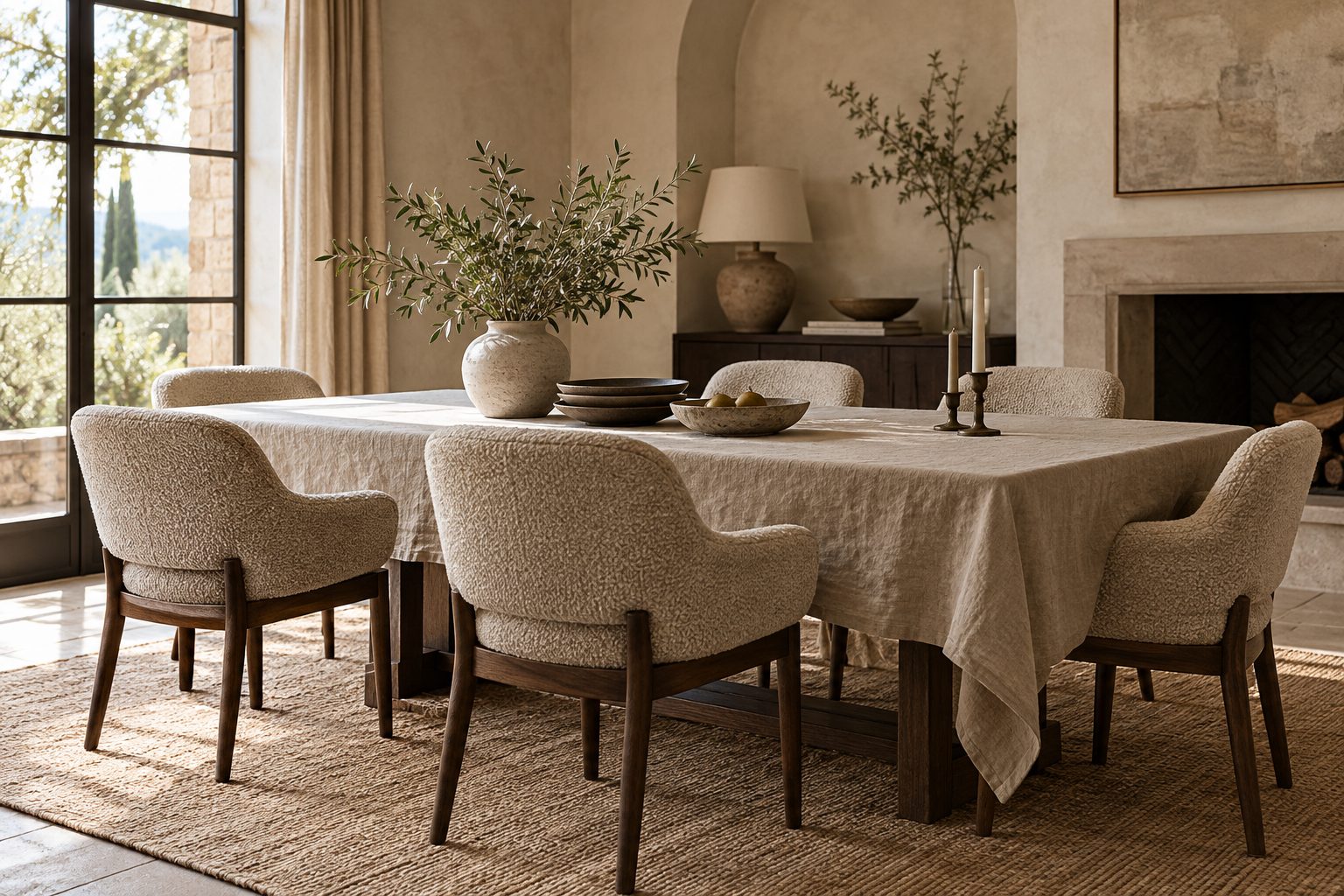
A wraparound back, 20–23 in (51–58 cm) wide, feels like a small armchair without true arms, so it still slides under most tables. It suits round tables especially well and looks good from behind, which matters in open plans.
Channel-back chairs
Vertical channel stitching gives a tailored, slightly 1970s look. Keep channels 3–4 in (8–10 cm) wide and the fabric tight; wide puffy channels collect crumbs.
Skirted and slipcovered chairs
Full-length or kick-pleat slipcovers bring a relaxed, European feel and can be washed. Hem them 1/2 in (12 mm) off the floor so they do not drag or wick spills.
Parsons and exposed-leg chairs
The parsons chair, a simple upholstered seat and back on straight legs, is the safest long-term choice. In 2027 we see it with walnut or oak legs showing below a shorter skirt, which reads lighter than a fully covered version.
How do you judge a well-made upholstered dining chair?
A well-made upholstered dining chair has a kiln-dried solid hardwood frame with glued and screwed corner blocks, high-resilience foam of at least 1.8 lb/ft³ (29 kg/m³) density, and a seat that is removable or easy to re-cover. Lift it, rock it and look underneath before you buy.
- Lift the chair. A solid beech or oak side chair usually weighs 12–20 lb (5–9 kg); very light chairs often have softwood or particleboard parts.
- Rock it on two legs. Any creak or flex at the back legs means weak joints.
- Turn it over. Look for corner blocks at each leg and a dust cover that can be removed.
- Press the seat. It should spring back immediately; slow recovery means low-density foam that will flatten in a year.
- Check the stitching and welt. Straight seams, matched pattern and no puckering at corners.
- Ask for the fabric spec. Rub count, cleaning code, pilling grade and fire standard should be on paper.
- Confirm replacement parts. Ask whether seats are screwed in and if extra fabric is available.
For a contract or hospitality project, also ask for the frame warranty in years and the chair's tested load; contract dining chairs are typically tested to 250–300 lb (113–136 kg) static loads.
What does a dining chair set cost?
A dining chair set costs about $300–900 for two, $600–1,800 for four, $900–2,700 for six and $1,200–3,600 for eight good mid-market upholstered chairs in the US in 2026. Custom, contract or heirloom-quality chairs cost two to three times more.
| Set size | Budget (typical) | Mid-market (typical) | Custom / contract (typical) |
|---|---|---|---|
| Dining chairs set of 2 | $150–300 | $300–900 | $1,000–2,400 |
| Dining chairs set of 4 | $250–600 | $600–1,800 | $2,000–4,800 |
| Dining chairs set of 6 | $400–900 | $900–2,700 | $3,000–7,200 |
| Dining room chairs set of 8 | $500–1,200 | $1,200–3,600 | $4,000–9,600 |
Prices per chair rise with three things more than with style: frame species, foam density and fabric grade. A customer's own material option, where you supply the fabric, saves money only if you buy a contract-grade cloth; allow 0.75–1 yd (0.7–0.9 m) per side chair seat and back, and 1.25–1.5 yd (1.1–1.4 m) per armchair, plus 10 percent for pattern matching. For restaurants and hotels, budget for fabric that meets the local flammability standard, which can add 5–15 percent to the fabric cost.
Budget sets usually mean rubberwood or metal frames, lower-density foam and polyester fabric rated 15,000–25,000 Martindale. They are fine for occasional use, but expect visible wear in two to four years at a kitchen table. Mid-market is the sweet spot for most homes.
Should kitchen table chairs be upholstered?
Kitchen table chairs can be upholstered if you choose a performance fabric with a bleach-cleanable or W cleaning code, or a removable slipcover; otherwise wood, cane or molded seats are more practical. Breakfast tables see three meals a day, homework and crafts.
A good compromise is a wood chair with an upholstered seat pad only, leaving the back in wood or cane. You get comfort where you sit and nothing to stain where kids grab. In breakfast nooks, upholstered chairs on the open side soften a bench; our breakfast nook ideas show how to combine them.
How do you mix upholstered chairs around a table?
Mix upholstered chairs around a table by keeping seat heights and widths consistent and varying only one thing: the fabric, the back shape or the end chairs. A dining chair dining room scheme with too many variables looks chaotic rather than collected.
- Host chairs: two upholstered armchairs at the ends, six simpler side chairs along the sides.
- Two-fabric scheme: one chair style in two coordinating fabrics, alternating or one per side.
- Bench plus chairs: an upholstered bench on one side and three chairs on the other.
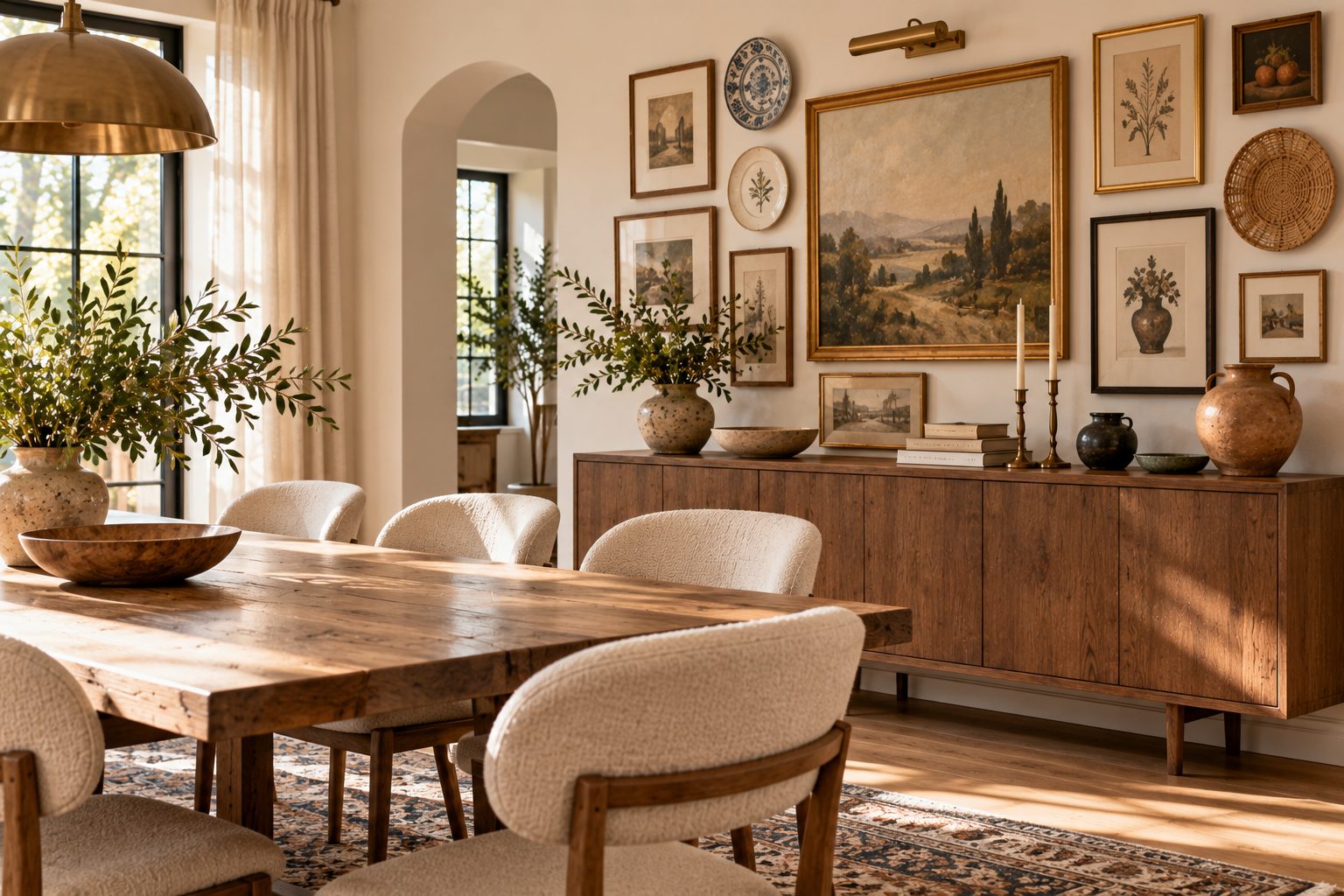
- Wood and fabric: upholstered seats with exposed wood frames matching the table tone.
Keep the seat heights within 1 in (2.5 cm) of each other and the backs within 2 in (5 cm), or the table will look uneven from across the room.
Mistakes we see with upholstered dining room chairs
The mistakes we see most often with upholstered dining room chairs are arms that will not clear the table apron, pale fabrics in family kitchens and chairs too deep for the table. All three are easy to avoid with a tape measure and a fabric spec sheet.
- Not measuring the apron: armchairs must sit at least 1 in (2.5 cm) below it.
- White or cream linen: stains within weeks unless slipcovered and washable.
- Seats over 21 in (53 cm) deep: diners perch on the front edge to reach the table.
- Tufting and buttons: they trap crumbs and pull loose; keep dining seats plain or channel-stitched.
- Ignoring the rug: chair legs should stay on the rug when pulled out, so it must extend 24 in (61 cm) past the table edge; our rug size calculator does the math.
Our verdict: buy six solid-framed side chairs in a mid-tone performance weave or wool blend, add two host armchairs if your table is over 84 in (213 cm), and insist on removable seats. That is the set that still looks good in 2037. Upholstered dining chairs are the single biggest comfort upgrade in a dining room, and they repay careful specification.
Specifying chairs for a restaurant, hotel or several homes? Send your table sizes, quantities and fabric preferences to our furniture sourcing desk for factory quotes with frame, foam and fabric specs in writing.
Free toolRug Size CalculatorFind the right rug size for your room and furniture.Shop & source the look
Buy it today — or have it made
Retail links are affiliate links: we may earn a commission at no extra cost to you (disclosure). “Get it made” sends the item to our sourcing desk for factory quotes in custom sizes and finishes.
Frequently asked questions
What is the standard height of an upholstered dining chair?
The standard seat height of an upholstered dining chair is 18 in (46 cm), with a usual range of 17–19 in (43–48 cm). That leaves 10–12 in (25–30 cm) of leg room under a standard 29–30 in (74–76 cm) table. Check the compressed height, since foam adds height until it settles.
Are upholstered dining chairs a good idea with kids?
Yes, upholstered dining chairs work with kids if you choose a performance fabric rated 40,000+ Martindale with a bleach-cleanable or W cleaning code, in a mid-tone color, and removable seats. Avoid pale linen, velvet with a high pile and tufting. Washable slipcovers are the most forgiving option.
How long do upholstered dining chairs last?
Well-made upholstered dining chairs last 15–20 years, usually with one re-cover of the seat after 7–10 years. The frame determines lifespan: kiln-dried hardwood with corner blocks outlasts rubberwood or metal. Budget chairs with low-density foam often look tired in two to four years of daily use.
How much space do you need per dining chair?
Plan 24–26 in (61–66 cm) of table edge per side chair and 28–30 in (71–76 cm) per armchair, plus 36 in (91 cm) behind each chair to a wall. Where people walk behind seated diners, allow 42–48 in (107–122 cm). A 72 in (183 cm) table seats six side chairs comfortably.
What fabric is easiest to clean on dining chairs?
Solution-dyed acrylic and polyester performance weaves are the easiest fabrics to clean on dining chairs, because color runs through the fiber and many tolerate diluted bleach. Leather and faux leather wipe clean too. Wool resists soiling naturally but needs gentler cleaning; linen is the hardest unless slipcovered.
Some links may be affiliate links. Regulations and specifications change — always confirm with suppliers and qualified professionals.