Outdoor Rugs Guide: Materials, Sizes and What Survives Rain and Sun
Outdoor rugs last 3–7 years when they are polypropylene, recycled PET or solution-dyed acrylic sized to the furniture. Compare fibers, sizes from 5x8 to 9x12, outdoor carpet and grass rugs, and how to keep them dry.
Part of our guide: Outdoor Living Trends 2027: Living Outdoor Space Ideas and Specs
Key takeaways
- Polypropylene is the default outdoor rug fiber: cheap, UV-stabilized, bleach-cleanable and quick to dry
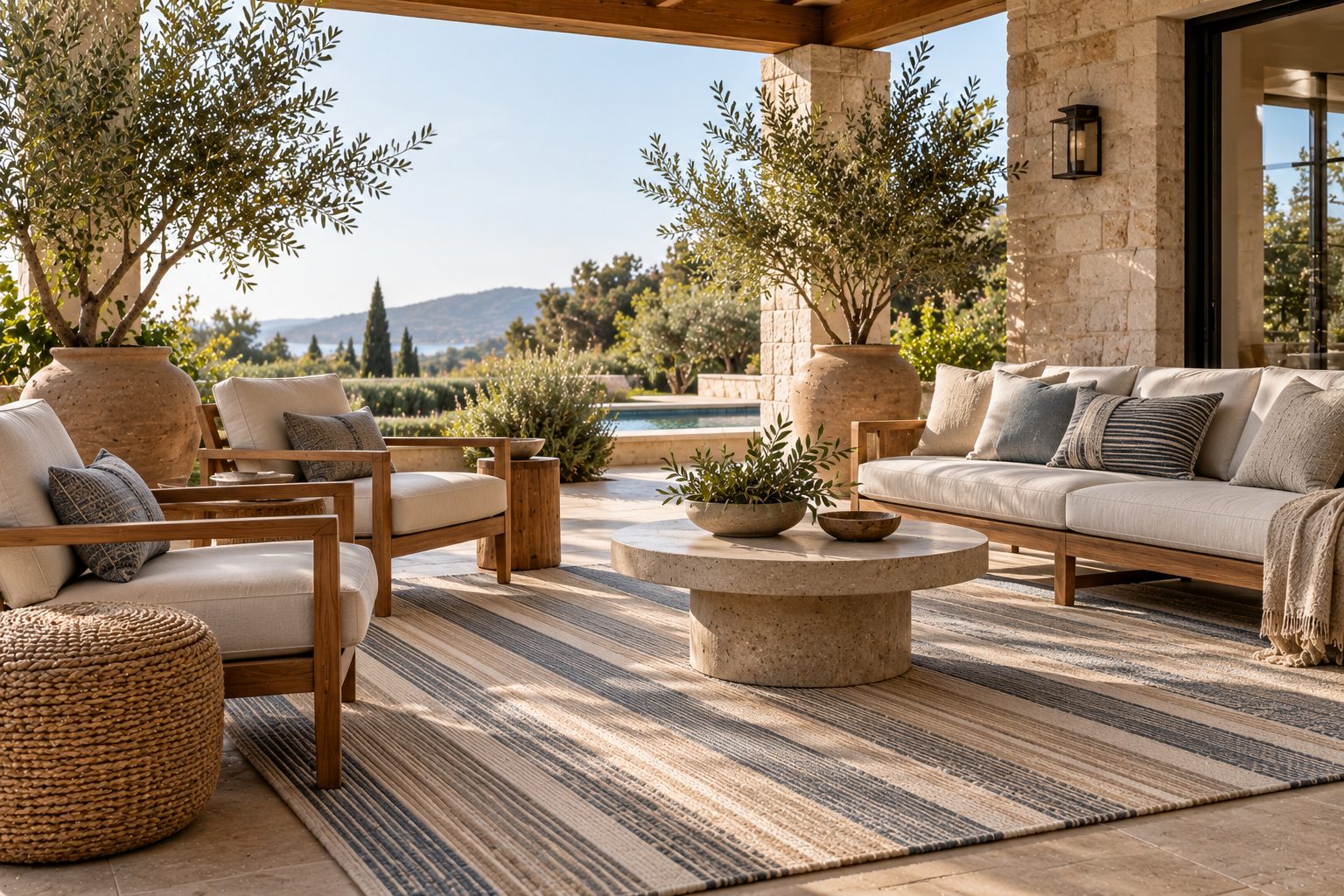
- Size an outdoor rug 8x10 for a four-seat conversation set and 9x12 for a six-seat dining table
- No outdoor rug is truly waterproof; choose open weaves and perforated backings that drain and dry fast
- Jute, sisal and cotton belong on fully covered porches at most, and should come in before wet weather
The best outdoor rugs are made of polypropylene, recycled PET or solution-dyed acrylic, because these fibers resist UV fading, do not absorb water and dry within hours. Expect a well-made 8x10 ft (244 × 305 cm) outdoor rug to cost $100–500 and last three to seven seasons. Size it to the furniture group, just as you would indoors.
Outdoor rooms are a central theme in our outdoor living trends 2027 report, and the rug is the piece that turns a patio into a room. This guide covers fibers, sizes, outdoor carpet, grass rugs and care.
- Best all-round fiber: polypropylene (olefin), UV-stabilized and solution-dyed.
- Most common size: outdoor rug 8x10 for a sofa and two chairs; 9x12 under a six-seat dining table.
- Typical price: $60–250 for 5x8, $100–500 for 8x10, $1–4 per sq ft for outdoor carpet by the roll.
- Lifespan: three to seven seasons in full sun; longer under cover.
- Care: hose off monthly, dry both sides, store rolled in winter.
What are the best outdoor rugs made of?
The best outdoor rugs are woven from synthetic fibers that are colored in the melt, or solution-dyed, so the color runs through each strand and cannot wash out. Polypropylene leads on price and toughness, recycled PET on softness, acrylic on color depth.
| Fiber | UV and fade resistance | Water and mildew | Feel | Typical 8 × 10 ft price |
|---|---|---|---|---|
| Polypropylene (olefin) | Good when UV-stabilized; budget versions fade in 1–2 seasons | Absorbs almost no water; bleach-safe | Firm, slightly waxy | $100–350 |
| Recycled PET (polyester) | Good | Low absorption; dries fast | Soft, close to cotton | $150–450 |
| Solution-dyed acrylic | Excellent; the fabric of performance cushions | Quick-drying; mildew-resistant | Soft, wool-like | $400–1,200 |
| Nylon (outdoor grade) | Fair; needs UV treatment | Absorbs some water | Soft, resilient | $200–600 |
| Jute, sisal, seagrass | Poor; bleaches and weakens | Absorbs water, rots and molds | Coarse, natural | $150–600 |
| Cotton flatweave | Poor | Absorbs water, mildews | Soft | $80–300 |
Prices are typical 2026 US retail ranges. Ask for the UV rating in hours where it is given; a 1,000–1,500 hour rating indicates a rug that will hold its color through several summers. Our outdoor furniture materials guide uses the same tests for frames and fabrics.
Is there such a thing as a waterproof outdoor rug?
No outdoor rug is fully waterproof; a good waterproof outdoor rug is really a water-resistant one that sheds water through an open weave and dries quickly. What matters is that the fiber does not absorb water and the backing lets it drain.
Flatwoven polypropylene and PET rugs, 0.15–0.3 in (4–8 mm) thick and reversible, are the fastest to dry, usually within two to four hours of sun after rain. Thick tufted outdoor rugs with a solid latex back trap water underneath, which is how decks get dark stains and patios grow mildew. Waterproof outdoor carpet with a sealed rubber or marine backing does exist, but it is meant to be glued or taped down on concrete, not moved around.
What size outdoor rug do you need?
An outdoor rug should be large enough that the front legs of every seat, or all four legs of every dining chair, sit on it, with at least 12 in (30 cm) of paving visible around it. On most patios that means an outdoor rug 8x10 or outdoor rugs 9x12.
| Outdoor setup | Furniture footprint | Rug size | Metric |
|---|---|---|---|
| Bistro set, two chairs | 24–30 in (61–76 cm) table | 5 × 7 or 6 ft round | 152 × 213 cm or 183 cm round |
| Loveseat and two chairs | About 8 × 7 ft (2.4 × 2.1 m) | 6 × 9 ft | 183 × 274 cm |
| Sofa, two chairs, coffee table | About 9 × 8 ft (2.7 × 2.4 m) | 8 × 10 ft | 244 × 305 cm |
| Outdoor sectional | About 10 × 10 ft (3 × 3 m) | 9 × 12 or 10 × 10 ft | 274 × 366 or 305 × 305 cm |
| Four-seat dining, 48 in table | Table plus 24 in chair pull-out | 8 × 8 or 8 ft round | 244 × 244 cm or 244 cm round |
| Six-seat dining, 72 in table | Table plus 24–30 in each side | 9 × 12 ft | 274 × 366 cm |
| Eight-seat dining, 96 in table | Table plus 24–30 in each side | 10 × 14 ft | 305 × 427 cm |
A large outdoor rug beyond 10 × 14 ft is hard to find woven; for bigger decks, bind a piece of outdoor carpet to size. For indoor sizing logic, our standard rug sizes chart lists every size in feet and centimeters, and our outdoor dining furniture guide gives table and chair clearances.
What is the difference between outdoor rugs and outdoor carpet?
Outdoor rugs are loose, finished-edge rugs in fixed sizes, while outdoor carpet, also sold as indoor outdoor carpet or patio carpet, is roll goods cut to any size and usually glued, taped or left loose on concrete. Rugs suit decks and patios you want to rearrange; carpet suits screened porches, boat docks, basements and covered patios.
- Widths: outdoor carpet for patio use is typically 6 ft (1.8 m) or 12 ft (3.7 m) wide, sold by the linear foot.
- Construction: needle-punch olefin, low loop or ribbed, 0.15–0.35 in (4–9 mm) thick, with marine-grade or rubber backing.
- Cost: typically $1–4 per sq ft for the material, plus $1–3 per sq ft for professional installation or $1–3 per linear ft for binding.
- Weak point: glued-down carpet traps water against wood decks; use it only on concrete or over a drainage mat.
Indoor outdoor rugs blur the line: flatwoven polypropylene or PET rugs designed for mudrooms, kitchens and covered porches, which is why they also feature in our runner rugs guide for entries.
Are artificial grass rugs worth it?
An artificial grass rug is worth it on a balcony, roof deck or dog run where real lawn is impossible, but it gets hot in direct sun and needs rinsing to stay fresh. A grass rug is a piece of synthetic turf, usually polyethylene blades on a perforated backing, with bound edges in sizes like 5 × 8 ft or 6 × 9 ft.
Look for a pile height of 0.75–1.25 in (19–32 mm), a perforated latex or polyurethane backing for drainage and a face weight of at least 50–70 oz per sq yd (1.7–2.4 kg/m²) for something that does not look thin. Fake grass carpet by the roll, sometimes called astroturf, costs typically $1.50–5 per sq ft. Synthetic turf surfaces in full sun can run noticeably hotter than air temperature, so test it barefoot at midday before laying it where children or pets play. Outdoor grass carpet in light-colored, cooling-treated blades helps a little.
Can jute rugs be used outdoors?
Jute rugs should not be used outdoors, except briefly on a fully covered, dry porch, because jute absorbs water, grows mildew within days of rain and weakens in sunlight. The same applies to sisal, seagrass and cotton.
If you love the natural look, buy a polypropylene or PET rug woven to imitate jute; the better ones are convincing from standing height. Keep real jute indoors, where our jute rug guide covers its care. On a deep screened porch with no blowing rain, a natural rug will survive a summer, but lift it onto a dry surface before storms and bring it in for winter.
Which outdoor rug colors last longest?
Mid-tone earth colors, greens and soft stripes last longest outdoors, because they hide pollen, soil and gradual fading better than bright white, black or saturated red. Solution-dyed yarns fade slowly; surface-printed rugs fade fast and unevenly.
#9A8B72#4F6B5A#C47A4E#3D4B5C#D9CFBCHex values are approximate screen references. On our own projects we use mid-tone terracotta, green and sandstone with a stripe or small geometric pattern for outdoor patio rugs; they look good after a season even when slightly sun-softened. Pull the cushion fabric from one of the rug colors, not the dominant one, so the set does not look matched from a catalog.
How do you clean and store outdoor rugs?
Clean outdoor rugs by shaking, hosing and drying them flat in the sun, and store them clean, dry and rolled, never folded, over winter. A short routine doubles their life.
- Shake or sweep weekly. Grit is what wears the fibers; a stiff broom or a leaf blower clears it.
- Hose monthly. Spray both sides; scrub spots with mild dish soap and a soft brush.
- Treat mildew. On polypropylene only, use a dilute oxygen bleach solution, rinse well and dry fully.
- Dry both sides. Drape the rug over a railing or flip it after rain so water does not sit underneath.
- Lift it off wood decks. Every few weeks, roll it back for a day so the boards dry and do not discolor.
- Store for winter. Clean, dry, roll face-in around a tube, wrap in breathable fabric and keep off a damp floor.
On paving, a thin outdoor rug pad with an open grid helps drainage and grip. On pavers set in sand, check that the rug is not slowing drainage or pushing joint sand around.
Where should you put outdoor rugs?
Put outdoor rugs where people sit or walk barefoot: under the main seating group, beneath the dining table, along a deck path and inside a covered porch. Avoid placing them where water pools, such as at the foot of a downspout or on a patio with poor fall.
Under seating and dining
Outdoor patio rugs are most useful under a conversation set, where they define the outdoor room and warm up hard paving. Under a dining table, the rug must reach 24–30 in (61–76 cm) beyond the table edge, or chairs catch the edge as they slide out.
Outdoor runner rugs
An outdoor runner rug of 2.5 × 8 ft (76 × 244 cm) or 3 × 10 ft (91 × 305 cm) works along a narrow balcony, beside a pool lounger row, on a porch leading to the front door, or in front of an outdoor kitchen counter. For longer paths, an outdoor carpet runner cut from 3 ft (91 cm) roll stock and bound on all sides costs far less than a custom woven rug.
Covered porches and sunrooms
Under a deep roof, you can use softer recycled PET or acrylic rugs and even thicker pile, because they will rarely be soaked. Indoor outdoor rugs are ideal here: they handle tracked-in grit and wet shoes but look like an indoor rug.
Pool decks and balconies
Next to pools, use flatwoven polypropylene that tolerates chlorinated water and drains instantly, and keep rugs 3 ft (91 cm) back from the edge. On balconies, check that the rug does not block the drain outlet; a slightly smaller rug with a gap at the drain side is the fix. In windy spots, a rug at least 0.2 in (5 mm) thick or rug tape at the corners stops lifting.
Patio carpet on concrete
For a basement walkout, a screened porch or a garage gym, patio carpet glued or taped to clean, dry concrete gives wall-to-wall coverage at a fraction of the cost of a large rug. Confirm the slab is not damp first: tape a sheet of plastic down for 24 hours and check for condensation underneath.
Mistakes we see with outdoor rugs
The mistake we see most often is a rug too small for the furniture, a 5x8 under a sectional, which makes the patio look smaller and lets chair legs hang off onto paving. The second is a thick indoor-style tufted outdoor rug on a wooden deck, which stays wet and leaves a dark rectangle on the boards.
Our verdict: for most homes, buy a flatwoven, UV-stabilized polypropylene or recycled PET rug in an 8x10 or 9x12, in a mid-tone pattern, and expect to replace it every four to six years. Spend more, on solution-dyed acrylic, only for a covered terrace you use daily. Skip natural fibers outside altogether.
Furnishing a terrace, rooftop or restaurant patio? Send us sizes, quantities and the exposure through our outdoor sourcing desk and we will match you with factories making outdoor rugs to a stated UV rating and size.
Free toolRug Size CalculatorFind the right rug size for your room and furniture.Shop & source the look
Buy it today — or have it made
Retail links are affiliate links: we may earn a commission at no extra cost to you (disclosure). “Get it made” sends the item to our sourcing desk for factory quotes in custom sizes and finishes.
Frequently asked questions
What is the best material for outdoor rugs?
Polypropylene is the best all-round material for outdoor rugs because it is UV-stabilized, absorbs almost no water, dries quickly and can be cleaned with dilute bleach. Recycled PET is softer for similar money, and solution-dyed acrylic holds color longest but costs two to three times as much.
Can jute rugs be used outdoors?
No, jute rugs should not be used outdoors except briefly on a fully covered, dry porch. Jute absorbs water, grows mildew within days of rain and weakens in sunlight. For the same look outside, choose a flatwoven polypropylene or PET rug designed to imitate natural fiber.
What size outdoor rug do I need?
Choose an outdoor rug large enough for the front legs of every seat, or all legs of dining chairs, to sit on it with 12 in of paving around it. That usually means 8x10 ft for a sofa and two chairs and 9x12 ft for a six-seat dining table.
Are outdoor rugs waterproof?
Outdoor rugs are water-resistant rather than waterproof. Good ones are woven from fibers that do not absorb water and have open or perforated backings that let rain drain, so they dry in two to four hours of sun. Solid-backed tufted rugs trap water underneath and can mark decks.
How long do outdoor rugs last?
A quality outdoor rug lasts about three to seven seasons in full sun and longer on a covered porch. Lifespan depends on UV stabilization, fiber and care: hosing it off, drying both sides after rain and storing it rolled and dry over winter all extend its life.
Some links may be affiliate links. Regulations and specifications change — always confirm with suppliers and qualified professionals.