Wood Accent Wall Ideas: 10 Designs, Costs & How to Install One
A wood accent wall covers one wall in slats, planks, shiplap or panels to add warmth and texture. Materials cost $4–30 per sq ft; a typical 12 × 9 ft wall runs $500–3,500 installed. Vertical slats and flat hardwood planks are the modern choices.
Part of our guide: Wall Treatments Guide: 14 Wall Finishes & Covering Ideas
Key takeaways
- A 12 × 9 ft wood accent wall costs $500–1,500 DIY in shiplap or planks, $1,500–3,500 for installed slats or hardwood, and $3,500–8,000 for panels with shelves and lighting
- Vertical slats on a dark felt backer and wide flat white oak planks are the modern designs; orange tones and gloss finishes date a wall instantly
- Put the wood on the wall the furniture faces or backs onto, with no windows, and keep it to one wall per room
- Acclimate boards for a week, fasten with adhesive plus nails into a backer or studs, and fit outlet box extenders
- Add solid blocking behind any shelf or TV position before cladding; slats and veneered panels cannot carry weight alone
A wood accent wall is a single wall clad in timber, as vertical slats, planks, shiplap, panels or hardwood flooring run up the wall, to bring warmth and texture to a room. Materials cost $4–30 per sq ft ($45–320 per sq m), and a typical 12 × 9 ft wall costs $500–3,500 installed. The modern wood accent wall is vertical, matte-finished and in a single pale or mid-tone species.
Wood and walls have a long history, from Georgian paneling to 1970s cedar dens, and the 2027 version takes a quieter line: natural wood accent walls in oak, ash and walnut, often behind a bed or a sofa, with slim slats or wide flat planks and a matte finish. This guide gives ten designs, their costs, species and finishes, and a full installation sequence. It belongs to our wall treatments guide and complements the detailed slat panel guide.
- Cheapest option: pine shiplap or tongue-and-groove boards, $4–8 per sq ft in materials.
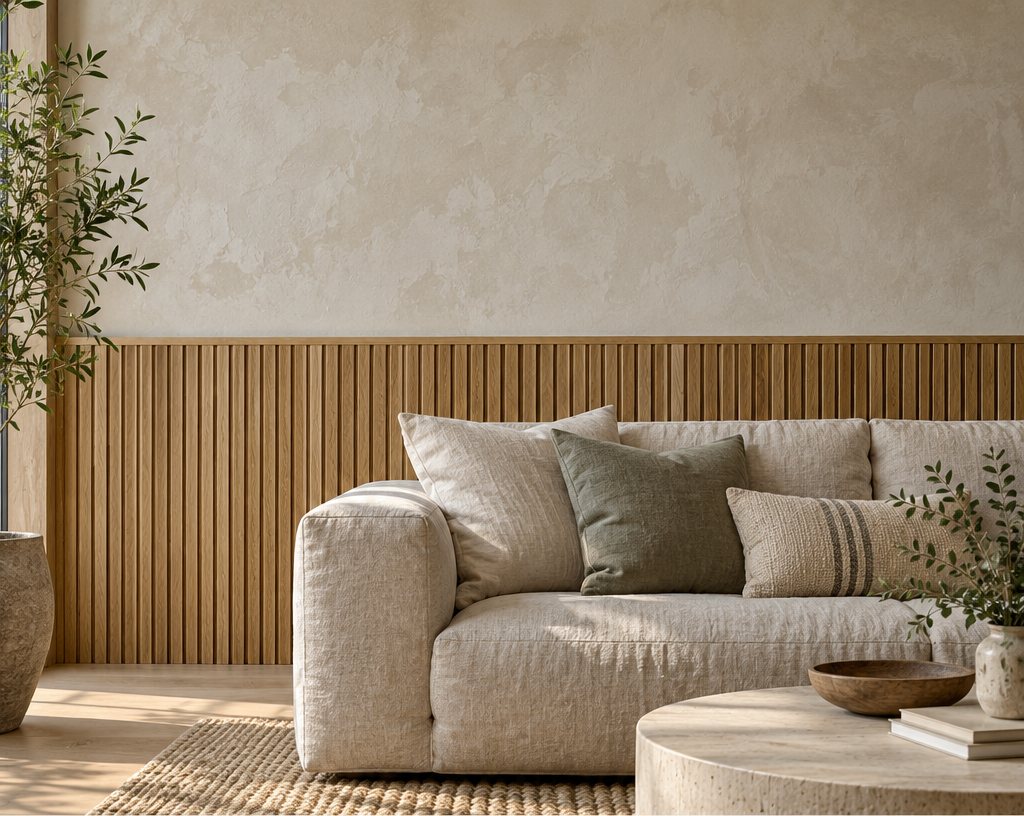
- Most popular design: vertical oak or walnut slats on a dark felt backer, $12–30 per sq ft.
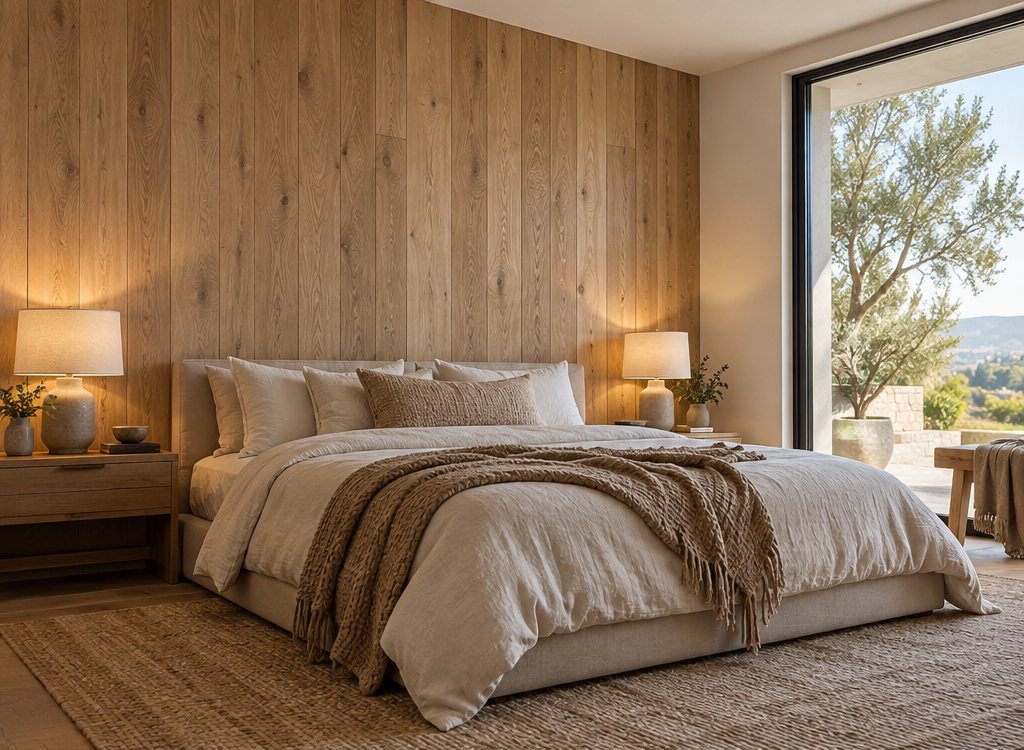
- Best for bedrooms: a headboard-height band of slats or planks, 48–60 in (122–152 cm) tall, or full height behind the bed.
- Installation: 1–2 days for a DIY plank or slat wall; panels with shelves need blocking in the wall.
- Finish: matte hardwax oil or water-based matte lacquer; avoid gloss.
What is a wood accent wall and why install one?
A wood accent wall is a feature wall clad in timber rather than painted or papered, used to anchor a room's focal point: the bed wall, the sofa wall, the fireplace, the dining-table wall or the back of an entry. It works because wood does three things at once: it adds visible grain and texture, it warms the color temperature of a room, and it softens sound, since any slatted or relief surface scatters reflections.
The reasons people choose feature walls with wood over paint or plaster are practical as well as aesthetic. A wood wall hides a damaged or textured surface without skim coating. It can carry integrated shelves, lighting and a TV without visible hardware. It is dry-room-friendly, repairable and removable. And it brings the material depth that organic modern and Japandi rooms are built on, without the cost of plaster across every wall.
What are the best wood accent wall designs?
The best wood accent wall designs for a contemporary home are vertical slats, wide flat planks, and framed flat panels; shiplap, herringbone, reclaimed boards and geometric mosaics suit specific styles. Here are the ten designs we specify most, with what each costs and where it works.
| Design | Material cost per sq ft | Installed cost per sq ft | DIY difficulty | Style | Best rooms |
|---|---|---|---|---|---|
| Vertical slats on felt backer | $12–30 | $20–45 | Easy (pre-made panels) | Modern, Japandi | Bedroom, living room, office |
| Site-built vertical slats | $6–15 | $15–35 | Moderate | Modern, custom | Living room, stair wall |
| Wide horizontal hardwood planks | $5–14 | $12–25 | Moderate | Contemporary, cabin | Living room, bedroom |
| Hardwood flooring on the wall | $4–10 | $10–20 | Moderate | Contemporary, warm | Bedroom, media wall |
| Shiplap or tongue-and-groove | $4–8 | $8–16 | Easy | Coastal, farmhouse, Scandinavian | Bedroom, hallway, bath |
| Flat panels with reveals | $8–20 | $18–40 | Hard | Modern, hotel | Living room, dining, entry |
| Decorative panels with shelves | $15–40 | $30–70 | Hard | Modern, built-in | Living room, office |
| Reclaimed barn wood | $6–15 | $12–28 | Moderate | Rustic, industrial | Den, restaurant, bar |
| Herringbone or chevron | $8–18 | $20–40 | Hard | Transitional, art deco | Dining, entry, bedroom |
| Peel-and-stick planks | $3–8 | $3–8 (DIY) | Easy | Rental, budget | Bedroom, office nook |
Vertical slats
Slats are the signature modern wood accent wall: strips 1–2 in (25–50 mm) wide and 3/4–1 in (19–25 mm) deep, spaced 1/2–1 in (12–25 mm) apart over a dark felt or painted backer. The vertical lines lift the ceiling, the shadow gaps give depth and the felt absorbs sound. Pre-made panels, typically 24 in (60 cm) wide and 94–106 in (240–270 cm) tall, screw straight to the wall; site-built slats on a plywood or furring backer give custom spacing and real hardwood at lower cost.
Flat planks and hardwood on walls
Wide horizontal planks, 5–8 in (13–20 cm), in white oak or ash, laid tight with no gap and finished matte, make the most restrained natural wood accent wall. Hardwood on walls ideas also include running the same engineered flooring from the floor up the bed wall, which makes a small bedroom feel like a cabinet; use the thinnest engineered board you can find, around 3/8 in (10 mm), and a construction adhesive plus finish nails.
Panels with shelves and integrated lighting
Decorative wood panels for walls with shelves turn the feature wall into a working one: flat veneered panels with floating shelves, a recessed TV niche, and an LED strip in a shadow gap. The key is blocking: 2 × 6 timber or 3/4 in (19 mm) plywood fixed to the studs behind every shelf position before the panels go on, because a veneered panel alone will not hold books. Budget $30–70 per sq ft installed, and have the panels made by a cabinet shop rather than built on site.
Which wood species and finishes look modern?
White oak, ash, walnut, maple and thermally modified pine look modern; red oak, honey-toned pine, orange cherry and glossy finishes look dated. The 2027 palette is pale and mid-tone, with grain visible and color kept natural or lightly tinted, finished matte.
- White oak: the default. Straight grain, warm beige, takes a clear hardwax oil beautifully. $8–14 per sq ft as solid slats, $5–9 as veneer.
- Ash: paler and more open-grained than oak, very Scandinavian. $7–12 per sq ft.
- Walnut: deep chocolate, the choice for a dark living room wood wall or a dramatic headboard wall. $14–25 per sq ft solid, $8–14 veneer.
- Maple and birch: blonde, smooth, almost grainless; good for painted or whitewashed walls and for slats on a budget. $5–10 per sq ft.
- Thermally modified pine or ash: heat-treated for stability and a warm caramel tone without stain; good in bathrooms and humid rooms. $6–12 per sq ft.
- Cedar and reclaimed softwoods: rustic, fragrant, knotty; right for cabins, saunas and bars, wrong for a modern bedroom.
Finish with a matte hardwax oil or a 5–10 percent sheen water-based lacquer; both keep the color honest and are repairable. A white or gray wash on oak or ash keeps the wall light and suits Scandinavian rooms. Whatever species you choose, match or deliberately contrast it with the floor and furniture using the rules in how to mix wood tones: either one species family throughout, or a clear two-tone contrast, never three near-misses.
Where should a wood accent wall go in a living room or bedroom?
A wood accent wall goes on the wall the furniture already faces or backs onto: the bed wall in a bedroom, the sofa wall or the fireplace wall in a living room, the TV wall in a media room, and the wall behind the table in a dining room. Put it on a wall with no windows and few doors, so the cladding reads as a single uninterrupted plane.
In a wood accent wall bedroom, the two layouts that work are full height behind the bed, running the full width of the wall, or a headboard band 48–60 in (122–152 cm) tall and 12–24 in (30–60 cm) wider than the bed on each side, which doubles as the headboard. Sconces or pendants can be wired through the slats or panels for a built-in look; placement heights are in the wall sconces guide. Keep the rest of the room's walls a warm white so the wood is the only strong material, and sit the bed centered using the bedroom layout guide.
For living room wood wall ideas, the sofa wall is the safe choice and the fireplace wall is the dramatic one, especially when slats run from floor to ceiling on either side of a plaster or stone chimney breast. On a TV wall, flat walnut or oak panels with a recessed niche make the screen disappear into a dark field. In an open-plan room, a wood wall can define the living zone against the kitchen, a trick that recurs in living room trends 2027. Check scale with the living room layout guide: a full-height wood wall needs a wall at least 10 ft (3 m) wide to avoid looking like a closet door.
How much does a wood accent wall cost?
A wood accent wall costs $500–1,500 for a DIY shiplap, plank or flooring wall on a 12 × 9 ft (108 sq ft) surface, $1,500–3,500 for a professionally installed slat or hardwood plank wall, and $3,500–8,000 for a cabinet-made panel wall with shelves, lighting and a TV niche. Per square foot, materials run $4–30 and installed costs $8–70 depending on design.
The variables are species (walnut costs roughly double oak), solid versus veneer (veneered plywood slats are 40–60 percent cheaper than solid), pre-made versus site-built (pre-made slat panels cost more in materials but save a day of labor), and finish (pre-finished boards save the mess and a day of drying). Trim, backer boards, adhesive, fasteners and a finish add $1–3 per sq ft. Keep 10 percent extra material for cuts and the occasional ugly board.
How do you install a wood accent wall?
Install a wood accent wall by preparing and marking the wall, fixing a backer or furring where needed, laying out the boards or slats from the center, fastening them with adhesive plus nails or screws into studs, then trimming the edges and finishing. A plank or shiplap wall is a one-day DIY job; a site-built slat wall takes two days; panels with shelves are a cabinet-shop job.
- Acclimate the wood. Stack the boards in the room for 5–7 days so they reach the house's humidity; this prevents gaps opening in winter.
- Prepare the wall. Remove baseboard and outlet covers, fix any loose drywall and mark every stud with a level line. Paint the wall a dark color (near-black or deep brown) if the design has gaps, so the drywall never shows through.
- Decide the layout on paper. Measure the wall width and calculate how many boards or slats fit with a full piece at each end, adjusting the gap or the edge pieces so the ends are symmetrical. For slats on a 144 in wall with 1.5 in slats and 0.75 in gaps, 64 slats fit with 0.75 in margins at each side.
- Fit a backer if required. Slats and thin planks go on 1/4–1/2 in (6–12 mm) plywood or MDF, or on 1 × 3 horizontal furring at 16 in (40 cm) centers, screwed into studs. Acoustic designs use a 9 mm felt panel over plywood. Flat hardwood planks and shiplap can go straight onto drywall into studs.
- Start from the center or from a level line. For vertical designs, snap a plumb line at the center and work outward in both directions. For horizontal designs, set a laser level line at the bottom and work up; the top course is the one that gets ripped to fit.
- Fasten with adhesive and nails. Run a bead of construction adhesive on the back of each piece and pin it with 18-gauge brad nails or 16-gauge finish nails into the backer or studs, two fasteners per 16 in (40 cm). Use a spacer block to keep slat gaps identical. Check for plumb every fourth piece.
- Cut around outlets and edges. Use box extenders to bring outlets flush with the new surface, which is required by code. Scribe the last pieces to the ceiling and adjacent walls; a 1/8 in (3 mm) shadow gap looks cleaner than a tight joint that will open.
- Trim and finish. Reinstall the baseboard over the cladding or run a matching wood base. Fill nail holes with a tinted wax stick, then apply two coats of matte hardwax oil or lacquer if the wood was not pre-finished, sanding lightly between coats.
For a wall that carries shelves or a TV, add solid blocking between studs at every mounting height before the cladding goes on, and photograph the blocking positions before they are covered. A wall-mounted TV bracket needs two lag screws into a stud or blocking, never into slats alone.
What are the mistakes to avoid with a wood accent wall?
The mistakes that make a wood accent wall look dated or cheap are choosing an orange or yellow tone, using gloss finish, adding wood to more than one wall in the room, running the wall into a window, and leaving the drywall visible between slats. The fixes are simple: pick a pale or neutral species, finish matte, stop at one wall, choose a windowless wall and paint the backer dark.
A second group of mistakes is structural. Fastening slats to drywall alone rather than a backer makes them loose within a year. Skipping outlet extenders is a code violation and a fire risk. Not acclimating boards opens 1/8 in gaps in winter. And hanging heavy shelves on veneered panels without blocking ends with the shelves on the floor. Finally, consider the sound: a flat plank wall reflects noise like drywall, so if acoustics matter in a media room or office, choose slats on felt or pair the wood with acoustic panels elsewhere in the room. For walls where wood is wrong, in a bathroom with a shower or a kitchen backsplash zone, a sealed plaster finish delivers similar warmth without the moisture risk.
Free toolPaint CalculatorWork out exactly how much paint to buy.Frequently asked questions
How much does a wood accent wall cost?
Materials run $4–30 per sq ft and installed costs $8–70 per sq ft depending on design. A typical 12 × 9 ft wall of 108 sq ft costs $500–1,500 as a DIY shiplap, plank or flooring wall, $1,500–3,500 for a professionally installed slat or hardwood wall, and $3,500–8,000 for cabinet-made panels with shelves and lighting. Walnut costs about twice as much as oak, and veneered slats cost 40–60 percent less than solid.
Are wood accent walls still in style?
Yes, in their modern form: vertical slats, wide flat planks and flat panels in white oak, ash or walnut with a matte finish, used on one wall in a bedroom, living room or office. The 2027 direction is natural wood as a quiet material accent in warm minimalist and Japandi rooms. Orange pine, glossy finishes, busy herringbone across whole rooms and rustic barn wood in modern homes are the versions that look dated.
What is the cheapest way to do a wood accent wall?
Pine shiplap or tongue-and-groove boards at $4–8 per sq ft, or leftover engineered hardwood flooring run up the wall, both installed yourself with construction adhesive and a brad nailer. Peel-and-stick wood planks at $3–8 per sq ft are cheaper still and renter-friendly, but they are thin veneers that can lift at the edges in humid rooms.
Which wall should be the wood accent wall?
The wall the room is organized around: the bed wall in a bedroom, the sofa, fireplace or TV wall in a living room, and the wall behind the table in a dining room. Choose a wall with no windows and as few doors or outlets as possible, so the wood reads as one continuous plane, and make sure it is at least 10 ft wide if the cladding runs full height.
Can you put wood planks directly on drywall?
Flat planks, shiplap and tongue-and-groove boards can go directly onto drywall as long as every piece is fastened into the studs behind it with adhesive plus finish nails. Slats, thin veneers and anything with gaps should go onto a plywood or furring backer screwed to the studs, both to hold the fasteners and so the backer, painted dark, fills the gaps between slats.
What wood is best for an accent wall in a bedroom?
White oak is the safest choice for a bedroom accent wall: warm, pale, straight-grained and calm under a matte oil finish. Ash is lighter and more Scandinavian, walnut is the choice for a dark, cocooning bedroom, and thermally modified pine is a budget alternative with a stable caramel tone. Keep the finish matte and the species the same as, or a clear contrast to, the floor.
Some links may be affiliate links. Regulations and specifications change — always confirm with suppliers and qualified professionals.