Wall Texture Types: 12 Drywall & Plaster Textures Compared
There are 12 common wall texture types, from sprayed orange peel and knockdown to hand-troweled skip trowel, slap brush, lime wash and plaster. Sprayed drywall textures cost $1–3 per sq ft; hand finishes run $3–15. Modern rooms favor smooth, lime wash and fine trowel textures.
Part of our guide: Wall Treatments Guide: 14 Wall Finishes & Covering Ideas
Key takeaways
- Sprayed drywall textures (orange peel, knockdown, popcorn) cost $1–3 per sq ft and read as builder-grade; hand plaster finishes cost $3–25 per sq ft and read as custom
- The modern specification is smooth level-5 drywall, lime wash, roman clay or a fine trowel plaster, not heavy relief
- Keep open-relief textures out of kitchens and bathrooms; use smooth or sealed lime plaster where walls get wet or greasy
- Textures show best in raking side light and in low-saturation mineral colors under a flat or matte paint
- Removing an old texture adds $1–5 per sq ft before any new finish, so decide during a renovation when walls are open
Wall texture is deliberate surface relief on an interior wall, in three families: sprayed drywall textures such as orange peel and knockdown ($1–3 per sq ft), hand-applied joint-compound textures such as skip trowel ($2–5 per sq ft), and decorative finishes such as lime wash and venetian plaster ($4–25 per sq ft). The best texture for a modern home is smooth or a very fine hand finish.
Builders texture walls because it hides drywall seams and speeds up finishing; designers texture walls because a subtle relief catches raking light and gives a flat painted room material depth. Those are different goals, and the textures that serve them look nothing alike. This guide covers every option, what it costs and where it belongs, and it sits alongside the other finishes in our wall treatments guide.
- Cheapest texture: sprayed orange peel, $1–2 per sq ft applied over new drywall.
- Most popular in new builds: knockdown in the West and Southwest; smooth in the Northeast and on the coasts.
- Most requested in 2027 renovations: smooth level-5 drywall, lime wash and fine trowel plaster.
- Hardest to remove: popcorn and heavy knockdown, $2–5 per sq ft to skim smooth.
- Texture that adds the most value: plaster and lime finishes, which read as custom rather than builder-grade.
What are the main types of textured walls?
The main types of textured walls are orange peel, knockdown, popcorn, splatter, skip trowel, slap brush (stomp), swirl, sand, comb, Spanish lace, smooth level-5, and the decorative plaster family of lime wash, roman clay, marmorino and venetian plaster. The first four are machine-sprayed; the next six are made by hand with joint compound; the last group uses lime, clay or acrylic plasters and is the only one most designers would specify in a new project.
| Texture | How it's made | Cost per sq ft (applied) | DIY difficulty | Look | Best rooms |
|---|---|---|---|---|---|
| Orange peel | Sprayed thin mud, fine splatter | $1–2 | Moderate (needs hopper) | Fine, even pebbling | Whole-house builder standard |
| Knockdown | Sprayed splatter, flattened with a knife | $1.50–3 | Moderate | Flat islands, mottled | Living rooms, hallways |
| Popcorn | Sprayed with polystyrene aggregate | $1–2 | Moderate | Heavy cottage-cheese | Ceilings only; dated |
| Splatter / spray sand | Sprayed mud with fine sand | $1.50–2.50 | Moderate | Gritty, uniform | Commercial, garages |
| Skip trowel | Thin mud skipped on with a curved trowel | $2.50–5 | Moderate | Random, stony, Mediterranean | Living rooms, kitchens |
| Slap brush / stomp | Rolled mud stomped with a stiff brush | $2–4 | Easy | Starburst, spiky | Ceilings, dens |
| Swirl | Brush or sponge swirled in wet mud | $2.50–4 | Easy | Fans and half-circles | Ceilings, dining rooms |
| Comb / stria | Notched trowel dragged in lines | $2.50–4 | Easy | Linear, rainbow arcs | Accent walls |
| Spanish lace / Santa Fe | Two-tone knockdown, heavy | $2–4 | Moderate | Lace-like high relief | Southwestern homes |
| Smooth level-5 | Full skim coat, sanded | $2–4 | Hard | Perfectly flat | Modern homes, everywhere |
| Lime wash / roman clay | Brushed or troweled mineral coating | $3–8 | Easy to moderate | Cloudy, chalky, soft | Bedrooms, living rooms |
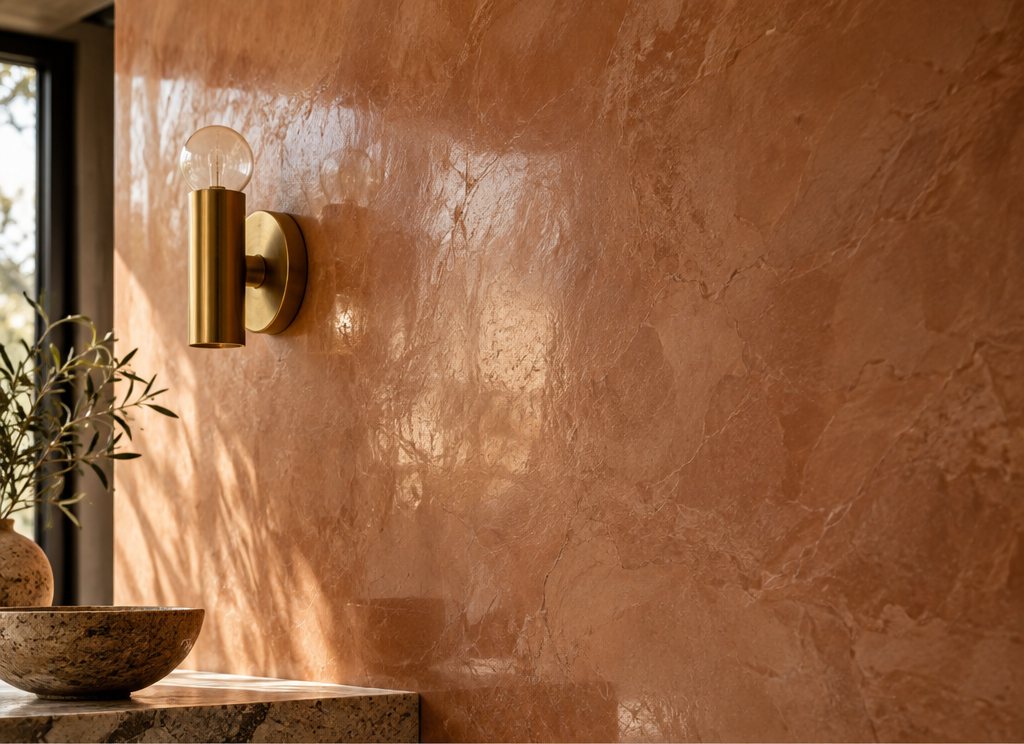
| Marmorino / venetian plaster | Troweled lime and marble dust | $8–25 | Pro | Stone-like, polished or matte | Feature walls, baths, entries |
What are the sprayed drywall wall textures?
Sprayed drywall wall textures are applied with a hopper gun and compressor over taped and primed sheetrock, and they exist mainly to hide joints and save finishing labor. Orange peel, knockdown, popcorn and splatter are the four sheetrock texture patterns almost every tract home since the 1970s has used.
Orange peel
Orange peel is thinned joint compound sprayed as a fine mist that dries into small, rounded bumps, like the skin of the fruit. It is the lightest sprayed texture, the easiest to paint, and the one that reads as almost smooth from across a room. It is also the cheapest wall finish there is after bare drywall, which is why it is the default in most of the country. Rolled on with a thick-nap roller it becomes a heavier "roller texture."
Knockdown
Knockdown starts as a coarser splatter and is flattened 10–15 minutes later with a wide knockdown knife, leaving flat-topped islands with valleys between. It hides more than orange peel and has a stony, mottled quality that suits Southwestern and Mediterranean-leaning houses. Heavy knockdown is dated; a fine, light knockdown is still acceptable in a modern room, especially under a flat paint.
Popcorn and splatter
Popcorn (acoustic texture) is compound mixed with polystyrene or vermiculite beads and sprayed thick, almost always on ceilings. It collects dust, cannot be cleaned and, in homes built before the early 1980s, may contain asbestos, so it should be tested before any disturbance. Splatter and spray sand are gritty, uniform commercial finishes with no decorative merit in a home.
What are the hand-applied joint compound textures?
Hand-applied textures are made by spreading or rolling joint compound onto the wall and manipulating it with a trowel, brush, sponge or comb before it sets. They cost more in labor than sprayed finishes but need no equipment, which makes them the realistic DIY wall texture options. Our companion guide, how to texture walls with joint compound, gives the full method for each.
Skip trowel
Skip trowel is the most refined of the mud textures. Thinned compound is loaded on a curved trowel held at a steep angle and skipped across the wall in short arcs so it catches only in patches, which are then lightly flattened. Done with a thin mix and a light hand, it looks like old lime plaster; done heavily, it becomes Spanish lace. It is the hand texture most often used to fake the plaster look at a tenth of the cost.
Slap brush, stomp and crow's foot
Slap brush, also called stomp or crow's foot, is compound rolled on evenly and then stamped with a stiff round or oval brush, leaving overlapping starburst patterns. It is easy and fast and hides a terrible ceiling, which is why it is nearly always a ceiling texture. On walls it catches dust and snags sleeves.
Swirl, comb and sand
Swirl patterns are made by dragging a wide brush or sponge in overlapping half-circles through wet mud, often in 10–12 in (25–30 cm) fans; it was the signature of mid-century plasterers and can look charming on a dining room ceiling. Comb textures use a notched trowel dragged straight or in arcs for a linear, striated effect that photographs well as a contemporary wall texture on a single accent wall. Sand texture is compound with fine silica mixed in, rolled on for an even, gritty finish that feels like an old painted plaster wall and is one of the more livable options.
Which wall textures look modern in 2027?
Modern wall texture in 2027 means one of three things: a perfectly smooth level-5 wall under a matte or flat paint, a hand-applied mineral finish such as lime wash or roman clay, or a fine trowel plaster. What it does not mean is orange peel, knockdown, stomp or popcorn, which read as builder-grade regardless of paint color. Buyers in renovation markets routinely budget to remove them.
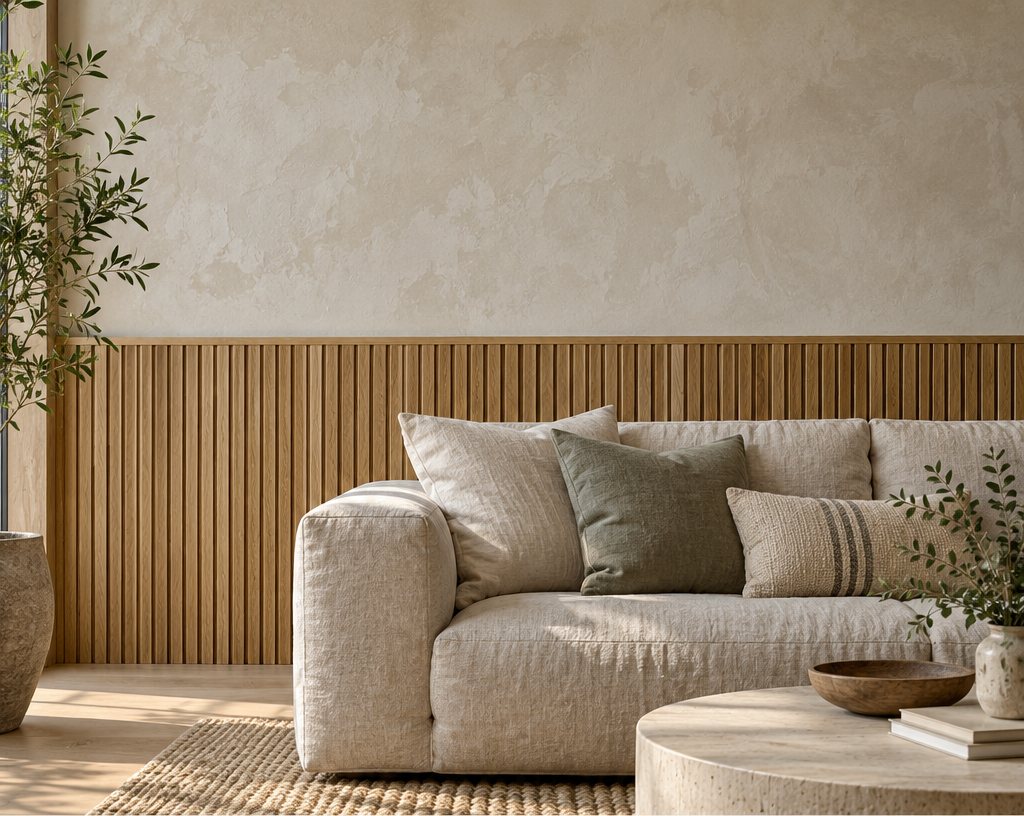
Smooth walls are the baseline of contemporary design because they let proportion, light and color do the work; the catch is that smooth walls demand better drywall, and a level-5 finish costs $2–4 per sq ft more than a sprayed texture that hides sins. Lime wash and roman clay are the textured painted walls ideas that have replaced faux finishes: brushed on in two coats, they leave cloudy, chalky movement without any physical relief, and they belong to the same palette as warm minimalism and organic modern interiors. Fine marmorino and matte venetian plaster are the premium step up, and a well-done skip trowel in thin joint compound is the budget route to a similar effect.
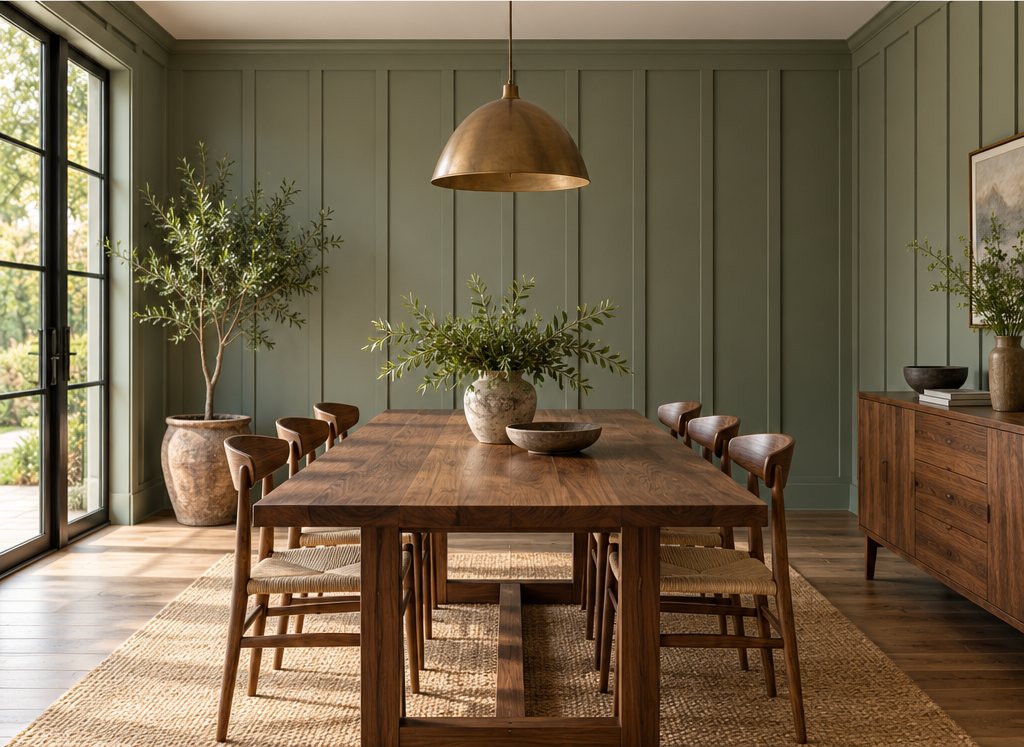
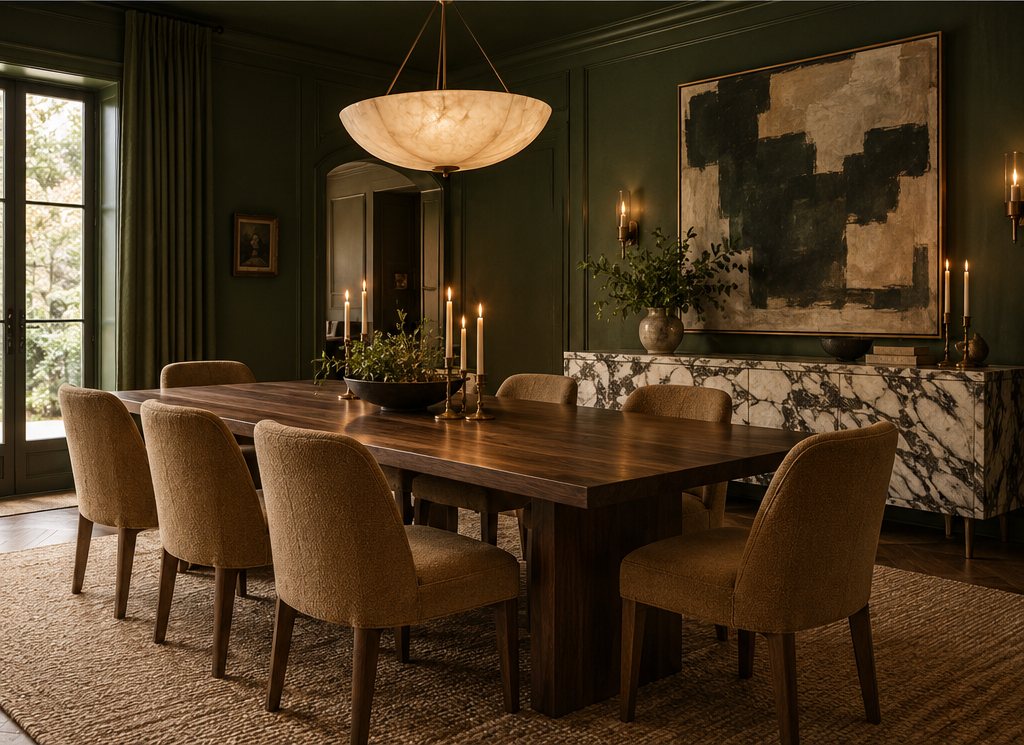
#EFE9DF#D9CDBB#B7A48C#8C9A85#5C5650Color matters as much as relief. Textured surfaces look best in low-saturation mineral tones, since every bump throws a tiny shadow and a saturated color turns muddy. Choose the sheen with care too: a flat or matte paint flatters any texture, while satin or semi-gloss highlights every ridge; our paint sheen guide explains why.
What is the best texture for walls in each room?
The best texture depends on how the room is used and lit. Living rooms and bedrooms can carry a soft decorative texture; kitchens, bathrooms and hallways want something smooth or sealed that wipes clean; ceilings tolerate the heavy hand textures that would be a mistake at eye level.
- Living room: smooth, lime wash, roman clay, fine skip trowel or marmorino on one wall. Raking light from side windows shows texture to its best advantage here.
- Bedroom: lime wash or roman clay behind the bed, smooth elsewhere; the soft movement works like a headboard wall, one of the ideas in bedroom trends 2027.
- Kitchen: smooth level-5 or sealed plaster; any open relief traps grease. Keep textures off backsplash zones entirely.
- Bathroom: smooth with a moisture-resistant paint, or sealed lime plaster (marmorino, tadelakt). Avoid joint-compound textures, which soften with humidity.
- Hallways and stairs: smooth or very fine orange peel, because scuffs on heavy texture cannot be touched up cleanly.
- Ceilings: smooth is ideal; a light knockdown or swirl is acceptable; popcorn should be removed.
- Home office or den: acoustic relief helps; a comb texture or a sand finish on one wall, or better, acoustic panels that actually absorb sound.
How much does wall texture cost?
Wall texture costs $1–3 per sq ft for sprayed drywall textures, $2–5 per sq ft for hand-applied joint compound textures, $3–8 per sq ft for lime wash and roman clay, and $8–25 per sq ft for lime plasters, all including labor on a prepared wall. A 1,000 sq ft interior repaint with new orange peel runs $1,000–2,000; the same walls in roman clay cost $3,000–8,000.
Removing an existing texture adds $1–3 per sq ft for a skim coat over orange peel or light knockdown and $2–5 per sq ft for popcorn or heavy relief, before any new finish. Those numbers are why the decision to go smooth is usually made during a renovation when walls are already being patched. The alternatives, costs and a step-by-step for the skim coat are in how to smooth textured walls.
How do you choose a wall texture?
Choose a wall texture by working through the practical questions before the aesthetic ones: what the wall must hide, how the room is lit, how the surface will be cleaned, and whether you want the texture to disappear or to be the design. Here is the sequence we use.
- Assess the drywall. New, well-taped board can take smooth or any texture. Old, patched or wavy walls favor knockdown or skip trowel, which hide imperfections; smooth requires a full skim coat.
- Study the light. Walls that get strong raking light from a side window show every bump, which flatters a fine decorative texture and exposes a sloppy sprayed one. Walls lit flat from the front hide relief and may not justify the expense.
- Decide whether the texture is background or feature. Background textures (orange peel, sand, smooth) should be invisible from 6 ft (1.8 m). Feature textures (skip trowel, comb, plaster) are chosen to be seen, and work best on one or two walls.
- Match texture to the house. A fine trowel plaster or lime wash suits almost any style; Spanish lace belongs in an adobe-style house; swirl ceilings suit a mid-century ranch; smooth is right for modern, Scandinavian and Japanese-influenced rooms.
- Check the maintenance. Anything with open relief holds dust and is hard to patch invisibly. If the wall will be touched, scrubbed or re-painted often, go smooth or sealed.
- Sample on a 2 × 2 ft (60 × 60 cm) board. Apply the texture and the intended paint color and sheen, then stand it against the wall for a day in natural and artificial light before committing.
- Price the whole job. Include removal of any existing texture, primer, paint and ceilings. Many quotes cover the texture only.
What are the decorative wall texture finishes beyond drywall mud?
Beyond joint compound sit the mineral and plaster finishes that give the most sought-after interior wall texture of the moment: lime wash, roman clay, clay plaster, marmorino, tadelakt and venetian plaster. They are more expensive, but they age well, breathe, and carry the hand-made quality that painted drywall cannot.
Lime wash is slaked lime and pigment brushed on in two thin coats with a wide block brush; it dries chalky and mottled, with the brush marks as the texture, and costs $3–6 per sq ft. Roman clay is a thick, matte, acrylic-bound compound troweled on in two coats for a suede-like movement without relief, at $4–8 per sq ft. Clay plaster is an earth-and-sand plaster with a soft, sandy surface that regulates humidity, at $5–10 per sq ft. Marmorino and venetian plaster are the lime-and-marble finishes covered in plaster walls and finishes, at $8–25 per sq ft. If what you want is depth rather than relief, these are the textured wall finishes worth paying for, and a wood or slat feature wall from our wood accent wall guide is the other way to add texture without touching the plaster at all.
Free toolPaint CalculatorWork out exactly how much paint to buy.Frequently asked questions
What is the most popular wall texture?
Orange peel is the most common wall texture in American homes because it is the cheapest to spray and hides drywall seams, with knockdown a close second in the West and Southwest. In renovations and new custom homes, the most requested finishes are now smooth level-5 drywall and soft mineral finishes such as lime wash and roman clay rather than any sprayed texture.
What wall texture is most modern?
Smooth is the most modern wall texture, followed by lime wash, roman clay and fine trowel plasters such as marmorino, all of which add movement without heavy relief. Orange peel, knockdown, slap brush and popcorn are associated with tract housing from the 1970s to 2000s and are the textures most often removed in a contemporary renovation.
Are textured walls outdated?
Heavy sprayed and stomped textures are outdated and buyers in many markets budget to remove them. Textured walls as a category are not: hand-applied plaster, lime wash and clay finishes are among the strongest interior directions for 2027, because they add the tactile, imperfect quality that flat paint lacks. The difference is scale and intention: fine and deliberate reads as design, coarse and uniform reads as cover-up.
What is the easiest wall texture to do yourself?
Slap brush (stomp), sand texture and a light roller texture are the easiest DIY wall textures because they need only a roller, a brush and premixed joint compound. Skip trowel takes more practice but is manageable, while sprayed textures need a rented hopper gun and compressor and a lot of masking. Lime wash is also beginner-friendly: it is brushed on like paint and the unevenness is the point.
Which wall texture hides imperfections best?
Knockdown and skip trowel hide the most, because their random islands and valleys disguise seams, patches and waves in old drywall. Heavy orange peel hides small flaws; smooth hides nothing and requires a full skim coat on anything less than perfect board. Popcorn hides everything but is not an acceptable finish on walls.
How much does it cost to texture walls?
Sprayed textures cost $1–3 per sq ft applied, hand-applied joint compound textures $2–5 per sq ft, lime wash and roman clay $3–8 per sq ft, and lime plasters such as marmorino or venetian plaster $8–25 per sq ft. Expect a job minimum of $300–500 for a single room from a drywall contractor and $800–1,500 from a decorative plasterer.
Some links may be affiliate links. Regulations and specifications change — always confirm with suppliers and qualified professionals.