Travertine Coffee Tables: How to Choose, Style & Care for One
Why the travertine coffee table became the warm-minimal centerpiece, shapes matched to sofas, solid versus top versus look-alike, a size guide, weight and floors, styling, care and an eight-piece edit by budget.
Key takeaways
- Size the table at about two-thirds the sofa length, 16–18 in from the seat and within 2 in of seat height; go slightly smaller with stone
- Rectangles suit straight sofas, rounds and nesting sets suit sectionals and small rooms, blocks need 24 in of clear floor around them
- Solid travertine weighs 150–300 lb; a travertine top on a metal or timber base gives the same surface at half the weight
- Seal with a penetrating sealer, use coasters against acid etching and clean only with pH-neutral products
A travertine coffee table should be about two-thirds the length of your sofa, 16–18 in (40–45 cm) from it, and within 2 in (5 cm) of the seat height, and it will weigh 80–300 lb (36–136 kg) if the stone is solid. This guide covers which shape suits which sofa, solid versus travertine-top versus travertine-look, moving and protecting one, styling and care, and eight generic buys by budget.
Why travertine coffee tables are everywhere
Travertine coffee tables took over because warm minimalism needed a centerpiece with texture but no color, and a block of pale banded stone is exactly that. The look descends from Italian tables of the 1970s and returned around 2020 as rooms shed pattern and shine. Against a bouclé sofa, a linen rug and a plaster wall, the stone supplies depth and shadow through its pits and layers without adding a second color. It also photographs well.
Travertine is a porous limestone, lighter and more textured than marble and considerably cheaper as a slab, so a substantial table costs less than the marble version and looks less formal. For the geology and finishes, our pillar guide Travertine Tile: Finishes, Costs & Where to Use It covers them; the short version for furniture is that honed and filled is the finish you want on a table top. For the room this table belongs in, see the warm minimalism guide.
Shapes: rectangle, round, block, nesting
Match the shape to the sofa first and the room second: a rectangle for a long straight sofa, a round or oval for a sectional or a small room, a block where the table is sculpture, nesting pieces where the seating group is loose.
- Rectangle. The travertine coffee table rectangle is the workhorse: a 40–55 in (100–140 cm) slab, 20–28 in (50–70 cm) deep, on a plinth or two pedestal legs. It runs parallel to a standard three-seat sofa and leaves room for a tray, books and a bowl. Rounded or pillowed corners are safer with children and soften the block.
- Round and oval. A 36–42 in (90–107 cm) round drum or a disc on a cylinder suits an L-shaped sectional, where a rectangle collides with the chaise, and any room where people walk past the table on two sides. Ovals of 48 × 30 in (120 × 75 cm) give rectangle capacity with round circulation.
- Block or plinth. The travertine block coffee table is a solid or hollow-core cube or slab, often 30–40 in (75–100 cm) square and 12–15 in (30–38 cm) high, with no visible legs. It is the most sculptural and the heaviest, and it reads best with at least 24 in (60 cm) of clear floor around it.
- Nesting. A travertine nesting coffee table set, usually two or three cylinders or squares at different heights, 14–18 in (35–45 cm) and 12–16 in (30–40 cm), can be pushed together under a large sofa or pulled apart for a party. Ideal with curved sofas and small rooms.
- Travertine and wood. A stone top on an oak, walnut or ash base, or a timber slab with a travertine inlay, lightens the piece visually and physically and bridges a room with a lot of wood. The travertine and wood coffee table is the version we specify most for family rooms because the base absorbs knocks better than stone.
If you are also choosing the sofa, do that first; our how to choose sofa size guide sets the widths and seat heights the table then has to answer.
Solid travertine vs travertine top vs travertine-look
Solid stone is the heaviest and most expensive, a travertine top on a metal or timber base gives the same surface at half the weight, and travertine-look is a print or composite that costs a fraction and fools nobody within arm's reach. The right one depends on how the table will be used and moved.
| Type | Construction | Weight (40 × 24 in table) | Price band | Best for |
|---|---|---|---|---|
| Solid travertine coffee table | Slab top 1.25–2 in (3–5 cm) on solid or hollow stone plinth | 150–300 lb (68–136 kg) | $900–4,000+ | Ground floors, permanent homes, statement pieces |
| Travertine top coffee table | Stone top 3/4–1.25 in (2–3 cm) on steel, brass or timber base | 60–120 lb (27–55 kg) | $400–1,800 | Apartments, upper floors, mixed-material schemes |
| Travertine veneer over composite | Thin stone or stone-and-resin skin on MDF or honeycomb core | 40–80 lb (18–36 kg) | $300–1,200 | Block shapes without the weight; rentals |
| Travertine-look | Printed laminate, sintered stone, concrete or resin cast | 30–90 lb (14–41 kg) | $150–800 | Budget rooms, outdoor covered areas, heavy family use |
To tell real travertine stone from a look-alike: it is cold to the touch and stays cold, the pits are irregular and go into the surface, and the banding continues around the edge and underneath. For a modern travertine coffee table the current preference is honed, filled, vein-cut stone with the bands running the long way, matte rather than polished.
Size guide
A coffee table should be roughly two-thirds the length of the sofa, sit 16–18 in (40–45 cm) from the seat edge and land within 2 in (5 cm) of the sofa's seat height, which for most sofas means a table 14–18 in (35–45 cm) tall. Because a stone table is visually heavy, err toward the smaller end of the range.
| Sofa | Table length | Table depth | Height | Shape |
|---|---|---|---|---|
| Loveseat 60–72 in (152–183 cm) | 36–44 in (90–112 cm) | 20–24 in (50–60 cm) | 15–17 in (38–43 cm) | Small rectangle, 30–36 in round, nesting pair |
| Three-seat 84–96 in (213–244 cm) | 48–60 in (120–150 cm) | 24–30 in (60–75 cm) | 15–18 in (38–45 cm) | Rectangle, 48 × 30 in oval |
| Sectional L 100–120 in (254–305 cm) | 36–42 in round or 40–48 in square | — | 14–17 in (35–43 cm) | Round drum, block, 40 in square |
| Curved or two facing sofas | 42–48 in (107–122 cm) round | — | 15–17 in (38–43 cm) | Round, nesting cylinders |
| Small room under 12 × 12 ft (3.6 × 3.6 m) | 30–36 in (75–90 cm) | 18–20 in (45–50 cm) | 15–17 in (38–43 cm) | Small travertine coffee table, round or oval |
Hold 30 in (75 cm) of walkway on any side that leads somewhere, and 16–18 in (40–45 cm) between the table and the sofa; closer than 14 in (35 cm) you knock shins on stone, which hurts more than wood. A slightly low table is more comfortable than a slightly high one. In a compact room a small travertine coffee table of 30–36 in (75–90 cm) round often works better than a rectangle because the eye and the feet can go around it.
Weight, floors and moving
A solid travertine block table can weigh as much as a refrigerator, and that weight decides where it can go and how it gets there. Travertine runs about 150 lb per cubic foot (2,400 kg/m³); a 40 × 24 × 2 in (100 × 60 × 5 cm) top alone is around 110 lb (50 kg), which is why most block tables are hollow-cored. Ask for the shipped weight before anything else.
- Check the floor. Residential floors are designed for about 40 lb per sq ft (195 kg/m²) live load; a 250 lb (113 kg) table on a 2 × 3 ft footprint is well inside that, but concentrate the load on four small feet and a softwood floor will dent. Use wide felt or cork pads, at least 2 in (5 cm) across.
- Protect the floor. On timber and engineered floors use felt pads and never drag; on stone or tile use cork or rubber so the table does not scratch the floor or itself. On thick rugs a heavy stone table crushes the pile permanently; accept the marks or choose a flatweave.
- Move it in pieces. Most travertine top coffee tables separate from the base; carry the top vertically like a sheet of glass, never flat, because a slab held flat can crack under its own weight. Two people for anything over 80 lb (36 kg); a furniture dolly and a third person for a block.
- Check the route for door widths, stair turns and elevator limits, then level the table on cork shims so a corner does not chip.
Upper floors and homes with small children point toward a travertine top on a lighter base; ground-floor rooms with a clear path from the door can take solid stone.
Styling a travertine coffee table
Style a stone table with fewer, larger objects than a wooden one; the surface is the point and clutter hides it. Three pieces, or one tray holding three: a stack of large books, one low bowl and something living, such as a branch in a heavy vase. Keep at least half the surface clear.
Because travertine is warm and matte, pair it with contrast in finish rather than color: a dark glazed bowl, a smoked-glass vase, a brass or blackened-steel object. A tray in timber, leather or dark stone protects the top where drinks land; size it at about one-third of the table length. Underneath, a jute or wool flatweave rug lets the table's mass sit; a high-shine or heavily patterned rug fights it.
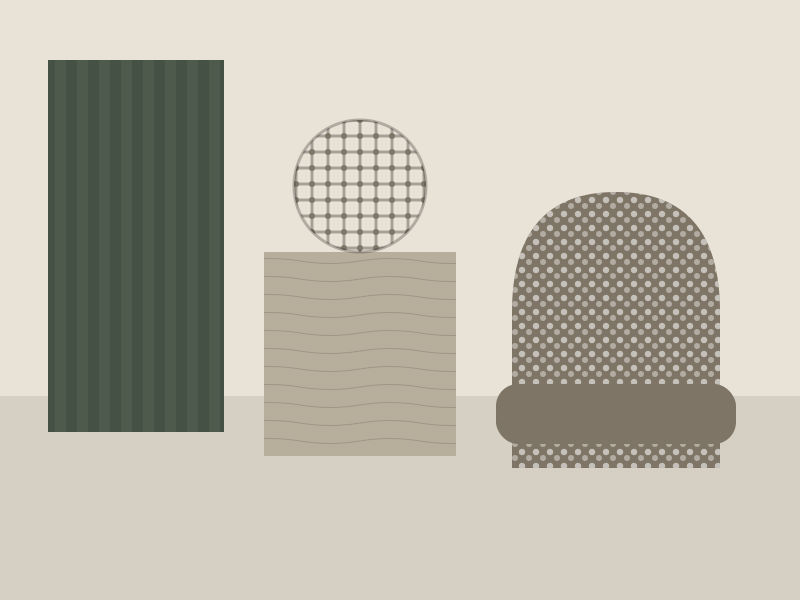
#EDE5D8#C4AE8E#E3D9C8#8A7A63#3E4A3C#332C25In color terms the table anchors a scheme of ivory, sand, oat and mushroom; the accent can be a deep green, an oxblood or a charcoal in a single object or one chair. Keep metal to one finish across the room.
Caring for it: coasters, sealing, stains
Travertine etches on contact with anything acidic and absorbs oil, so a coffee table needs a coaster habit and a penetrating sealer, and then it is easy. Wine, citrus, coffee, cola and many cleaners react with the calcium carbonate and leave a dull spot within minutes; that is etching, and no sealer stops it. Staining, which a sealer does slow, comes from oil and dyes soaking into the pores.
- Seal it with a water-based penetrating impregnating sealer when it arrives if the seller has not, and again every one to two years. Wipe on, wait 5–15 minutes, buff off; the finish should not change.
- Clean it with a soft cloth and warm water or a pH-neutral stone cleaner. Never vinegar, citrus cleaners, bleach, ammonia or abrasive powders.
- Coasters and trays under every glass and cup, always; a cork-backed or felt-backed coaster is best because unglazed ceramic can scratch.
- Oil and wine stains: apply a poultice of baking soda and water, or a commercial stone poultice powder, cover with plastic for 24 hours, then lift and rinse. Repeat once if needed.
- Etch marks: a marble polishing powder rubbed with a damp cloth removes light etching on honed stone; deep etching or scratches need a stone restorer to re-hone the top, typically $150–400.
- Open pits collect crumbs; vacuum with a brush attachment, and replace lost fill with a color-matched stone epoxy kit.
Our edit: 8 travertine coffee tables at different budgets
Generic specifications rather than products, in ascending price; take them to a retailer or a factory as a brief. Prices are typical retail ranges.
- Travertine-look cast concrete drum, 32 in (80 cm) round, $150–350. Lightweight fiber-cement cylinder with a stone-effect finish; fine for a first apartment or a covered terrace.
- Small travertine top on black steel hairpin base, 30 × 20 in (75 × 50 cm), $300–550. A 3/4 in (2 cm) honed filled top, about 45 lb (20 kg); the entry to the real material.
- Travertine nesting cylinders, 18 and 14 in (45 and 35 cm) diameter, veneer over core, $400–800 the pair. Two heights, movable by one person; suits curved sofas and small rooms.
- Travertine and wood rectangle, 48 × 26 in (120 × 65 cm), $600–1,200. Honed top on a solid oak or walnut trestle base; the family-room choice.
- Round travertine top on brushed-brass or bronze frame, 40 in (100 cm), $700–1,500. 1.25 in (3 cm) vein-cut top, a lighter, more tailored look for a sectional.
- Hollow-core travertine block, 36 × 36 × 14 in (90 × 90 × 35 cm), $900–1,800. Mitered slab construction, reads as solid at about 120–160 lb (55–73 kg).
- Solid travertine plinth rectangle, 55 × 28 in (140 × 70 cm), $1,500–3,000. A 2 in (5 cm) top on two solid stone blades, 200–300 lb (90–136 kg); the classic 1970s silhouette.
- Custom-cut slab and plinth to your dimensions, $2,000–4,500. Vein-cut, honed, filled, sealed, with pillowed edges, made to the two-thirds rule for your specific sofa.
For a complete warm-minimal living room around a stone table, our ready-made room edit in the shop pairs the table with the sofa, rug and lighting at three budgets. For a custom size, a pair, or trade quantities for a hotel or rental portfolio, the sourcing desk will quote from stone furniture workshops against your drawing.
Free toolTile CalculatorWork out tiles, boxes, grout and adhesive with the right wastage.Shop & source the look
Buy it today — or have it made
Retail links are affiliate links: we may earn a commission at no extra cost to you (disclosure). “Get it made” sends the item to our sourcing desk for factory quotes in custom sizes and finishes.
Frequently asked questions
What size travertine coffee table is right for my space?
About two-thirds the length of your sofa, 16–18 in (40–45 cm) from the seat edge and within 2 in (5 cm) of the seat height, usually 14–18 in (35–45 cm) tall. A three-seat sofa takes a 48–60 in rectangle; a sectional takes a 36–42 in round; a room under 12 × 12 ft suits a 30–36 in round. With stone, choose the smaller end of the range.
How do you clean and care for travertine coffee table?
Wipe with a soft cloth and warm water or a pH-neutral stone cleaner, never vinegar, citrus or bleach, and use coasters under every drink because acids etch the surface within minutes. Apply a water-based penetrating sealer on arrival and every one to two years. Lift oil or wine stains with a baking-soda poultice left under plastic for 24 hours.
What's the real difference between the main types of travertine coffee table?
Solid travertine is stone through and through, 150–300 lb and the most expensive; a travertine top sits a 2–3 cm stone slab on a metal or timber base at half the weight; veneer blocks wrap thin stone over a core; travertine-look pieces are printed or cast with no real stone. Choose by weight and floor first, then budget, and insist on honed, filled, sealed stone for any real top.
What should you look for when choosing modern travertine coffee table?
A honed, filled, vein-cut top with the bands running lengthwise, a matte finish, a slab at least 2 cm thick, pillowed or slightly rounded edges and a base that separates for moving. Check the stated weight against your floor and route, ask whether it arrives sealed, and prefer a plinth or thin metal base over ornate legs for the current look.
What should you look for when choosing travertine coffee table rectangle?
Length at about two-thirds of your sofa, usually 48–60 in for a three-seater, and depth of 24–30 in so a tray and books fit with room to spare. Look for rounded corners if children use the room, a top of 2–5 cm, a plinth or twin-pedestal base that leaves knee room, and 16–18 in of clearance to the sofa once it is placed.
Some links may be affiliate links. Regulations and specifications change — always confirm with suppliers and qualified professionals.