Orange Peel Wall Texture: How to Spray, Match, Paint & Remove It
Orange peel wall texture is a fine, dimpled finish sprayed with thinned joint compound at 25–40 psi. It costs $0.50–$2.50 per sq ft to apply, comes in light, medium and thick grades, and paints best with a 1/2 in nap roller in matte.
Part of our guide: Wall Treatments Guide: 14 Wall Finishes & Covering Ideas
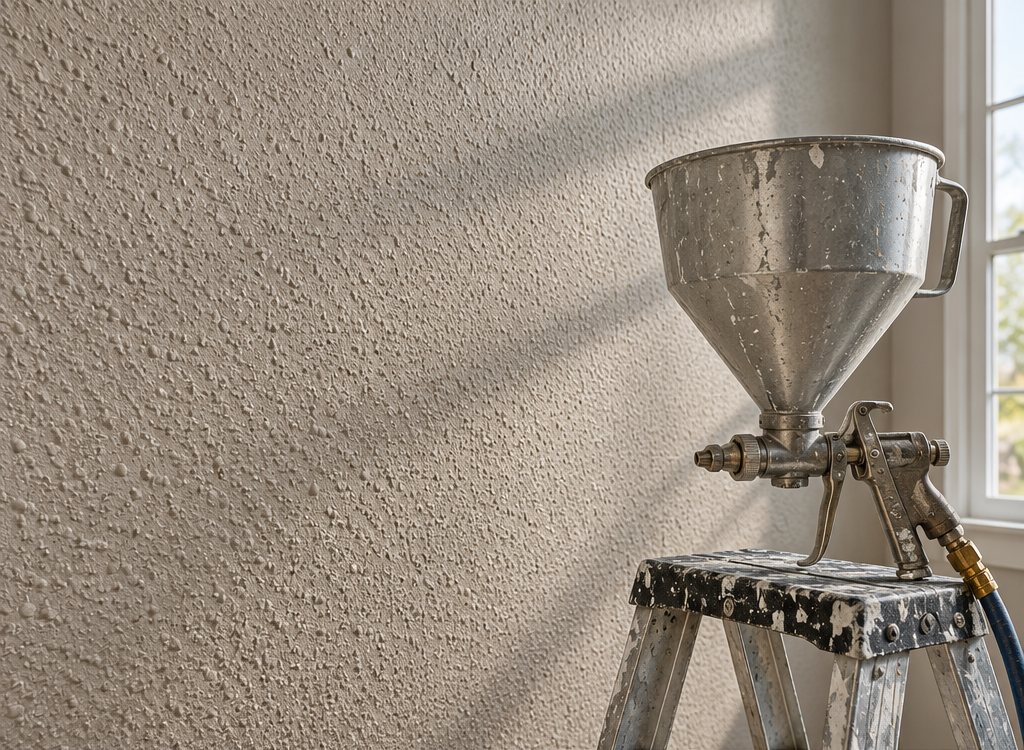
Key takeaways
- Orange peel is thinned joint compound sprayed at 30–40 psi through a 7–8 mm nozzle from 18–24 in away; it costs $1.50–$2.50 per sq ft hired
- Light orange peel suits modern rooms and matte paint; thick orange peel hides more but reads dated and is the grade most people remove
- Paint orange peel walls with a 1/2 in nap roller in flat or matte, and budget 15–25 percent more paint than the smooth-wall coverage figure
- Removing orange peel means skim coating two or three times to level 5, at $1.50–$4.00 per sq ft, not scraping
Orange peel wall texture is a light, randomly dimpled finish sprayed onto drywall with thinned joint compound, so the surface looks like the peel of an orange rather than a flat sheet. It is the most common wall texture in American homes built after 1980, costs $0.50–$2.50 per sq ft ($5–27 per m²) to apply, and comes in light, medium and thick grades depending on nozzle size and air pressure.
Builders love it because it hides taping seams and nail pops in a single pass and dries in a few hours. Homeowners are more divided: in 2027 the move is toward smoother finishes, but a well-sprayed light orange peel still reads as neutral and clean, especially under matte paint. This guide covers how it is applied, how to match an existing patch, how to paint it, and how to take it off if you want flat walls.
- Look: fine, rounded splatter with no sharp peaks; dimples 1/16–3/16 in (1.5–5 mm) across.
- Material: all-purpose joint compound thinned to a pancake-batter consistency, or aerosol texture for patches.
- Application cost: $0.50–$1.20 per sq ft DIY materials and rental; $1.50–$2.50 per sq ft hired.
- Dry time: 4–8 hours before priming, 24 hours before the first coat of paint.
- Removal cost: $1.50–$4.00 per sq ft to skim coat to a smooth level 5 finish.
What is orange peel wall texture?
Orange peel is a spray-applied drywall texture made of thinned joint compound that lands on the wall as thousands of small droplets, flattens slightly as it dries, and leaves a surface of soft, rounded dimples. Unlike knockdown texture, nothing is troweled after spraying; unlike popcorn, nothing is added to the mix. The pattern is uniform and low-relief, usually 1/32–1/16 in (0.8–1.5 mm) in height, which is why it hides drywall imperfections without casting the heavy shadows of a rougher wall texture type.
The finish became the default for production housing because it is fast. A two-person crew can texture a 2,000 sq ft (186 m²) house in a day, and the drywall underneath only needs to be finished to level 3 rather than the level 5 that a smooth, painted wall demands. That saves a day or two of sanding per house, which is the entire economic argument for orange peel on walls.
Light, medium and thick orange peel compared
The three grades differ in how heavily the compound is sprayed and how far it spreads before it hits the wall. Light orange peel wall texture is sprayed thin, from farther away, and leaves 60–70 percent of the wall nearly flat with tiny dimples; it is the grade that pairs best with modern interiors and is the easiest to paint. Medium is the builder standard. A thick orange peel texture uses a larger nozzle, lower air pressure and thicker mud, so the droplets are bigger and closer together; it hides more but looks dated when painted in a sheen, and it is the one most people want removed.
| Grade | Nozzle / pressure | Relief height | Coverage per 4.5 gal (17 L) bucket | Best for |
|---|---|---|---|---|
| Light | 6–7 mm nozzle, 35–40 psi, thin mix | 1/32 in (0.8 mm) | 250–300 sq ft (23–28 m²) | Living rooms, bedrooms, modern homes |
| Medium | 7–8 mm nozzle, 30–35 psi | 1/16 in (1.5 mm) | 180–220 sq ft (17–20 m²) | Hallways, kids' rooms, rentals |
| Thick | 8–10 mm nozzle, 25–30 psi, heavy mix | 3/32–1/8 in (2.5–3 mm) | 120–160 sq ft (11–15 m²) | Garages, basements, damaged walls |
How much does orange peel wall texture cost?
Hiring a drywall contractor to spray orange peel costs $1.50–$2.50 per sq ft ($16–27 per m²) of wall area, including primer-ready drying but not paint; doing it yourself runs $0.50–$1.20 per sq ft once you rent a hopper gun and compressor. For a 12 × 14 ft (3.7 × 4.3 m) bedroom with 8 ft (2.4 m) ceilings, that is about 400 sq ft (37 m²) of wall, or $600–1,000 hired and $200–480 DIY.
| Item | DIY cost | Contractor cost | Notes |
|---|---|---|---|
| Joint compound, 4.5 gal (17 L) | $15–22 per bucket | Included | One bucket covers roughly 200 sq ft at medium grade |
| Hopper gun + compressor rental | $60–110 per day | Included | Compressor must deliver 4–6 cfm at 40 psi |
| Aerosol texture can, 20 oz (567 g) | $12–20 per can | n/a | Covers 10–20 sq ft; patches only |
| Labor, new drywall | Your weekend | $1.00–1.50 per sq ft | Drywall must already be taped to level 3 |
| Labor, over existing paint | Your weekend | $1.50–2.50 per sq ft | Adds sanding and a bonding primer |
| Priming and two coats of paint | $0.40–0.80 per sq ft | $1.50–3.00 per sq ft | Texture absorbs 15–25% more paint than smooth walls |
Texturing is cheap; the expensive part is reversing it. Keep that in mind if you are texturing a room now in a house that will likely be smoothed later. Our complete wall treatments guide compares the whole-room cost of texture, paneling, plaster and wallpaper.
How do you apply orange peel texture to walls?
Orange peel is applied by spraying thinned all-purpose joint compound through a hopper gun with a 7–8 mm nozzle at 30–40 psi, holding the gun 18–24 in (46–61 cm) from the wall and moving in overlapping passes. The pattern is set by three variables you control: mud consistency, air pressure and distance. Thinner mud, higher pressure and more distance all give a finer pattern.
- Prepare the drywall. Tape and mud all seams and screws to a level 3 finish, sand the ridges, and vacuum the dust. Texture hides small flaws but telegraphs ridges and bumps larger than 1/16 in (1.5 mm).
- Prime first. Roll one coat of PVA drywall primer and let it dry. Unprimed paper absorbs water from the texture unevenly and leaves blotchy patches that show through paint.
- Mask everything. Spray texture travels. Cover floors, trim, outlets and the ceiling line with plastic and tape; overspray is far harder to clean than to prevent.
- Mix the compound. Thin all-purpose joint compound with water at roughly 1 part water to 3–4 parts mud, mixing with a paddle on a drill for two minutes until it pours like thick pancake batter and runs off the paddle in a steady ribbon. Lumps clog the nozzle, so strain the mix through a paint strainer bag if the bucket was old.
- Dial in the gun on cardboard. Fit the 7 mm nozzle, set the compressor to 35 psi, open the material valve one and a half turns, and test on a large sheet of cardboard from 20 in (51 cm). Adjust: tighten the valve or raise pressure for a finer pattern; open it or lower pressure for a thicker one.
- Spray the wall. Work in 4 × 4 ft (1.2 × 1.2 m) sections, keeping the gun perpendicular to the wall and moving in a loose, continuous figure-eight. Aim for 60–70 percent coverage on the first pass; you can always add, you cannot subtract.
- Cross-hatch the second pass. Come back once the first pass has lost its wet gloss, 10–20 minutes, and spray again at a slight angle to fill thin spots. Stop when the surface looks even from 6 ft (1.8 m) away.
- Let it dry. Allow 4–8 hours, longer in humid weather, then prime with a flat latex primer before painting. Do not sand; the dimples are the finish.
Can you roll orange peel texture instead of spraying it?
Yes, for small rooms and patches. Thin the compound slightly more and roll it on with a 3/4 in (19 mm) nap roller, then go back over it lightly with a dry roller to stipple the surface. The result is coarser and more regular than sprayed texture, closer to a sand finish, so keep roller texture to closets, laundry rooms and areas where it will not sit beside a sprayed wall.
How do you match an existing orange peel patch?
Match a patch by using an aerosol texture can with an adjustable nozzle, spraying a test on cardboard until the droplet size matches the wall, then feathering the spray 6–8 in (15–20 cm) past the repair so the edge disappears. The patch shows when the droplets are the wrong size, the compound stands prouder than the old texture, or the repaired area is flat while the surrounding wall has 30 years of paint rounding its dimples.
The trick most people miss is thinning the old edge. After the patch is dry, lightly sand its perimeter with 150-grit paper to knock the new droplets down slightly, then prime the entire patch and feathered zone with a sealing primer before painting. On walls with a thick orange peel texture, aerosol cans usually cannot build enough relief; use a hopper gun or a texture brush and a small batch of mud instead. For patches larger than about 2 × 2 ft (61 × 61 cm), spray the whole wall from corner to corner rather than trying to blend an island.
What is the best way to paint orange peel walls?
The best way to paint orange peel walls is a 1/2 in (13 mm) nap roller with a flat or matte paint, rolling in a W pattern and back-rolling slowly so the paint gets down into the dimples instead of skipping over them. Texture scatters light, and higher sheens exaggerate every dimple, so matte and flat finishes are the standard for living spaces; use eggshell only in kitchens and baths where scrubbability matters. Our paint sheen guide explains the trade-off room by room.
Budget 15–25 percent more paint than the can's smooth-wall coverage figure. A gallon rated at 400 sq ft (37 m²) will cover about 320 sq ft (30 m²) of medium orange peel, and less on a thick grade. The paint calculator has a texture allowance built in. If you are painting orange peel walls that have never been painted, prime with a flat latex primer first; the raw compound drinks paint and dries flat and chalky in the dimples.
Painting orange peel texture: roller nap, sheen and technique
- Roller nap: 1/2 in (13 mm) for light and medium texture, 3/4 in (19 mm) for thick. A 3/8 in nap leaves unpainted pinholes in the dimples.
- Sheen: flat or matte for bedrooms and living rooms; eggshell for kitchens, baths and hallways; never satin or semi-gloss on a textured wall.
- Loading: keep the roller fully loaded and do not press hard; pressure flattens the nap and skips the low spots.
- Cutting in: use a 2.5 in (64 mm) angled brush and stipple into the corners rather than dragging; a dragged brush leaves a smooth stripe that shows beside the texture.
- Color: mid-tone warm neutrals and off-whites flatten the texture visually; dark colors and strong raking light make it jump. See our guide to neutral paint colors for colors that quiet a textured wall.
Is orange peel wall texture outdated in 2027?
Orange peel is not outdated the way popcorn ceilings are, but it is no longer what people choose when they have a choice. The 2027 direction in interior design trends is toward smooth, plaster-like walls and tactile finishes such as limewash and hand-troweled plaster textures, and a sprayed orange texture wall reads as builder-grade next to them. Light orange peel in a matte paint is still perfectly acceptable, and in a rental, a flip or a hard-wearing family hallway it remains the sensible finish.
The honest test is lighting. Under soft, diffuse light, light and medium orange peel disappears. Under a wall washer, a sconce or a low west-facing window, the dimples cast a thousand tiny shadows, and the wall looks exactly like what it is. If a room has strong raking light and you care about how the walls look, that is the room to smooth.
How do you remove orange peel texture from walls?
Orange peel is removed by skim coating over it, not by scraping it off. Unlike popcorn, the compound is bonded to the drywall paper, so scraping tears the surface; instead, two or three thin coats of joint compound are troweled over the whole wall, sanded flat and primed, which costs $1.50–$4.00 per sq ft ($16–43 per m²) hired. A 12 × 14 ft bedroom with 400 sq ft of wall comes to $600–1,600.
- Wash and scuff. Clean the wall with a degreasing cleaner, let it dry, and sand lightly with 120-grit on a pole sander to knock down the highest peaks and dull the paint.
- Prime for adhesion. Roll a bonding primer over painted texture so the new compound grips the old paint; this step is skipped only on never-painted texture.
- First skim coat. Thin all-purpose compound slightly and roll it on with a 3/4 in nap roller, then pull it tight with a 12–14 in (30–36 cm) knife held at a low angle. This coat fills the dimples; it will not look flat yet.
- Second coat, opposite direction. After 24 hours, apply a second coat with strokes perpendicular to the first. Most walls need a third, thin coat of lightweight topping compound to reach a true level 5 surface.
- Sand and check. Sand with 150–220 grit, then rake a work light across the wall at a low angle; any shadow is a ridge to fix. Vacuum thoroughly.
- Prime with a high-build primer. Smooth walls show everything, so a high-build or surfacer primer is the standard before the finish coat.
Our step-by-step on how to smooth textured walls goes deeper into tools and the level 5 standard. If a full skim is more than the budget allows, a cheaper middle path is to cover the worst wall with paneling or a slat wall and leave the texture on the others.
Orange peel vs knockdown vs smooth walls: which should you choose?
Choose light orange peel for a hard-wearing, forgiving finish on a budget, knockdown for a more deliberate hand-finished look on larger walls, and smooth drywall for modern interiors or any room with strong raking light. The decision is mostly about how the room will be lit and how long you plan to live with it.
| Finish | Applied cost per sq ft | Hides flaws | Repair difficulty | Style read in 2027 |
|---|---|---|---|---|
| Light orange peel | $1.50–2.50 | Good | Easy with aerosol can | Neutral, builder-standard |
| Thick orange peel | $1.75–2.75 | Very good | Moderate; hard to match | Dated |
| Knockdown | $2.00–3.50 | Very good | Moderate | Southwestern, transitional |
| Skip trowel | $2.50–4.00 | Very good | Harder; needs a hand | Mediterranean, rustic |
| Smooth, level 5 | $3.00–5.00 | None | Easy but visible | Modern, premium |
For a whole-house decision, read the comparison in our joint compound wall texture guide, which covers every finish you can make with a bucket of mud and a hopper gun.
Free toolWallpaper CalculatorHow many rolls you need, allowing for the pattern repeat.Frequently asked questions
What is orange peel wall texture?
Orange peel is a sprayed drywall texture made of thinned joint compound that lands as small droplets and dries into soft, rounded dimples, so the wall resembles the skin of an orange. It is low-relief, usually under 1/16 in (1.5 mm) high, and is the most common texture in US homes built since the 1980s because it hides seams and is fast to apply.
How do you paint orange peel walls?
Prime raw texture with a flat latex primer, then roll on paint with a 1/2 in (13 mm) nap roller in a W pattern, back-rolling slowly so the paint reaches into the dimples. Use a flat or matte sheen in living spaces and eggshell in kitchens and baths. Expect to use 15–25 percent more paint than the can's smooth-wall coverage.
What is the difference between light and thick orange peel texture?
Light orange peel is sprayed thin and from farther away, leaving most of the wall nearly flat with fine dimples; thick orange peel uses a larger nozzle, lower pressure and heavier mud for bigger, denser droplets up to 1/8 in (3 mm) high. Light suits modern rooms and takes paint evenly; thick hides more damage but looks dated under sheen paint.
Can you put orange peel texture on walls yourself?
Yes. Rent a hopper gun and compressor for $60–110 a day, thin all-purpose joint compound to a pancake-batter consistency, set the compressor to 30–40 psi and test on cardboard until the droplet size looks right. Spray in overlapping passes from 18–24 in (46–61 cm) away, cross-hatch a second pass, and let it dry 4–8 hours before priming.
How much does it cost to remove orange peel texture?
Expect $1.50–$4.00 per sq ft ($16–43 per m²) for a contractor to skim coat a textured wall smooth, sand it and prime it, or about $600–1,600 for a typical bedroom. DIY materials run $0.30–$0.60 per sq ft, but the work takes two or three coats over two to three days plus careful sanding.
Is orange peel texture outdated?
It is no longer a first choice for new high-end interiors, where smooth or hand-plastered walls are the 2027 standard, but light orange peel in a matte paint is still neutral and acceptable. Thick orange peel and any orange peel under satin or semi-gloss paint tend to look builder-grade, especially in rooms with strong raking light.
Some links may be affiliate links. Regulations and specifications change — always confirm with suppliers and qualified professionals.