Industrial Interior Design: Materials, Colors and How to Get the Look
Industrial interior design uses exposed brick, concrete, black steel and reclaimed wood from converted warehouses. Learn the materials, typical costs, a 5-color palette and 7 steps to create the look at home.
Part of our guide: Interior Design Styles: 24 Decorating Styles Explained for 2027
Key takeaways
- Industrial interior design shows the structure: brick, concrete, steel, ductwork and timber are left visible rather than covered
- Balance hard surfaces with wood, leather, wool and plants, or the room feels cold and echoes
- Modern industrial keeps the materials but adds warmer whites, cleaner lines and fewer vintage props
- Use warm 2200–2700K lighting at CRI 90+ and soft textiles to make concrete and metal livable
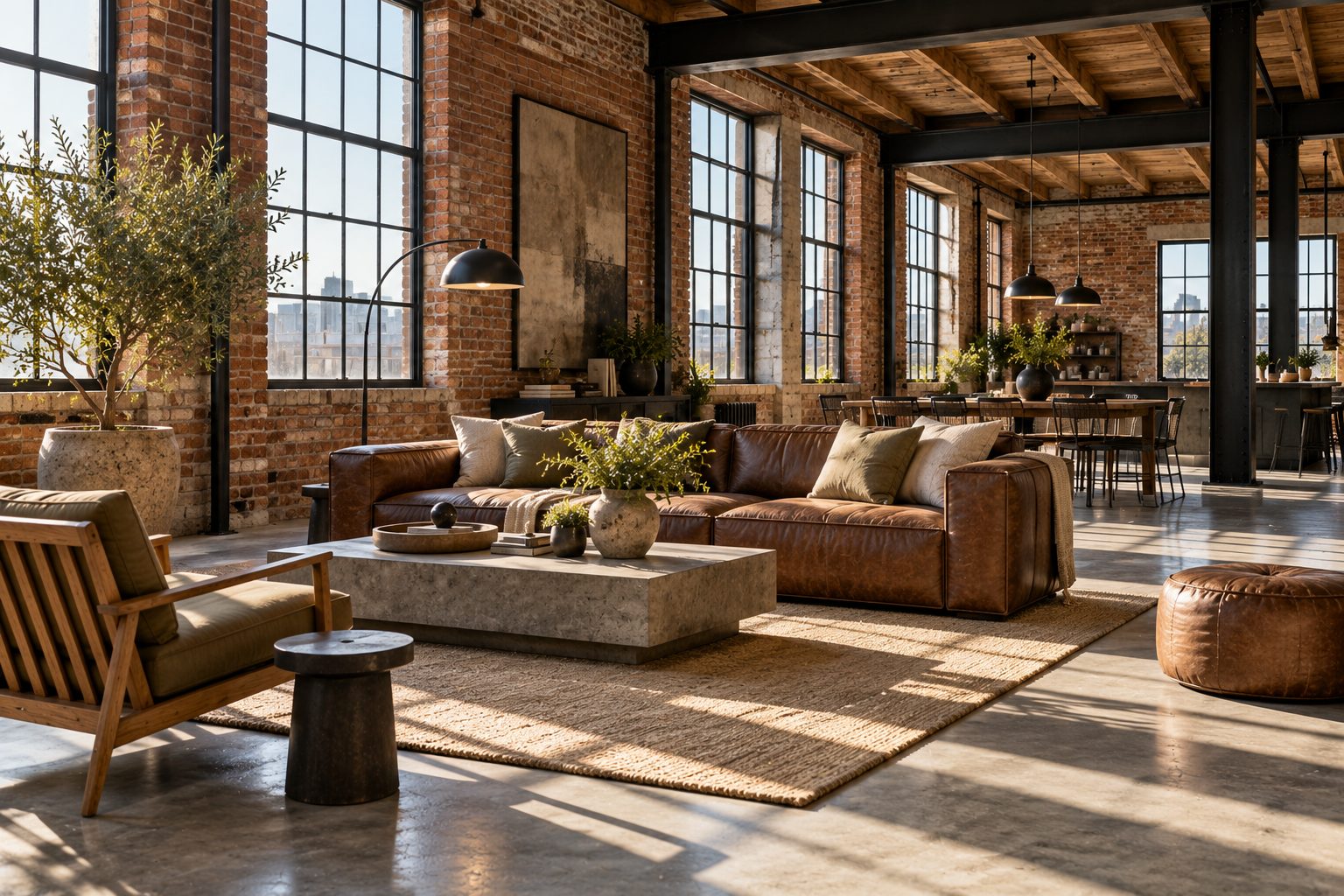
Industrial interior design is a style that leaves a building's structure and raw materials on show: exposed brick, concrete floors, black steel, visible ductwork and reclaimed wood, inspired by converted factories and warehouses. Done well it is warm rather than cold, because leather, wool, timber and 2700K lighting soften every hard surface.
Industrial is one of the core looks in our interior design styles guide, and it remains one of the most adaptable. It works in a real loft with 14 ft (4.3 m) ceilings and, with some restraint, in a suburban house or a new-build apartment.
- Origin: loft conversions in former industrial buildings, from the 1960s onward.
- Core materials: brick, concrete, steel, iron, reclaimed wood, leather and glass.
- Palette: charcoal, rust, cognac, concrete gray and warm white.
- Budget pressure point: structural work (exposed ceilings, steel windows) costs far more than decor.
What is considered industrial decor?
Industrial decor is anything that looks salvaged from or inspired by a factory: metal and wood furniture, cage and enamel pendants, steel-framed glass, vintage signage, raw finishes and utilitarian storage. The test we use is simple. If an object looks like it was made to do a job, with visible fixings and honest materials, it belongs; if it is ornamental for its own sake, it probably does not.
The industrial interior also depends on the shell. Exposed brick, board-formed or polished concrete, visible beams and pipes do the heavy lifting, and the furniture follows. In a room with smooth drywall and carpet, industrial decor alone can look like a costume, so add at least one architectural element first.
What materials define industrial style interior design?
Industrial style interior design is defined by five materials (brick, concrete, steel, reclaimed wood and leather), and the cost of getting each one into a home varies widely. These are the typical US 2026 ranges we see for the main finishes, installed:
| Material | How it is used | Typical installed cost | Watch out for |
|---|---|---|---|
| Exposed brick (original) | Strip plaster, clean, seal | $5–15 per sq ft ($55–160 per m²) | Dust, crumbling mortar, needs repointing |
| Thin brick veneer | 1/2 in (13 mm) slips on a wall | $10–25 per sq ft ($110–270 per m²) | Fake-looking if grout joints are too even |
| Polished concrete floor | Grind and seal existing slab | $3–12 per sq ft ($32–130 per m²) | Hard, cold, cracks are part of the look |
| Microcement | 2–3 mm coating on floors and walls | $10–25 per sq ft ($110–270 per m²) | Needs a skilled applicator |
| Steel-framed glass partition | Interior windows and doors | $150–400 per sq ft ($1,600–4,300 per m²) | Long lead times, heavy |
| Exposed ceiling and ductwork | Remove drywall, paint services | $4–10 per sq ft ($43–110 per m²) | Noise and heat loss; check fire codes |
| Reclaimed wood | Tables, shelves, wall cladding | $8–20 per sq ft ($85–215 per m²) cladding | Nails, moisture content, pests |
Industrial interior construction is where budgets go wrong. Exposing ceilings or removing plaster from brick is messy, and both can affect insulation, acoustics and fire separation, so get a contractor to check before demolition. If you want concrete without a slab, our microcement guide explains the thin-coat option.
How to create an industrial look at home
To create an industrial look, start with one raw architectural surface, add metal and wood furniture, then warm the room with leather, textiles and low-Kelvin light. This is the order we follow on projects:
- Pick one structural feature. An exposed brick wall, a concrete floor, a steel-framed interior window or visible beams. One is enough in a normal house.
- Set a dark-and-warm palette. Charcoal or black for metal, warm white for walls, cognac and rust for leather and textiles.
- Choose furniture with visible structure. Steel bases, riveted or welded joints, chunky wood tops of 1.5–2 in (38–51 mm).
- Add one leather piece. A sofa or a pair of chairs in full-grain leather that will age rather than wear out.
- Layer the lighting. Enamel or cage pendants plus floor lamps and wall sconces, using 2200–2700K bulbs at CRI 90 or higher.
- Soften the hard surfaces. A wool rug of at least 8 × 10 ft (2.4 × 3 m), linen curtains and plants absorb sound and warm the room.
- Edit the props. One or two vintage pieces, such as a factory cart or old sign, not a collection of them.
Our lighting layering guide explains how to mix pendants, sconces and lamps so a dark industrial room is not lit only from above.
What colors work in an industrial home interior?
The colors that work in an industrial home interior are charcoal, iron black, concrete gray, rust, cognac and a warm, slightly creamy white. Avoid cool blue-whites, which make concrete look damp, and keep saturated color to one accent such as deep olive or oxblood.
#2B2B2B#5A5C5E#A39E96#9C4A2A#8B5A2B#EFE8DCThe hex values are screen approximations. For walls, choose a warm white with an LRV of 75–85 so it bounces light around darker materials; on a north-facing loft wall, go creamier still.
What is modern industrial interior design?
Modern industrial interior design keeps the raw materials of the classic loft but adds cleaner lines, lighter walls, warmer wood and fewer vintage objects. It is the version most people actually want to live in, and the one we recommend for family homes.
| Element | Classic industrial | Modern industrial |
|---|---|---|
| Walls | Raw brick, dark paint | Painted brick, warm white, plaster |
| Metal | Distressed iron, rivets | Matte black or bronze, slim profiles |
| Wood | Heavily reclaimed, rough | Oak or walnut, smooth and oiled |
| Seating | Distressed leather Chesterfield | Leather or wool sofa with clean arms |
| Accessories | Signage, gears, factory carts | Ceramics, plants, large art |
The furniture shapes shift too. Classic industrial loves tall stools, heavy factory tables and worn Chesterfields; modern industrial interior design swaps them for a tight-back sofa with slim arms, a dining table with a thinner 1.25 in (32 mm) top on a black steel trestle, and woven or upholstered chairs that soften the metal. A modern industrial interior often adds one natural texture the classic loft lacks, such as a jute or wool flatweave rug, linen curtains or a limewashed wall, which brings it close to organic modern without losing the edge.
Modern and industrial decor overlap heavily, which is why modern industrial design suits new apartments: you can bring in a steel-and-glass partition, black hardware and a concrete-look floor without pretending the building was a factory.
Industrial decor ideas by room
Industrial decor ideas work best when each room gets one strong industrial element and a softer supporting cast. Here is where we would put the effort:
- Living room: brick or concrete-look feature wall, leather sofa, steel-and-wood coffee table about 2/3 the sofa length, wool rug.
- Kitchen: open steel shelving, a concrete or honed dark stone counter, enamel pendants hung 30–36 in (76–91 cm) above the island.
- Dining room: reclaimed oak table on a steel base, mixed metal chairs, one large pendant or a linear fixture.
- Bedroom: keep it calm: a metal or dark wood bed frame, linen bedding, one brick or plaster wall, blackout curtains.
- Bathroom: black fittings, large-format concrete-look porcelain tile, a wall-hung vanity in wood.
Industrial chic decor, the softer cousin, adds velvet, vintage rugs and brass to the same base. Our guide to mixing metals shows how to combine black steel with brass or bronze without clutter.
Mistakes we see in industrial house design
The mistake we see most is a room with every hard surface and nothing soft, which looks dramatic in photos and sounds like a parking garage in real life. Concrete, brick and glass reflect sound; plan at least one large rug, upholstered seating and curtains in every industrial room, and consider acoustic panels where ceilings are exposed.
- Bare bulbs everywhere. Exposed filament bulbs at eye level glare; use them in shaded pendants or dim them to 30–50 percent.
- Theme-park props. Fake gears, faux-rusted signs and pipe-fitting lamps date quickly.
- Wrong-scale furniture. Spindly metal chairs disappear in large lofts; heavy factory tables overwhelm a 12 ft (3.7 m) wide room.
- Cold whites. A blue-white wall next to gray concrete makes the room feel institutional.
Our verdict: industrial home design succeeds when it is honest. Expose one real material, buy fewer and better metal-and-wood pieces, and let leather and wool do the warming. If you like the rawness but want more color and collected objects, our eclectic interior design guide shows how to loosen it up.
Furnishing a loft, restaurant or multi-unit project in this style? Send your room sizes and quantities to our furniture sourcing desk for factory quotes on steel-and-wood tables, leather seating and shelving, with typical MOQs and lead times.
Free toolTile CalculatorWork out tiles, boxes, grout and adhesive with the right wastage.Shop & source the look
Buy it today — or have it made
Retail links are affiliate links: we may earn a commission at no extra cost to you (disclosure). “Get it made” sends the item to our sourcing desk for factory quotes in custom sizes and finishes.
Frequently asked questions
What is considered industrial decor?
Industrial decor is furniture and accessories inspired by factories and warehouses: steel and reclaimed wood tables, leather seating, enamel or cage pendants, metal shelving and steel-framed glass. It favors visible fixings, raw finishes and utilitarian shapes. Objects should look made for a purpose rather than purely ornamental, and they work best against brick, concrete or exposed beams.
How do you create an industrial look?
Create an industrial look by exposing or adding one raw surface, such as brick or concrete, then furnishing with metal-and-wood pieces and a leather sofa. Use a charcoal, rust and warm white palette, warm 2700K lighting, and a large wool rug and curtains to soften the hard materials and control echo.
What is the difference between industrial and modern industrial?
Classic industrial uses raw brick, distressed metal, rough reclaimed wood and vintage factory props, while modern industrial keeps the same materials but adds lighter walls, smoother wood, slimmer black or bronze metal and fewer props. Modern industrial suits family homes and new apartments better because it feels warmer and less themed.
Can industrial style work in a small house?
Yes, industrial style works in a small house if you limit it to one architectural feature and lighter colors. Choose a brick-look wall or concrete-look floor, keep walls warm white, use slim steel furniture and glass partitions to keep sightlines open, and avoid heavy factory tables that overwhelm rooms under 12 ft (3.7 m) wide.
Some links may be affiliate links. Regulations and specifications change — always confirm with suppliers and qualified professionals.