Sustainable Interior Design: Principles, Materials and Costs
Sustainable interior design reduces a home's environmental and health impact through six principles: keep what exists, choose low-carbon renewable materials, cut toxins under 50 g/L VOC, design for durability, lower energy use and plan for end of life. Materials, numbers and a plan.
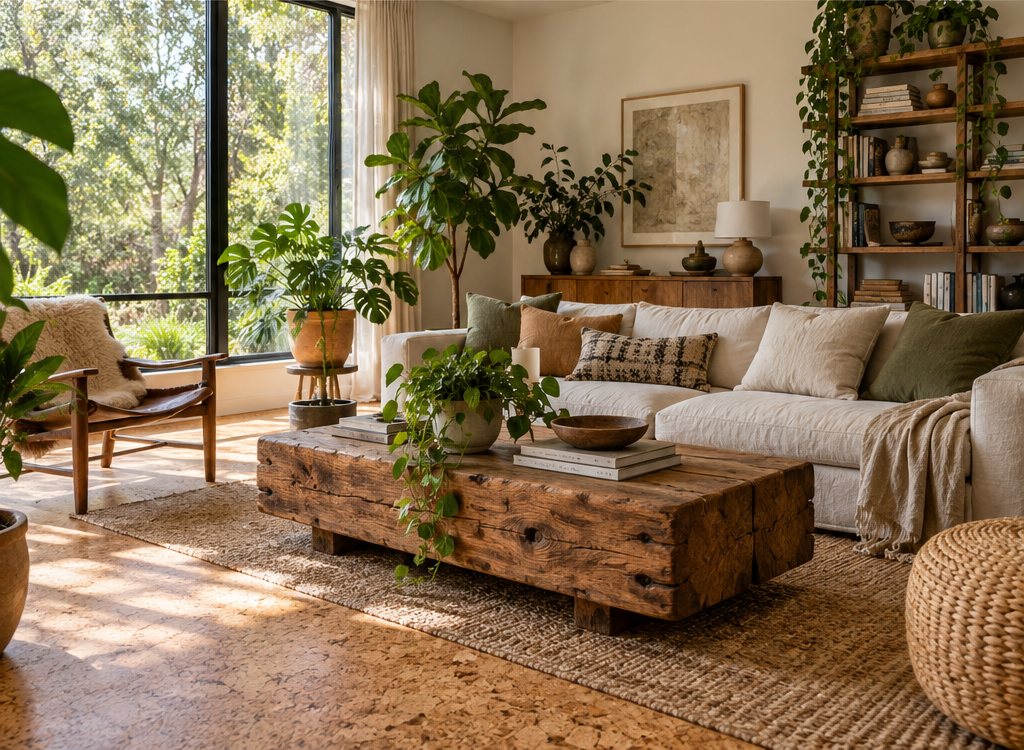
Key takeaways
- The most sustainable material is the one already in the house: keeping a kitchen carcass, a floor or a sofa frame saves more carbon than any new eco product
- Specify paints and finishes under 50 g/L VOC, boards with no added formaldehyde and textiles that are natural, undyed or certified low-impact
- Embodied carbon varies 10 to 1 across common finishes: solid timber and cork sit near 1–3 kg CO2e per m², vinyl and new stone at 10–30
- Durability is a sustainability spec: a 40,000 Martindale sofa fabric and a solid-timber frame outlast three cheap sofas
- Lighting at 2700K LED on dimmers, insulated curtains and a thermostat set 2°F (1°C) lower cut a home's operating energy faster than any material swap
Sustainable interior design is furnishing and finishing a home so that it uses fewer resources, lasts longer, harms health less and can be repaired or recycled at end of life. It rests on six principles: keep what exists, choose low-carbon renewable materials, cut indoor toxins (paint under 50 g/L VOC), design for durability, reduce energy use and plan for disassembly. Here are the materials, costs, certifications and a room-by-room plan.
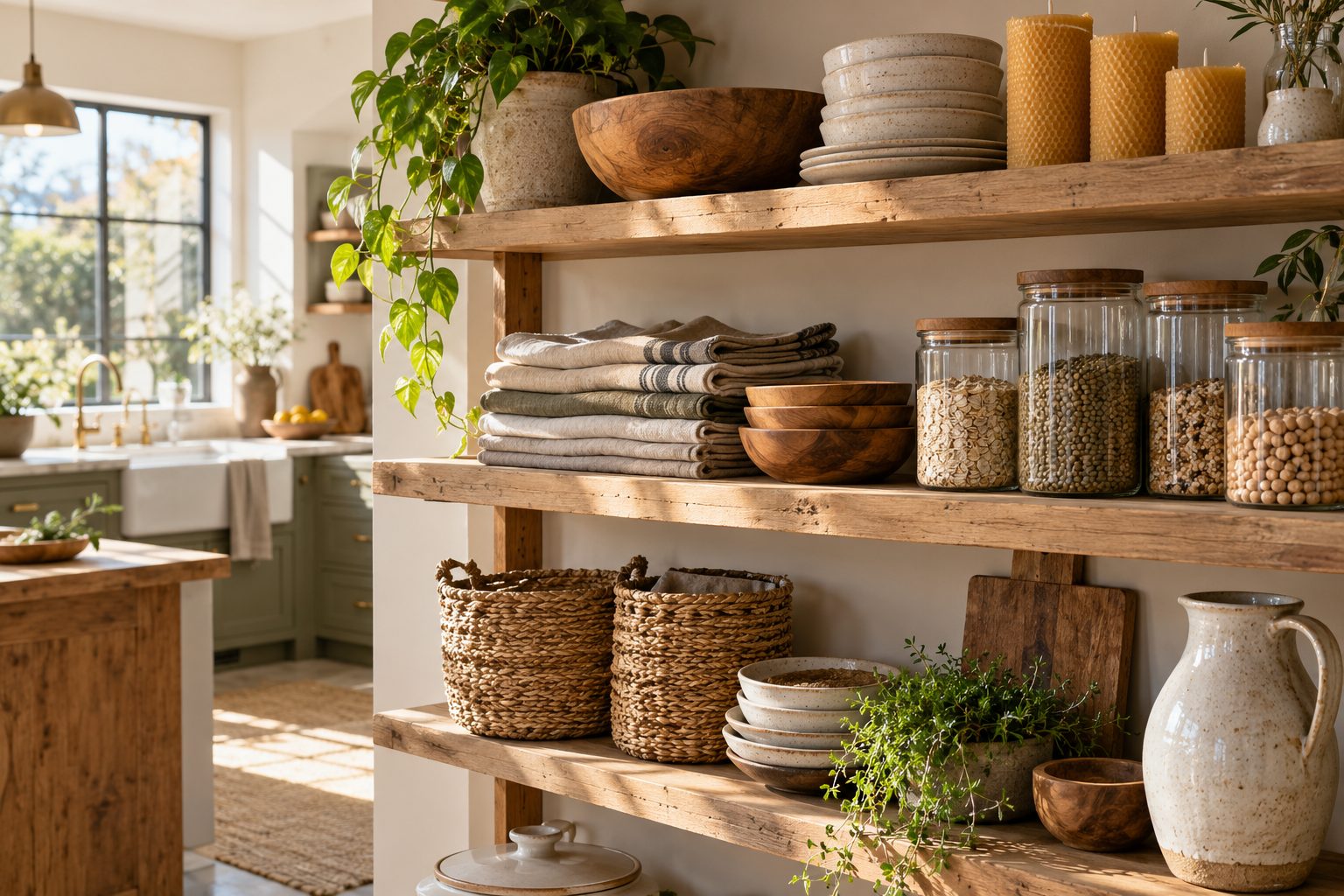
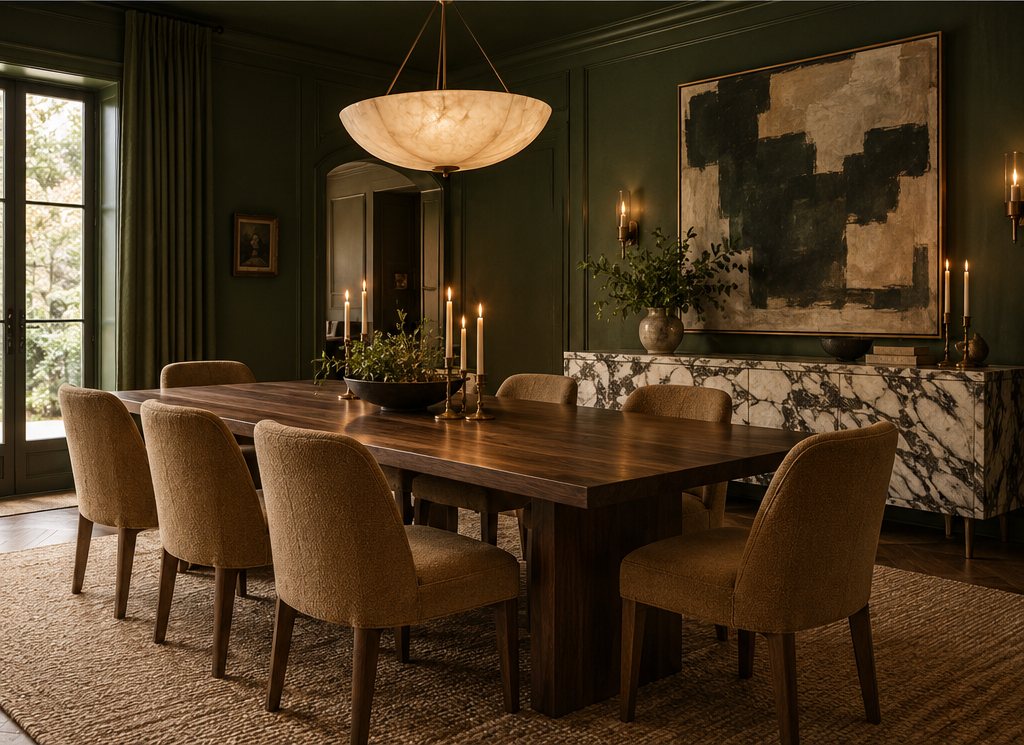
Green design in interior design has moved from a niche into the mainstream brief, partly because clients ask for it and partly because the materials that perform best on carbon and health, solid timber, lime plaster, wool, linen, cork and clay, are also the materials behind the warm, natural look that dominates interior design trends 2027. This article is the parent of our sustainable home goods buying guide, which covers the objects; here we cover the thinking, the surfaces and the systems.
- Biggest lever: reuse. Keeping a kitchen carcass saves 1,000–2,500 kg CO2e; keeping a timber floor saves 300–800 kg.
- VOC limit to specify: under 50 g/L for paint, under 100 g/L for floor finishes, zero added formaldehyde for board.
- Embodied carbon range: 1–3 kg CO2e per m² for cork and local timber flooring; 10–30 for vinyl, imported stone and new carpet.
- Durability targets: 30,000+ Martindale upholstery, solid or thick-veneer furniture, 25-year flooring, repairable joinery.
- Energy: LED at 2700K on dimmers uses 80–90 percent less than halogen; lined curtains cut window heat loss by 15–25 percent.
What is sustainable interior design?
Sustainable interior design is an approach that measures every decision about a room against four questions: what did it cost the planet to make, what does it do to the people living with it, how long will it last, and what happens to it afterward. It is wider than "eco friendly interior design" as the phrase is usually used, which tends to mean buying products labeled green. A sustainable interior may contain no new eco products at all, if the existing floor was sanded, the sofa reupholstered and the walls finished in lime.
The field borrows from three disciplines. From building science it takes embodied carbon (the greenhouse gas emitted in making and transporting a material) and operational energy (what the home uses to run). From health research it takes indoor air quality, measured through volatile organic compounds (VOCs), formaldehyde and particulate levels. From circular economy thinking it takes durability, repairability and end-of-life recovery. A genuinely environmentally friendly design scores well on all three, which is harder than scoring well on one.
What are the principles of green design in interior design?
There are six principles, and the order matters, because the first saves far more than the last.
- Keep what exists. Refinish rather than replace, reface rather than rip out, reupholster rather than rebuy. The carbon in an existing kitchen, floor or sofa is already spent; a new one adds its own.
- Choose low-carbon, renewable or recycled materials. Timber from certified forests, cork, bamboo, wool, linen, hemp, lime, clay, recycled glass and metal, and reclaimed anything.
- Cut toxins. Low- or zero-VOC paints and finishes, no-added-formaldehyde boards, natural or certified textiles, no stain-repellent or flame-retardant chemistry where it is not required by code.
- Design for durability and repair. Solid timber frames, replaceable covers, standard fittings, modular joinery, classic rather than fashionable forms.
- Reduce operational energy. LED lighting on dimmers, daylight planning, insulated window treatments, efficient appliances, heating zoned by room.
- Plan for end of life. Materials that separate (screws, not glue), mono-materials that recycle, biodegradable fibers, and a disassembly path for built-ins.
A useful check: if a product only addresses principle two, it is a green product, not a sustainable design. A bamboo floor glued down with a high-VOC adhesive over a perfectly good oak floor fails principles one, three and six.
Which materials are the most sustainable for interiors?
The most sustainable interior materials are those that are renewable or recycled, low in embodied carbon, non-toxic in use and durable: local certified timber, cork, lime and clay plasters, wool, linen, hemp, natural rubber, recycled glass and reclaimed stone and timber. The table below gives indicative embodied carbon per square meter for common floor and wall finishes, plus cost and lifespan, which together determine the true impact.
| Material | Embodied carbon (kg CO2e/m², indicative) | Installed cost per sq ft | Lifespan | Health notes |
|---|---|---|---|---|
| Reclaimed timber floor | 0.5–2 | $10–20 | 50+ years, refinishable | Finish with hardwax oil under 100 g/L VOC |
| Local certified solid oak | 2–5 | $12–22 | 50+ years | Same; avoid solvent-based lacquer |
| Cork floor or wall tile | 1–3 | $5–12 | 20–30 years | Naturally antimicrobial; check adhesive VOC |
| Linoleum (real, linseed-based) | 3–6 | $5–9 | 25–40 years | Biodegradable; not the same as vinyl |
| Bamboo (strand-woven) | 4–8 after shipping | $6–12 | 20–30 years | Check for no-added-formaldehyde binder |
| Wool carpet, natural backing | 8–15 | $8–18 | 15–25 years | No moth treatment chemistry if possible |
| Ceramic / porcelain tile | 10–18 | $8–20 | 50+ years | Inert; longevity offsets carbon |
| Local limestone or slate | 6–12 | $15–30 | 100+ years | Seal with water-based sealer |
| Imported polished marble | 15–30 | $20–50 | 100+ years | Transport dominates; buy regional |
| Luxury vinyl plank | 10–20 | $4–9 | 10–20 years | PVC; plasticizers off-gas; hard to recycle |
| Lime plaster wall | 2–4 | $8–15 | 50+ years | Breathable; absorbs CO2 as it cures |
| Clay plaster wall | 1–3 | $8–16 | 50+ years | Regulates humidity; zero VOC |
| Painted drywall, low-VOC | 3–6 | $2–4 | 10 years to repaint | Paint under 50 g/L VOC |
| Microcement | 6–10 | $12–25 | 20–30 years | Cement-based; check sealer VOC; see what microcement is |
Figures are indicative ranges from published life-cycle data for typical products and vary with the manufacturer, the distance shipped and the finish applied. The rule they illustrate is robust: natural, local, long-lived materials sit at the low end, and plastics, long-haul stone and short-lived products sit at the high end. For a design-led view of several of these surfaces, our trending materials guide covers travertine, rattan, bouclé and microcement, and travertine tile and terrazzo tile have notes on sourcing closer to home.
Furniture and textile materials
- Frames: kiln-dried hardwood or formaldehyde-free plywood; avoid particleboard, which fails at the joints within 5–10 years and cannot be repaired.
- Cushions: natural latex, feather and down, wool wrap or coconut coir in place of polyurethane foam where comfort allows; foam without added flame retardants where it is used.
- Upholstery: wool, linen, hemp, organic cotton or recycled polyester at 30,000+ Martindale; see the custom upholstery guide for how a sofa is built to last.
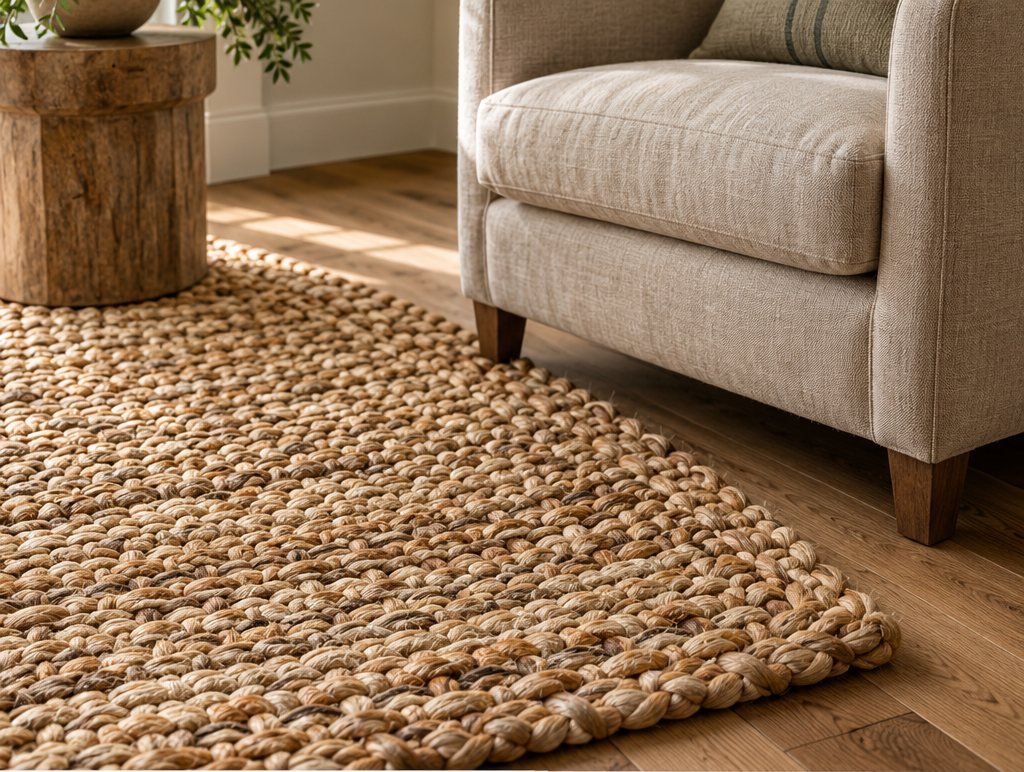
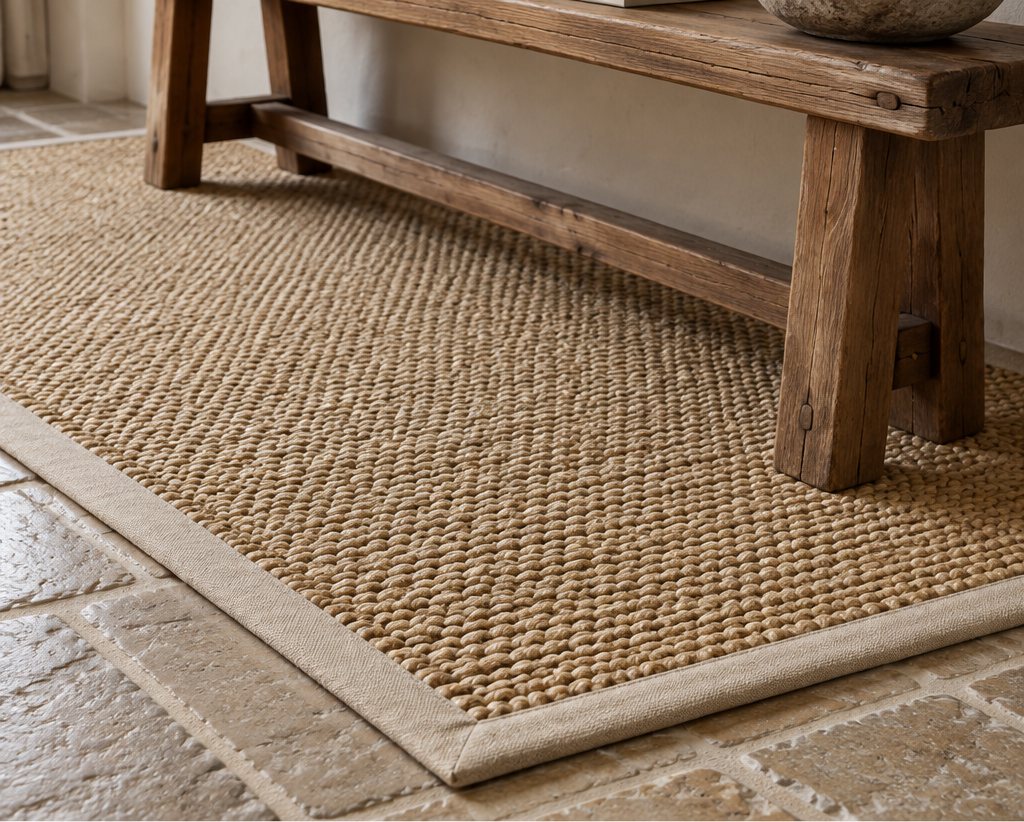
- Rugs: wool, jute, sisal and seagrass with natural latex or cotton backing; the wool rug guide and jute rug guide compare them.
- Window treatments: linen, hemp and wool; lined with cotton rather than polyester where blackout is not needed.
How do you reduce toxins and improve indoor air quality?
Reduce indoor toxins by specifying paints and finishes under 50 g/L VOC, boards with no added formaldehyde, textiles without stain-repellent or flame-retardant treatments where code allows, and by ventilating during and after installation. Indoor air in a newly finished room can hold two to five times the VOC concentration of outdoor air for weeks, mostly from paint, adhesives, composite board and new foam. The targets we specify:
| Product | Specify | Avoid | Why |
|---|---|---|---|
| Wall paint | Under 50 g/L VOC; mineral, lime or clay paints at near zero | Solvent-based, "odorless" oil paints | VOCs off-gas for 2–6 weeks |
| Floor finish | Hardwax oil or water-based polyurethane under 100 g/L | Solvent polyurethane, acid-cure lacquer | Highest-emitting finish category |
| Composite board | No added formaldehyde (NAF) or ultra-low-emitting (ULEF) MDF and plywood | Standard urea-formaldehyde MDF | Formaldehyde emission continues for years |
| Adhesives | Water-based, under 50 g/L; mechanical fixing where possible | Contact and solvent adhesives | Also prevents disassembly |
| Upholstery foam | Natural latex, or foam certified free of added flame retardants | Treated foam where code does not require it | Flame-retardant dust accumulates indoors |
| Textiles | Natural fibers, undyed or low-impact dyed, no stain-repellent finish | Fluorinated stain treatments | Persistent chemistry; wool resists stains naturally |
Beyond specification, ventilate new rooms for 48–72 hours with windows open and a fan running, let new furniture air in a garage or open room for a week, and use plants and a mechanical ventilation rate of at least 0.35 air changes per hour in living spaces. The biophilic design guide covers the air, light and plant side of a healthy home in more detail.
Is eco friendly interior design more expensive?
Eco friendly interior design costs about the same as conventional design over a ten-year horizon, and often less, because the main principle, reuse, costs nothing, and the durable materials it favors are bought once. Where it costs more is at the point of purchase for certain products: low-VOC paint runs 10–30 percent above standard, a solid-timber sofa frame 20–50 percent above a particleboard one, and lime plaster three to four times the cost of painted drywall. Where it costs less: refinishing a floor at $3–5 per sq ft instead of replacing at $12–20, refacing a kitchen at $5,000–12,000 instead of $30,000+, and reupholstering a good sofa at $1,500–3,500 instead of buying a comparable new one at $4,000–8,000.
The budget split we recommend for a sustainable renovation of a 1,500 sq ft (140 m²) home puts 10–15 percent into assessing and repairing what exists before any new purchase, 20–25 percent into the envelope (insulation, window treatments, draft-proofing), 20 percent into floors and walls, 15 percent into lighting and energy, and the balance into furniture bought for a 20-year life. That is roughly the same total as a conventional mid-range renovation at $60–120 per sq ft; the money simply moves from replacement toward repair and longevity.
Which certifications and labels actually mean something?
Certifications worth looking for are the ones run by independent third parties with published standards: forest certification for timber, organic and low-impact textile standards, indoor-emission labels for paints, finishes and furniture, and recognized product-level carbon declarations. The words "eco", "green" and "natural" on a label are unregulated and mean nothing by themselves. What to ask for:
- Timber: a chain-of-custody forest certificate for the specific product, or documented reclaimed origin.
- Textiles: an organic fiber standard covering the fiber and the dyeing, or a recognized low-chemical textile label; for wool, a responsible-farming standard.
- Paints, finishes and furniture: a third-party indoor-emission label that tests the finished product, with the VOC figure printed in g/L.
- Board and panels: no-added-formaldehyde or ultra-low-emitting formaldehyde certification to the relevant national standard.
- Carbon: an environmental product declaration (EPD), which gives embodied carbon per unit from a third-party-verified life-cycle assessment.
- Fair labor: a published supplier code and factory audit for anything made overseas; the furniture sourcing guide explains what an audit covers.
How do you reduce a home's energy use through interior design?
Interior design cuts operational energy through lighting, window treatments, surface color and layout: LED lighting at 2700K on dimmers uses 80–90 percent less electricity than halogen, lined and interlined curtains cut heat loss through single-glazed windows by 15–25 percent, and pale ceilings and walls at an LRV above 70 let you light a room at a third of the lumens. The specifics:
- Lighting: LED throughout, warm 2700K, CRI 90+, three circuits on dimmers so the room runs at 30–50 percent output most of the evening. Our lighting layering guide and the lighting calculator size this without over-lighting; lighting trends 2027 covers warm-dim LEDs.
- Daylight: keep furniture low under windows, use mirrors opposite them and choose sheer linen for privacy instead of blinds that stay closed all day.
- Windows: lined curtains to the floor, closed at dusk in winter; cellular blinds inside the reveal; the curtain size guide gives the fullness that seals the window.
- Floors and rugs: a wool rug with a felt pad over a solid floor adds measurable insulation and comfort, letting the thermostat drop 1–2°F (0.5–1°C).
- Heating zones: arrange seating in the warmest, best-lit part of the room, and zone heating so unused rooms run cooler.
- Appliances and water: in kitchens and baths, specify induction, low-flow taps at 1.2–1.5 gpm (4.5–5.7 L/min) and a dishwasher under 42 dB that also uses less water per cycle.
How do you apply sustainable design room by room?
Apply the six principles in each room in order: audit what can stay, fix the envelope and the air, then choose finishes, then furniture, then objects. Here is where the biggest gains are in each room.
Living room
Reupholster the sofa if the frame is hardwood; if not, buy one with a solid frame, feather or latex cushions and removable wool or linen covers at 30,000+ Martindale. Lay a wool or jute rug with a felt pad. Paint in a low-VOC mineral or lime paint; limewash gives a textured, breathable wall at $3–6 per sq ft. Light with LED lamps on dimmers. Our warm minimalism guide and wabi-sabi interiors describe the restrained aesthetic that pairs naturally with this approach.
Kitchen
Keep the carcasses if they are sound and reface the doors in solid timber or NAF plywood; replace the worktop with local stone, solid timber or recycled-glass terrazzo (what terrazzo is covers the recycled-aggregate versions). Specify induction, a quiet dishwasher and low-flow taps. Choose solid brass hardware that can be refinished; see brass cabinet hardware.
Bedroom
A solid-timber bed, a natural latex or wool-and-cotton mattress without flame-retardant foam, linen or organic cotton bedding, and wool blankets. Blackout from lined curtains rather than plastic blinds. Paint in a zero-VOC clay or mineral paint; bedrooms are where you spend eight hours breathing the finish. Bedroom trends 2027 shows how calm, natural bedrooms are being styled.
Bathroom
Porcelain or local stone tile with a lifespan of 50+ years, a water-based sealer, a teak or solid-wood vanity rather than veneered MDF (wood bathroom vanities explains what to look for), low-flow fixtures and an extractor that actually vents outside to control moisture and mold.
Home office
A solid-wood desk that will outlast three laminate ones (see solid wood desks), a chair with replaceable parts, a daylight-first layout and a task lamp at 2700–3000K so overhead lighting can stay off.
What does circular design mean for furniture and joinery?
Circular design means specifying furniture and built-ins so that every component can be repaired, replaced, reused or recycled rather than sent to landfill, which in practice means solid or thick-veneer timber, mechanical fixings instead of glue, standard sizes, replaceable covers and finishes that can be renewed. Furniture is the largest category of household waste by volume in most developed countries, and most of it fails at a joint, a cover or a foam cushion that could have been designed to be replaced.
Design rules for circular joinery and furniture:
- Screw, don't glue: carcasses on cam fittings or screws can be taken apart and moved; glued units cannot.
- Mono-materials where possible: an all-timber chair recycles; a timber-steel-plastic-foam chair does not.
- Standard dimensions: 24 in (60 cm) kitchen modules, standard mattress sizes, standard drawer runners, so parts are available in 20 years.
- Replaceable wear parts: zip-off covers, loose seat cushions, drop-in drawer boxes, oiled rather than lacquered tops that re-oil in an afternoon.
- Classic form over fashion: a plain oak table is still wanted in 30 years; a highly styled one is not. Mid-century modern pieces are the proof: 70-year-old furniture still trades at full value because it was built to be repaired.
How do you start a sustainable interior design project?
Start with an audit of what you already have, then fix air and energy, then make the material choices, in that order; most of the impact is decided in the first two steps before a single product is chosen.
- Audit the house. List every floor, wall finish, built-in and major piece of furniture, and mark each as keep, repair, reface or replace. Aim to keep or repair at least half.
- Fix air and envelope first. Draft-proof, add lined curtains, improve extraction in kitchen and bath, and ventilate.
- Set the specification standards in writing: VOC limits, NAF board, Martindale minimums, timber certification, no fluorinated or flame-retardant treatments where code allows.
- Choose a tight material palette of five to seven materials for the whole house, local where possible, and use them in every room; it reduces waste and makes the home read as calm. See whole-house color schemes for how the palette carries through.
- Buy the long-life pieces first (sofa frame, bed, dining table, kitchen fronts) to the durability specs above, and secondhand or reclaimed wherever the quality is there.
- Light with LED on dimmers, three circuits per room, sized with the lighting calculator.
- Finish with objects chosen by the rules in sustainable home goods: natural, repairable, fairly made, and fewer than you planned.
- Keep the records. Paint codes, fabric sources, timber certificates and the disassembly logic of any built-in, so the next owner, or you in ten years, can repair rather than replace.
In this guide
Frequently asked questions
What is sustainable interior design?
Sustainable interior design is furnishing and finishing a home so that it uses fewer resources, lasts longer, harms health less and can be repaired or recycled at end of life. It follows six principles: keep what exists, choose low-carbon renewable materials, cut toxins such as VOCs and formaldehyde, design for durability, reduce energy use and plan for disassembly.
What are the principles of green design in interior design?
Reuse before replacement; low-carbon, renewable or recycled materials; low-toxin specification (paint under 50 g/L VOC, no-added-formaldehyde board, untreated natural textiles); durability and repairability; reduced operational energy through LED lighting, daylight and insulated window treatments; and end-of-life planning with mechanical fixings and recyclable mono-materials.
What are the most eco friendly materials for interior design?
Reclaimed and locally certified timber, cork, lime and clay plaster, real linoleum, wool, linen, hemp, natural latex, recycled glass and regional stone. These sit at roughly 1–6 kg CO2e per m² of embodied carbon, compared with 10–30 for vinyl, imported polished marble and new synthetic carpet, and most of them are also non-toxic in use and long-lived.
Is eco friendly interior design expensive?
Over ten years it costs about the same as conventional design or less. Reuse costs nothing, refinishing a floor runs $3–5 per sq ft against $12–20 to replace, and refacing a kitchen costs $5,000–12,000 against $30,000+. Some products cost more up front: low-VOC paint by 10–30 percent, solid-frame sofas by 20–50 percent and lime plaster at three to four times painted drywall.
How do you make a home environmentally friendly without renovating?
Switch all bulbs to 2700K LED on dimmers, hang lined curtains to the floor and close them at dusk, lay a wool rug with a felt pad, reupholster or recover the sofa, repaint one room at a time in zero-VOC mineral paint, buy secondhand solid-wood case pieces, and ventilate daily. Each of these cuts energy, carbon or indoor pollutants without touching the building.
What VOC level is safe for interior paint?
Specify paint under 50 g/L VOC, and prefer mineral, lime or clay paints that sit near zero. Floor finishes should be under 100 g/L, using hardwax oil or water-based polyurethane. Ventilate for 48–72 hours after painting; standard paints can keep indoor VOC levels two to five times outdoor levels for several weeks.
Which certifications matter for sustainable furniture and materials?
Look for third-party labels with published standards: chain-of-custody forest certification for timber, an organic or low-chemical textile standard covering fiber and dyeing, an indoor-emission label with the VOC figure in g/L for paints, finishes and furniture, no-added-formaldehyde certification for board, and an environmental product declaration (EPD) for embodied carbon. Unregulated words like eco or green mean nothing on their own.
What is circular design in interiors?
Circular design specifies furniture and built-ins so every part can be repaired, replaced, reused or recycled: solid or thick-veneer timber, screws and cam fittings instead of glue, standard module and mattress sizes, zip-off covers and loose cushions, oiled finishes that can be renewed, and plain classic forms that stay wanted. It is the opposite of glued particleboard furniture that fails at a joint in five years.
Some links may be affiliate links. Regulations and specifications change — always confirm with suppliers and qualified professionals.