Two Tone Kitchen Cabinets: Color Combinations That Work in 2027
Two tone kitchen cabinets work best with darker lower cabinets and lighter uppers, a 30–50 point gap in LRV, and one shared undertone. Here are 6 tested combinations with hardware and countertops.
Part of our guide: Interior House Paint Ideas: Color Schemes & Room Paint Design
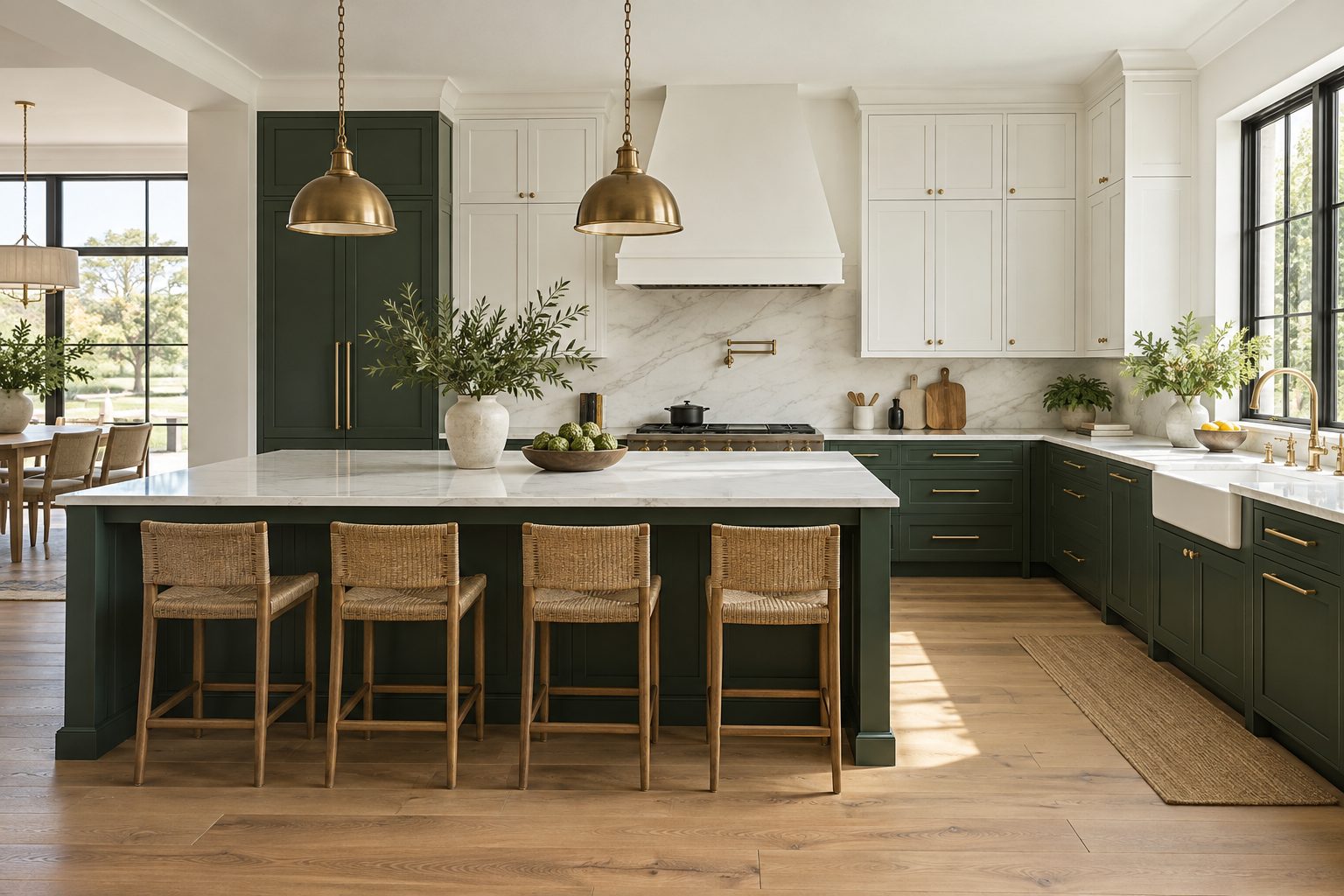
Key takeaways
- Two tone kitchen cabinets are still in style for 2027, but the look has shifted from stark navy-and-white to tonal, earthy pairs and wood with paint
- Put the darker color on the lower cabinets or island and the lighter color on the uppers, so the room stays grounded and bright
- Aim for a 30–50 point LRV gap between the two colors and keep both on the same warm or cool undertone
- Use one metal for all hardware and let the countertop bridge the two cabinet colors
Two tone kitchen cabinets look best when the darker color goes on the lower cabinets or island and the lighter color on the uppers, with a 30–50 point gap in light reflectance value and the same undertone in both. The pairings that work in 2027 are tonal and earthy, such as olive with warm white or walnut with cream, rather than the stark navy-and-white of the last decade.
Splitting a kitchen into two colors is one of the cheapest ways to change the room: repainting only the base cabinets or the island costs a fraction of new doors and immediately changes the proportions. It is also easy to get wrong, with colors that fight or a split that chops the room in half. This guide is part of our interior painting ideas series and covers where each color goes, which combinations hold up, and how to pair hardware, countertops and wood.
- Rule of placement: darker below, lighter above; or one color on the perimeter and a second on the island.
- Contrast range: a 30–50 point LRV gap reads as intentional; under 20 looks like a mismatch, over 60 looks harsh.
- Cost to repaint: $3,000–8,000 for professional spraying of 20–30 doors and drawer fronts in a typical kitchen.
- Finish: satin or semi-gloss enamel, or a factory-applied lacquer; never flat paint on cabinets.
- Hardware: one metal finish across both colors, usually aged brass, bronze or matte black.
Are two tone kitchen cabinets still in style?
Yes, two tone kitchen cabinets are still in style, but the 2027 version is softer: tonal color pairs and paint-plus-wood have replaced the high-contrast navy-and-white look. The two tone kitchen became popular because it lets a large run of cabinetry feel lighter and gives an island a furniture-like presence. Those reasons have not changed. What has changed is the palette.
The combinations that now look dated are bright white uppers over glossy navy or charcoal lowers, and gray uppers over black. In our kitchen trends 2027 forecast, the direction is warm and natural: earthy greens, clay, mushroom and taupe paired with cream, and painted perimeter cabinets set against a wood island or wood uppers. Two tone white and wood kitchen cabinets, in particular, have become a long-running classic rather than a trend.
Which cabinets should be darker, upper or lower?
Lower cabinets should be darker in almost every kitchen, because a dark base grounds the room, hides scuffs and keeps light colors at eye level where they reflect daylight. This mirrors how we treat a room generally: darker floor, mid-tone walls, lighter ceiling. Dark uppers over light lowers feel top-heavy and make the ceiling seem lower, particularly under 8 ft (2.4 m).
There are two useful exceptions when deciding on upper and lower cabinet colors:
- Tall ceilings: with 10 ft (3 m) or higher ceilings and cabinets run to the top, darker uppers can look dramatic and deliberate, especially in a library-style kitchen.
- Wood uppers or open shelving: mid-tone wood uppers over painted lowers in a deeper color works, because wood reads as texture rather than a block of color.
Tall pantry and oven cabinets usually take the lower color when they stand alone, so they read as a solid, grounded block, and the upper color when they sit within a run of wall cabinets.
What color combinations work for two tone cabinets?
The two color kitchen cabinets that work best share an undertone and differ clearly in depth: a warm mid-dark color paired with a warm white, or a wood tone with a cream or green paint. These six combinations are ones we have specified and seen in finished kitchens under real lighting.
#5C6B4E#F2ECE0#8A5A3C#E8DFCC#2F3A40#A89A86| Combination | Uppers | Lowers | Island | Hardware | Countertop |
|---|---|---|---|---|---|
| Olive and warm white | Warm white, LRV 80–85 | Olive green, LRV 15–20 | Olive or white oak | Aged brass | Honed white marble or cream quartz |
| Walnut and cream | Cream paint, LRV 75–80 | Walnut or dark oak stain | Walnut | Unlacquered brass or bronze | Warm white quartz, soapstone |
| Ink blue and oat | Oat or stone, LRV 65–72 | Oat | Ink blue, LRV 6–10 | Polished nickel | Gray-veined quartzite |
| Mushroom and white oak | Natural white oak | Mushroom taupe, LRV 35–40 | Mushroom | Matte black or bronze | Limestone-look porcelain |
| Clay and cream | Cream, LRV 75–80 | Terracotta clay, LRV 20–25 | Clay | Aged brass | Travertine or warm quartz |
| Charcoal and natural wood | Rift oak or open shelves | Soft charcoal, LRV 8–12 | Charcoal | Brushed stainless | Concrete-look or white quartz |
To test two tone kitchen cabinets ideas properly, paint two 24 × 36 in (61 × 91 cm) boards, one in each color, and stand them side by side at their real positions for three days. Look at them in the morning, at dusk and under your kitchen lighting at night. Check the boards against the countertop sample and a hardware sample at the same time; a combination that looks right on a phone screen can turn green or gray once it sits next to real stone.
Should the island be a different color?
An island in a different color is the safest form of two-tone kitchen, because it isolates the contrast in one freestanding piece and lets the perimeter stay calm. It works best when the island is at least 6 ft (183 cm) long and has 42–48 in (107–122 cm) of clearance around it, so it reads as a piece of furniture rather than an extension of the run.
Three ways to handle a two tone kitchen island:
- Dark island, light perimeter: the classic approach; it anchors an open-plan room and hides wear at knee level.
- Wood island, painted perimeter: the warmest version, and the one we recommend most often for open kitchens that face a living area.
- Match the island to the lowers: in a three-color risk scenario, keep island and base cabinets the same and change only the uppers, which avoids a third tone.
Avoid three different cabinet colors in one kitchen. Different color kitchen cabinets on uppers, lowers and island almost always look accidental unless one of them is natural wood.
How do you pair hardware, countertops and wood with two-tone cabinets?
Use one hardware finish throughout and choose a countertop that contains, or sits between, both cabinet colors, so the two tones connect rather than compete. Hardware that changes finish between upper and lower cabinets is the quickest way to make two toned kitchen cabinets look unplanned.
- Hardware: aged or unlacquered brass suits greens, clays and wood; polished nickel suits blues and grays; matte black suits taupe and oak. Our brass cabinet hardware guide covers sizing: pulls roughly one third of the drawer width, 5–8 in (13–20 cm) on standard drawers.
- Countertop: a veined stone or quartz that picks up both colors, or a neutral that matches the lighter one. A busy granite against two cabinet colors is one pattern too many.
- Wood tones: if the island or uppers are wood, keep the floor at least two shades different, or match it exactly. Our guide on how to mix wood tones explains the undertone rule.
- Backsplash: pull it from the lighter cabinet color or the countertop, not the darker cabinet; see our kitchen backsplash ideas.
What paint finish and sheen should cabinets use?
Whatever kitchen cabinet paint colors you choose, cabinets need a hard, washable enamel in satin or semi-gloss, or a factory catalyzed lacquer, because flat and eggshell finishes burnish and stain under daily handling. The same sheen should be used on both colors; mixing satin uppers with gloss lowers draws attention to the split for the wrong reason.
| Finish | Durability | Look | Typical cost |
|---|---|---|---|
| Water-based alkyd enamel, satin | Good; cures hard in 2–4 weeks | Soft sheen, hides brush marks | $3,000–6,000 professionally sprayed |
| Semi-gloss enamel | Very good; easiest to wipe | Brighter, shows surface flaws | $3,000–6,000 |
| Catalyzed lacquer or 2K polyurethane | Excellent; factory or spray booth | Smooth, furniture-grade | $5,000–8,000 or included with new fronts |
| Stain and clear coat (wood) | Excellent; touch-up friendly | Shows grain | $4,000–9,000 refinish |
How do you do two tone white and wood kitchen cabinets?
Two tone white and wood kitchen cabinets work when the white is warm enough to sit beside the timber and the wood is used in one clear block, either all the lowers, all the uppers or the island. Scattering wood across random doors, a tall unit here and a drawer bank there, breaks the kitchen into patches and is the most common failure of this scheme.
Match the white to the wood's undertone. Oak and walnut lean yellow-red, so they want a creamy white with an LRV of 78–84; a cool, blue-white makes oak look orange and walnut look muddy. Ash and maple are paler and cooler and can take a cleaner white. The wood itself should be rift-sawn or quarter-sawn for a modern kitchen, because the straight, tight grain reads calmer than the cathedral pattern of flat-sawn veneer, and it should have a matte or satin clear finish rather than gloss.
- Wood lowers, white uppers: the warmest and most forgiving version, especially over a pale floor.
- White perimeter, wood island: the best choice for open-plan kitchens, because the island reads as furniture from the living area.
- Wood uppers or shelves, white lowers: works with ceilings of 9 ft (2.7 m) or more and keeps the work zone bright.
Keep one more wood in the room at most, usually the floor, and make it clearly lighter or darker than the cabinets.
How to plan a two-tone kitchen step by step
Plan a two-tone kitchen by fixing the fixed elements first, floor, countertop and backsplash, and only then choosing the two cabinet colors that sit between them.
- List the fixed finishes: floor, countertop, backsplash and any wood you are keeping. Note whether each is warm or cool.
- Decide the split: uppers and lowers, perimeter and island, or paint and wood. Pick one; do not combine them.
- Choose the darker color first: it carries more visual weight. Check its LRV, ideally 8–25 for a true contrast.
- Choose the lighter color to match its undertone: a warm white with olive or clay, a cleaner white with ink blue.
- Test at full size: paint large boards and view them for several days under your real lighting.
- Pick one hardware finish: order one sample pull and hold it against both colors.
- Specify sheen and process: degrease, sand, prime with a bonding primer, then two topcoats sprayed.
Our verdict on two tone kitchen cabinets
Our favorite 2 tone kitchen cabinets scheme for 2027 is a deep olive or clay on the lowers with a warm white above and a white oak island, finished with aged brass. It is warm, it hides daily wear, and it will not date as quickly as the blue-and-white kitchens of the 2010s. If you are nervous about color, start with the island alone: it is one piece, one weekend, and it tells you whether you want to go further.
The other lesson from finished projects is that color is only half of the result; the split line is the other half. Make sure the change of color happens at a natural break, such as a counter edge, an appliance or the end of a run, and never halfway along a single wall of uppers. Treat tall units consistently, and paint cabinet sides, toe kicks and scribe panels in the same color as the doors next to them so no raw edge shows.
Planning new fronts rather than repainting? Send us your door count and colors through our furniture sourcing desk for factory quotes on painted and wood cabinet doors.
Free toolPaint CalculatorWork out exactly how much paint to buy.Shop & source the look
Buy it today — or have it made
Retail links are affiliate links: we may earn a commission at no extra cost to you (disclosure). “Get it made” sends the item to our sourcing desk for factory quotes in custom sizes and finishes.
Frequently asked questions
Are two tone kitchen cabinets still in style?
Yes, two tone kitchen cabinets remain in style for 2027, but the look has softened. Earthy, tonal pairs such as olive with warm white, clay with cream and painted perimeters with a wood island have replaced the high-contrast navy-and-white and gray-and-black schemes that now date a kitchen to the 2010s.
Which cabinets should be darker, upper or lower?
The lower cabinets should usually be darker. A dark base grounds the room, hides scuffs and keeps light colors at eye level, which makes the kitchen feel brighter and taller. Darker uppers only work with ceilings of about 10 ft or higher, or when the uppers are wood rather than paint.
What color combinations work for two tone cabinets?
Combinations that share an undertone and differ clearly in depth work best: olive and warm white, walnut and cream, ink blue and oat, mushroom and white oak, clay and cream, or charcoal and natural wood. Aim for a 30–50 point gap in LRV and use one hardware finish across both colors.
Should the island be a different color?
A different-color island is the easiest way to do a two-tone kitchen, because the contrast is contained in one freestanding piece. Choose a darker paint or a natural wood for the island, keep the perimeter lighter, and avoid adding a third cabinet color unless one of the three is wood.
Some links may be affiliate links. Regulations and specifications change — always confirm with suppliers and qualified professionals.