Living Room Storage Ideas: Benches, Built-Ins and Small-Space Fixes
The best living room storage ideas hide clutter in pieces you already need: a 16–20 in deep storage bench, a closed media wall and shallow built-ins. Here are 14 ideas with sizes, clearances and typical costs.
Part of our guide: Small Living Room Decorating Ideas: Space Planning That Works
Key takeaways
- Closed storage beats open shelving in a living room: aim for roughly two-thirds doors and drawers, one-third display
- A storage bench is the hardest-working piece in a small room, giving seating and 3–6 cu ft of hidden space in 16–20 in of depth
- Shallow is the secret: 8–12 in deep shelving holds books and media without stealing floor space
- Plan storage after the walkways: keep 30–36 in clear in front of every cabinet, bench and drawer
The living room storage ideas that work best are the ones that double as furniture: a storage bench under a window, a closed media wall around the TV, shallow 8–12 in (20–30 cm) built-in shelving and ottomans with lift-up lids. Put roughly two-thirds of your storage behind doors or lids and one-third on display, and the room reads tidy even when it is full.
- Bench depth: 16–20 in (41–51 cm), seat height 17–19 in (43–48 cm) including the cushion.
- Bookshelf depth: 10–12 in (25–30 cm) for paperbacks and most hardcovers.
- Media cabinet depth: 16–20 in (41–51 cm) for streaming boxes, consoles and a soundbar.
- Clearance: 30–36 in (76–91 cm) in front of any drawer, door or lid.
- Prices: all figures are typical US ranges for 2026.
Storage is the part of a living room most people add last and regret first. This guide sits under our small living room ideas pillar, which covers layout and scale; here we focus only on where the stuff goes. Living room storage is a planning problem before it is a shopping problem, so start with an honest inventory: games, cables, blankets, books, toys, paperwork and whatever arrives through the front door.
What are the best living room storage ideas?
The best living room storage ideas combine seating with storage, close off the media zone and use shallow wall depth that ordinary furniture wastes. The table ranks the pieces we specify most often by how much they hold for the floor space they take.
| Storage piece | Typical size | Approx. capacity | Typical price (US 2026) |
|---|---|---|---|
| Storage bench, lift-up lid | 36–60 in W × 16–20 in D (91–152 × 41–51 cm) | 3–6 cu ft (85–170 L) | $150–900 |
| Storage ottoman | 24–36 in square (61–91 cm) | 2–5 cu ft (57–142 L) | $100–600 |
| Closed media console | 60–84 in W × 16–20 in D (152–213 × 41–51 cm) | 8–16 cu ft (225–455 L) | $300–2,500 |
| Built-in wall unit, floor to ceiling | Per linear ft, 12–24 in D (30–61 cm) | 10–15 cu ft per linear ft | $500–1,500 per linear ft installed |
| Floating shelves | 8–12 in D (20–30 cm) | 15–30 lb per ft on studs | $40–250 per shelf |
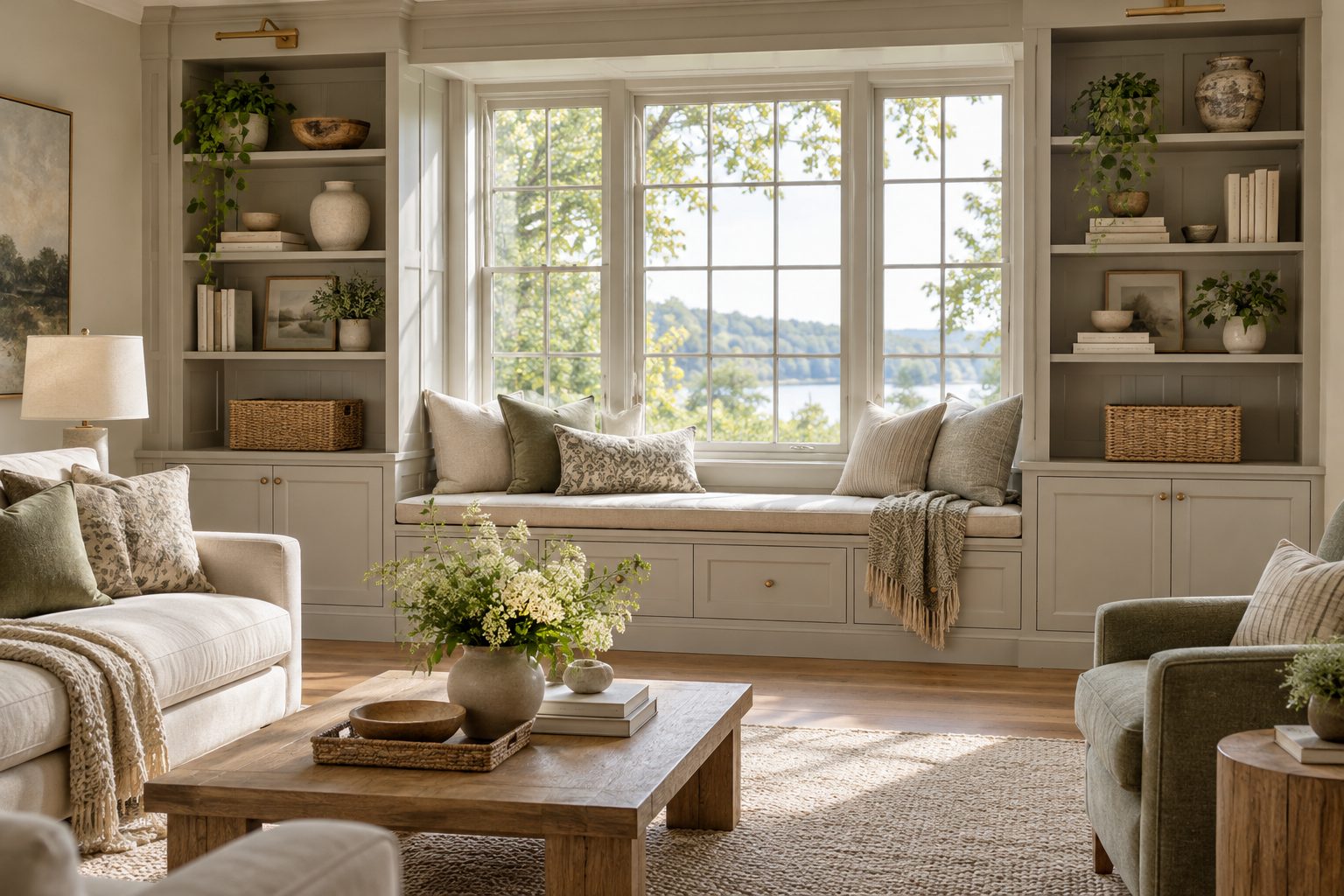
| Window seat with drawers | 48–96 in W × 18–24 in D (122–244 × 46–61 cm) | 6–14 cu ft | $1,200–5,000 built |
| Cube shelving with baskets | 13 in cubes (33 cm), 2 × 4 or 4 × 4 | 8–16 baskets | $80–400 |
Capacity figures are approximate internal volumes; real usable space drops by 20–30 percent once you allow for lids, frames and the awkward corners nobody fills.
Why is a storage bench the most useful living room bench?
A storage bench is the most useful living room bench because it adds seating, a landing spot and 3–6 cu ft of hidden storage in less than 2 ft of depth. Storage and benches are among the most searched furniture pairings for exactly that reason: no other piece does three jobs this cheaply.
Choosing a bench seat with storage
For a bench seat with storage you will actually sit on, keep the seat height at 17–19 in (43–48 cm) including the cushion, the same as a dining chair. A cushioned bench storage piece should have a lid on soft-close or gas-stay hinges so it never slams on fingers, and a cushion of at least 2–3 in (5–8 cm) high-resilience foam. Drawers beat lids if the bench will hold things you use daily, because nobody wants to move three throw pillows to reach a remote.
Where to put a living room bench seat
- Under a window: the classic sitting room bench; leave 2–4 in (5–10 cm) below the sill so curtains still hang.
- Behind a floating sofa: a 12–14 in (30–36 cm) deep bench or console doubles as a back-of-sofa shelf.
- Opposite the sofa, instead of chairs: a 60 in (152 cm) bench seats two guests and tucks under a console when not needed.
- Beside the entry: in apartments without a hall, the living room bench becomes the shoe and bag drop.
Indoor benches furniture ranges from solid oak slab benches to fully upholstered pieces. For a living room, upholstered or cushioned versions are more comfortable for longer sitting; bare wood suits an entry zone. Fabric should be rated at 20,000+ Martindale (or 15,000+ Wyzenbeek double rubs) because benches get sat on, kicked and used as footrests. If you want the bench built in, use the same seat depths and back angles as a kitchen banquette: 18–20 in (46–51 cm) deep with a 10–15 degree back rake.
How do you add storage to a living room without built-ins?
You add storage without built-ins by choosing freestanding pieces that hide things: closed consoles, lidded ottomans, a tall cabinet and wall-hung shelves on rails. Renters and anyone not ready to spend on joinery can get 80 percent of the effect this way.
- Swap the coffee table for a storage version. A lift-top or drawer coffee table at 16–18 in (41–46 cm) high holds remotes, chargers and magazines.
- Close the media zone. Replace an open TV stand with a console with doors; open shelves under a TV are the single biggest source of visual clutter we see.
- Add one tall cabinet. A 30–36 in (76–91 cm) wide, 72–84 in (183–213 cm) tall cabinet in a corner holds more than three low pieces.
- Use the end tables. Side tables with a drawer or a closed cube cost little more than open ones.
- Go vertical with rails. Wall-mounted shelf rails take shelves at any height and leave only screw holes when you move.
- Baskets last. Use lidded baskets to tidy what is left, not as the main system.
What are the best storage ideas for small spaces?
The best storage ideas for small spaces are shallow, tall and multi-purpose: furniture that folds, lifts or nests, and shelving that uses wall height instead of floor area. In a small room every inch of depth costs walkway, so storage for small spaces should be measured in depth first and width second.
Space saving furniture worth buying includes nesting side tables, a drop-leaf or wall-mounted desk, a sofa with drawers in the base, and an ottoman that opens. Clever furniture for small spaces is usually simple furniture with one extra function, not a transformer piece with ten hinges; the fewer moving parts, the longer it lasts. Our small apartment furnishing ideas guide covers sofa and table sizes for rooms under 150 sq ft (14 m²).
Small apartment storage ideas that earn their space
- Over-door and above-door shelves: a 10 in (25 cm) deep shelf 12 in (30 cm) above a doorway holds books you rarely need.
- Bed-height thinking in the living room: sofas with 6–8 in (15–20 cm) of clearance underneath take flat storage boxes.
- Mirrored cabinet fronts: a mirrored wall cabinet adds storage and bounces light in a dark small flat.
- Ceiling-height shelving: run shelves to within 12 in (30 cm) of the ceiling and keep the top row for seasonal items.
The same rules apply to small flat storage ideas in older buildings, where alcoves beside chimney breasts are often 12–16 in (30–41 cm) deep: perfect for a cupboard below and shelves above. For open-plan studios, our studio apartment ideas guide shows how a bookcase can also divide sleeping and living zones.
What are good narrow space storage ideas?
Good narrow space storage ideas use pieces 6–12 in (15–30 cm) deep: picture ledges, slim cabinets, recessed niches and shelves built between studs. A hallway-width strip beside a sofa or behind a door is usually wasted, and a shallow piece turns it into the most useful storage in the room.
- Between-stud niches: standard 2 × 4 walls give about 3.5 in (9 cm) of recess depth between studs at 16 in (41 cm) centers, enough for paperbacks, candles, chargers and remotes.
- Slim console behind the sofa: 10–12 in (25–30 cm) deep, the same height as the sofa back or 1–2 in (2.5–5 cm) lower.
- Picture ledges: 3–4 in (8–10 cm) deep, for art, records and books displayed face-out.
- Tall narrow cabinet: 12–18 in (30–46 cm) wide fills the gap beside a fireplace or window.
For the TV wall specifically, our guide to how to decorate around a TV covers cabinet heights and cable routes, and our floating shelves ideas explain load ratings and bracket types for shallow shelving.
Are built-in shelves and media walls worth it?
Built-in shelves and media walls are worth it when you own the home and plan to stay five years or more, because they hold up to twice as much as freestanding furniture in the same footprint. Expect roughly $500–1,500 per linear foot installed for painted MDF or plywood joinery, and more for solid wood or complex lighting.
The best layouts follow a simple split: closed cabinets 16–24 in (41–61 cm) deep at the bottom, 30–36 in (76–91 cm) high, and open shelves 10–12 in (25–30 cm) deep above. That lower ledge becomes a display surface, and the deeper base holds the unattractive things. Paint the built-ins the same color as the walls and they recede; paint them a contrast color only if the room is large enough to carry a statement.
#E8E1D4#B9AE97#6F7660#3D4743#8A6A4FThe swatches are approximate screen references. In small rooms we usually paint built-ins in the wall color at a satin or semi-gloss sheen, which wipes clean better than flat paint, and add oak shelves or interior lining for warmth.
How do you plan storage when you decorate a small living room?
When you decorate a small living room, plan storage after the furniture layout and walkways, not before. Storage that blocks a route or forces a drawer into a walkway will be ignored within weeks.
Work in this order: fix the sofa and rug, mark the 30–36 in (76–91 cm) walkways, then look for the leftovers: under windows, behind the sofa, the alcoves and the wall above doors. Rug choice affects storage too, because benches and consoles sitting half on and half off a rug wobble; our living room layout ideas cover the furniture-on-rug rules. Storage and seating that align with the rug edge, either fully on or fully off, look deliberate. If you are asking how to arrange a small living room or how to furnish a small living room from scratch, list what must be stored first and let that list decide whether you need a bench, a cabinet or a wall of shelves.
On a long wall, a continuous low cabinet run of 8–12 ft (2.4–3.7 m) with art above is the calmest solution: it gives storage, a display ledge and a single horizontal line that makes the room feel wider. On a large wall, take shelving to the ceiling and treat it as the room's feature instead of hanging a big piece of art.
Mistakes we see with living room storage
The mistakes we see most often are too much open shelving, storage that is too deep for the room and pieces bought before measuring the inventory. Every one of them makes a room look cluttered even after money has been spent fixing it.
- All open shelves: open shelving needs styling and dusting; keep it to a third of the storage.
- 24 in (61 cm) deep bookcases: books get lost two rows deep; 12 in (30 cm) is plenty.
- Cheap lids: a storage bench without soft-close hinges is a trap for children's fingers.
- Baskets as a system: ten unlabeled baskets are just clutter with lids.
- Ignoring cables: media cabinets need rear cut-outs and ventilation, or the doors stay open forever.
Our verdict: in most living rooms we would buy one good storage bench, close the media zone and add one run of shallow shelving, then stop. That covers living room storage for a typical household before you think about built-ins.
Furnishing several rooms or a rental portfolio? Send dimensions and quantities to our furniture sourcing desk for quotes on storage benches, media consoles and cabinet runs made to your sizes.
Free toolCurtain Size CalculatorRod length, panel size, ready-made match and yardage.Shop & source the look
Buy it today — or have it made
Retail links are affiliate links: we may earn a commission at no extra cost to you (disclosure). “Get it made” sends the item to our sourcing desk for factory quotes in custom sizes and finishes.
Frequently asked questions
How can I add storage to my living room?
Add storage by choosing pieces that double up: a storage bench, a lift-top coffee table, a closed media console and a lidded ottoman. Then use wall height with 8–12 in (20–30 cm) deep shelves. Keep about two-thirds of storage behind doors so the room looks tidy, and keep 30–36 in (76–91 cm) clear in front of every drawer.
How deep should a storage bench be?
A storage bench should be 16–20 in (41–51 cm) deep, with a seat height of 17–19 in (43–48 cm) including the cushion. Go deeper, 20–24 in (51–61 cm), only for a window seat you want to lounge on. Shallower benches of 12–14 in (30–36 cm) work behind a sofa or in a narrow entry.
How do you decorate a small living room with lots of stuff?
Decorate a small living room with lots of stuff by hiding most of it: closed cabinets, storage benches and lidded ottomans, plus shallow shelves for the few things worth displaying. Use furniture with legs to keep the floor visible, paint storage the wall color so it recedes, and edit the inventory before buying anything.
Are built-in shelves worth the cost?
Built-in shelves are worth the cost if you plan to stay at least five years, since they store far more per foot than freestanding furniture and can add resale appeal. Typical US 2026 pricing is $500–1,500 per linear foot installed. Renters get most of the benefit from tall freestanding cabinets and wall-rail shelving.
What is the best furniture for small spaces?
The best furniture for small spaces has one extra function and a small footprint: storage benches, nesting tables, drop-leaf desks, sofas with storage bases and 12 in (30 cm) deep bookcases. Raised legs, rounded corners and pieces under 18 in (46 cm) deep keep walkways clear. Avoid complex transforming furniture, which tends to wear out quickly.
Some links may be affiliate links. Regulations and specifications change — always confirm with suppliers and qualified professionals.