Fireplace Tile Ideas: Surrounds, Hearths and Accent Walls That Last
The best fireplace tile ideas use heat-safe porcelain, zellige or stone on the surround and a hearth that extends 16–20 in in front of the opening. Ideas, specs and costs for surrounds and full accent walls.
Part of our guide: Mantel Decor Ideas: How to Decorate a Fireplace Mantel in 2027
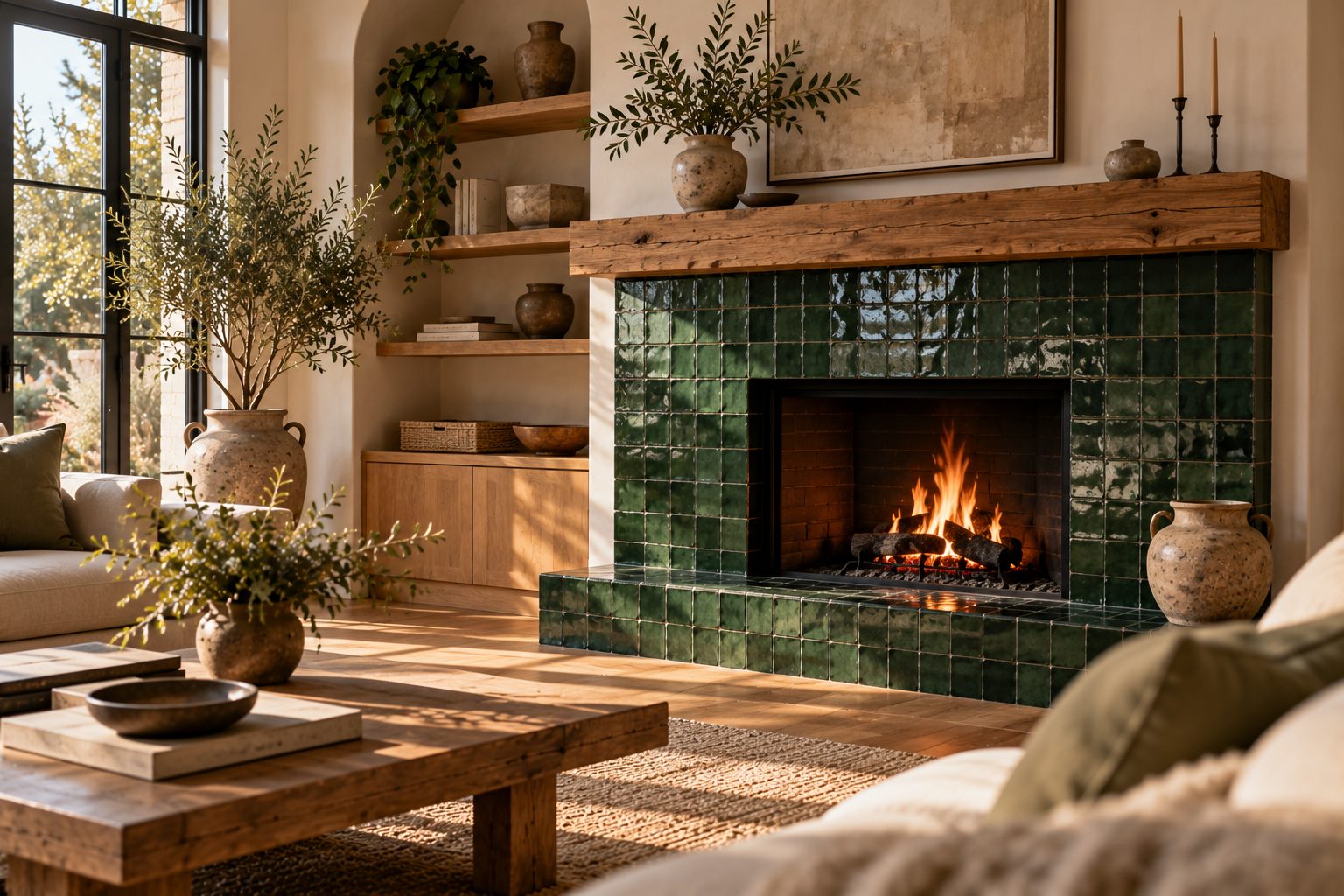
Key takeaways
- Use porcelain, glazed ceramic, zellige or natural stone around a fireplace; skip glass mosaic and resin-backed tile near the opening
- Set tile with a heat-resistant modified thinset over cement board, never over drywall, and check the noncombustible clearances for your firebox
- A hearth must extend 16 in (406 mm) in front of openings under 6 sq ft and 20 in (508 mm) for larger ones, plus 8–12 in to each side
- Tile the full wall for drama, but keep the tile quiet if the room already has a strong mantel or built-ins
The best fireplace tile ideas are handmade zellige or glazed ceramic around the opening, porcelain slab or large tile on a full accent wall, and a sealed stone or porcelain hearth at least 16 in (406 mm) deep. Any tile rated for heat works on the surround; the choice is about scale, pattern and how much of the wall you want to cover.
A tiled fireplace is the easiest way to give a living room a focal point that does not depend on art or a TV. This guide sits alongside our fireplace mantel decor guide, which covers what goes on the shelf; here we cover the surface around and below it.
- Safe tile types: porcelain, glazed ceramic, zellige, terracotta, natural stone and cement tile.
- Avoid near the opening: glass mosaic on mesh, resin-backed or peel-and-stick tile.
- Substrate: cement backer board with heat-resistant modified thinset, never drywall.
- Hearth depth: 16 in (406 mm) for openings under 6 sq ft, 20 in (508 mm) above that.
- Typical cost: $900–3,500 for a tiled surround, $3,000–10,000+ for a full fireplace wall, installed.
What tile is best around a fireplace?
Porcelain is the best all-round fireplace tile because it is dense, heat-stable and available in every look, while zellige and handmade ceramic give the most character on the surround.
Fireplace tile does two jobs: it protects the wall from heat and it frames the firebox. Tile around a fireplace usually sees 150–300°F (65–150°C) on the face near a wood fire and less with gas. Fired clay and stone handle that easily. The weak points are adhesives and mesh backings, so use a polymer-modified thinset rated for heat, a cementitious grout and, for gas inserts, follow the manufacturer's noncombustible clearance, usually 6–12 in (15–30 cm) of nothing combustible around the opening.
| Tile type | Look | Heat tolerance | Typical material cost (per sq ft) | Best use |
|---|---|---|---|---|
| Porcelain (standard or large format) | Stone, concrete, plain | Excellent | $3–12 | Surround, hearth, full wall |
| Porcelain slab, 6 mm | Seamless marble or stone | Excellent | $12–30 | Modern fireplace wall |
| Zellige or handmade ceramic | Glossy, uneven, artisan | Very good | $15–40 | Surround, small wall |
| Cement or encaustic tile | Patterned, matte | Good (sealed) | $10–25 | Hearth, surround |
| Natural stone (marble, limestone, slate) | Classic, veined | Excellent | $10–50 | Hearth slab, surround |
| Glass mosaic | Reflective | Poor near opening | $10–30 | Avoid near heat |
Material prices are typical US 2026 ranges. Labor for a surround is often a fixed job price of $400–1,500 because of cutting and trim work.
Fireplace wall ideas: surround, wall or feature wall?
Most fireplace wall ideas fall into three scales: a tiled surround framing the opening, tile up to the mantel, or a full floor-to-ceiling fireplace feature wall. Pick the scale by the room, then the tile.
Tiled surround
A band 6–12 in (15–30 cm) wide around the opening, finished with a wood or stone mantel. It suits traditional rooms and existing mantels and needs only 8–20 sq ft (0.7–1.9 m²) of tile, so you can afford something special.
Tile to the mantel, wood or plaster above
Tile on the chimney breast up to mantel height, typically 52–60 in (132–152 cm), with paint or plaster above. It balances a room with a TV or art over the mantel.
Full fireplace accent wall
Floor-to-ceiling tile on the chimney breast, or across the whole wall in a modern fireplace wall with a linear insert. This is the most dramatic fireplace wall design and the one where large-format porcelain or slab panels shine, because fewer joints read as one surface. For layout around seating, see our living room layout with fireplace guide.
Fireplace accent wall ideas by style
The fireplace accent wall ideas that age best match the architecture of the house rather than the trend of the year.
- Modern: honed porcelain slab in a limestone or concrete look, mitered corners, linear gas insert, no mantel or a floating timber shelf.
- Warm minimal: vertical stacked 2 × 8 in (5 × 20 cm) tile in a clay or sand tone, matching grout.
- Traditional: marble or limestone surround, painted wood mantel, a patterned hearth.
- Artisan or Mediterranean: zellige in green, cream or terracotta, laid in a straight stack or herringbone.
- Farmhouse: handmade white or cream subway tile with a reclaimed wood beam mantel.
#E9E2D3#C46F45#56705F#D9CBB4#2C2A28These hex values approximate common glaze and stone colors. A living room fireplace accent wall in a mid-tone glaze, LRV roughly 25–50, looks richer than bright white and hides soot marks at the opening. Our accent wall ideas guide covers paint and paneling alternatives for the same wall.
Zellige tile fireplace: what to know
A zellige tile fireplace gives the most light-catching, handmade surface of any option, but expect irregular edges, chips and color variation by design.
Zellige is glazed handmade terracotta, usually 4 × 4 in (10 × 10 cm) and 3/8–1/2 in (10–13 mm) thick, with uneven faces. Install with tight joints of about 1/16 in (1.5 mm), seal the unglazed edges and grout before grouting so the clay does not stain, and blend tiles from several boxes. Order 15–20 percent overage, because some pieces will be too chipped to use. Our zellige tile guide covers sourcing and sealing in more detail.
Hearth and fireplace tiles: sizes and rules
Hearth tiles must be noncombustible and extend at least 16 in (406 mm) in front of the opening and 8 in (203 mm) to each side for openings under 6 sq ft (0.56 m²), or 20 in (508 mm) and 12 in (305 mm) for larger openings.
Those are the typical US model code figures for masonry fireplaces; prefabricated units and inserts list their own minimums, which take precedence, and local code always rules. Fireplace floor tiles on a raised hearth sit 12–18 in (30–46 cm) high as extra seating; a flush hearth suits modern rooms and small spaces. Choose a matte porcelain, slate or honed stone with a DCOF of 0.42 or higher, since hearths double as a step. A single stone slab 1.25 in (32 mm) thick looks more finished than small tile and takes falling logs better.
How to tile around a fireplace
Tiling around a fireplace is a two-day job for a confident DIYer on a small surround and a pro job for a full wall or slab panels. The sequence:
- Check clearances and cool-down. Confirm the firebox or insert clearances and let the fireplace be cold for 24 hours.
- Prepare the substrate. Remove drywall within the clearance zone and screw 1/2 in (13 mm) cement backer board to studs or masonry.
- Dry-lay the pattern. Center the layout on the opening so cut pieces are equal on both sides; full tiles go at the top edge of the opening.
- Set with heat-resistant thinset. Use a polymer-modified mortar, back-butter large tiles and support the top row with a ledger board.
- Grout and seal. Use cementitious grout, then seal grout and porous tile once cured, typically after 72 hours.
- Wait before the first fire. Give the mortar at least seven days before lighting a wood fire.
Measure the wall with our tile calculator, then add 10 percent for straight lay or 15–20 percent for herringbone and handmade tile. Our tile installation cost guide covers what a pro will charge.
Mistakes we see on tiled fireplaces
The mistake we see most often is tiling over painted drywall right up to the firebox, which cracks and discolors within a season of use.
Close behind: a busy patterned tile fighting a carved mantel, so the eye has nowhere to rest; white grout around a wood-burning opening that turns gray in months; and decorative tiles for a fireplace bought in one box run, then a second order that does not match. A tile mantel, meaning a shelf clad in tile, also chips at the front edge unless you use a mitered porcelain edge or a solid stone shelf. Our editorial rule: one star per fireplace. If the tile is patterned, keep the mantel plain; if the mantel is the star, keep the tile quiet.
Our verdict on fireplace tile ideas
For a period room we would tile a narrow surround in green or cream zellige and add a honed limestone hearth slab. For a modern room we would clad the whole chimney breast in honed porcelain slab with mitered edges and skip the mantel entirely. Both look intentional in ten years. Of all the fireplace tile ideas we see, the ones that disappoint are trend patterns chosen without regard for the room, so start with the house and let the tile follow.
Need tile, slab or a stone hearth sized and quoted? Send dimensions and photos to our tile sourcing desk and we will match you with suppliers and typical lead times.
Free toolTile CalculatorWork out tiles, boxes, grout and adhesive with the right wastage.Shop & source the look
Buy it today — or have it made
Retail links are affiliate links: we may earn a commission at no extra cost to you (disclosure). “Get it made” sends the item to our sourcing desk for factory quotes in custom sizes and finishes.
Frequently asked questions
What kind of tile can go around a fireplace?
Porcelain, glazed ceramic, zellige, terracotta, cement tile and natural stone can all go around a fireplace because they are fired or mineral and noncombustible. Set them on cement backer board with a heat-resistant modified thinset. Avoid glass mosaic on mesh, resin-backed and peel-and-stick tile close to the opening, since their backings and adhesives cannot take the heat.
Can you tile directly over a brick fireplace?
Yes, you can tile over a brick fireplace if the brick is sound, clean and reasonably flat. Remove soot and sealer, fill deep mortar joints with a skim coat of thinset or leveling mortar, and let it cure before tiling. Very uneven or painted brick is better covered with cement board first, mechanically fixed into the masonry.
How far should a hearth extend from a fireplace?
A hearth should typically extend at least 16 in (406 mm) in front of a fireplace opening under 6 sq ft and 20 in (508 mm) for larger openings, plus 8–12 in (203–305 mm) to each side. Factory-built units and inserts have their own listed minimums, and your local building code takes precedence over these typical figures.
How much does it cost to tile a fireplace?
Tiling a fireplace surround typically costs $900–3,500 installed in the US in 2026, depending on tile, size and trim work. A full floor-to-ceiling fireplace accent wall usually runs $3,000–10,000 or more, and porcelain slab or handmade zellige sit at the top of that range because of material cost and cutting time.
Is zellige tile good for a fireplace?
Zellige is a very good fireplace tile because it is fired terracotta with a heat-stable glaze, and its uneven surface catches firelight beautifully. Seal the porous edges before grouting, use tight 1/16 in joints and order 15–20 percent extra. Expect chips and color variation, which are part of the look rather than defects.
Some links may be affiliate links. Regulations and specifications change — always confirm with suppliers and qualified professionals.