Japandi Furniture: Solid Wood Pieces, Sizes and What to Pay
Japandi furniture is low, simple solid wood furniture in oak, ash or walnut with visible joinery and matte oiled finishes. Here are the 8 core pieces, real sizes, wood grades and what to pay, from $600 to custom.
Part of our guide: Japandi Style Guide: Principles, Palette and Shopping List
Key takeaways
- Japandi furniture is low, solid, simple wood furniture: oak, ash or walnut, matte oiled, with rounded edges and visible joinery
- Keep pieces lower than usual: 15–17 in (38–43 cm) sofa seats, 10–14 in (25–36 cm) bed bases, 14–16 in (36–41 cm) coffee tables
- Real 100 percent solid wood costs more but can be sanded and repaired for decades; ask for kiln-dried boards at 6–9 percent moisture
- Use two wood tones at most, one light and one dark, and let linen, paper and stone fill the gaps
Japandi furniture is low, simple, solid wood furniture that blends Japanese restraint with Scandinavian comfort: oak, ash or walnut in matte oiled finishes, rounded edges, visible joinery and very little hardware. Expect $600–2,500 for a good solid wood table and $1,200–4,000 for a handmade or custom piece in the US in 2026.
Japandi style is about calm, craft and fewer, better things, and furniture carries most of that load because a Japandi room has so little else in it. For the full look, from color to lighting and layout, read our pillar Japandi style guide. This page focuses on the furniture: which pieces, which woods, which sizes and how to tell real wood from imitation.
- Height: 2–4 in (5–10 cm) lower than standard Western furniture on sofas, beds and coffee tables.
- Woods: white oak, ash and beech for light tones; walnut, smoked oak or charred wood for dark accents.
- Finish: matte hardwax oil or soap finish, 5–15 gloss units, never high-gloss lacquer.
- Construction: solid hardwood or thick veneer, mortise-and-tenon or dowel joints, hidden fixings.
What is Japandi furniture?
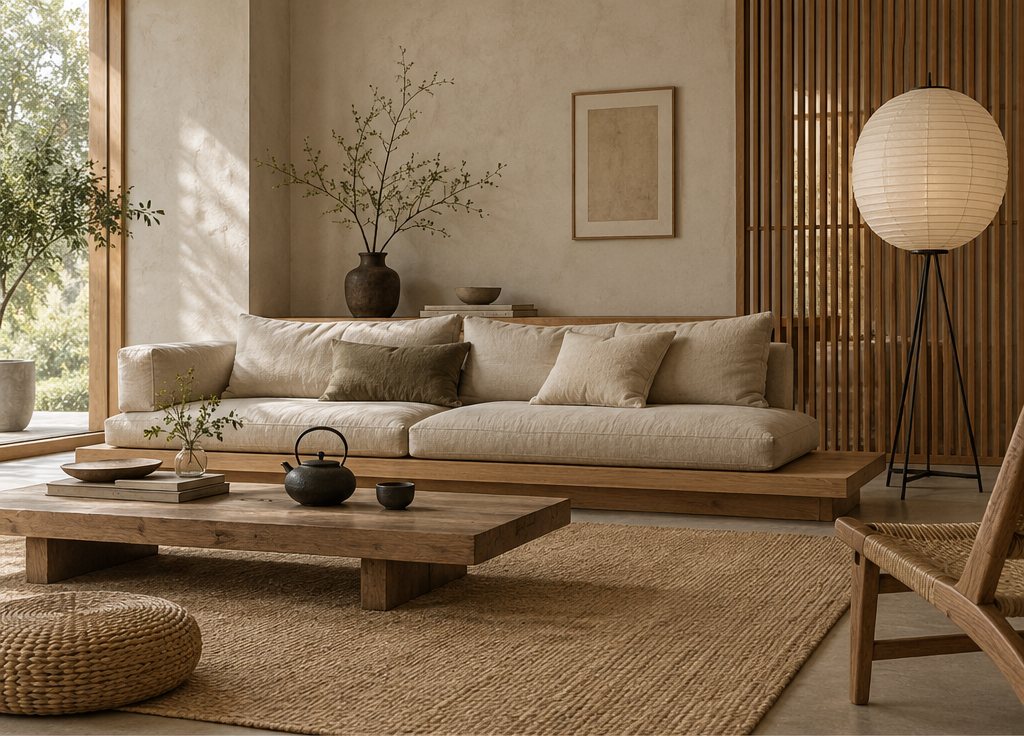
Japandi furniture is furniture designed for Japandi interior design: pieces with plain geometry, natural wood grain as the main decoration, low proportions and comfortable but uncluttered upholstery. It borrows the floor-level, quiet character of Japanese rooms and the warmth and practicality of Scandinavian homes.
What separates it from generic modern furniture is restraint. Japandi design avoids shiny metal, thick ornamental legs, button tufting and busy patterns. Instead it uses softened edges, a single material per piece where possible, and joinery that is honest about how the piece is held together. A good Japandi interior has perhaps 30 percent fewer pieces than an average room, so each one has to be well made.
Japandi vs Scandinavian and Japanese furniture
Scandinavian furniture is lighter, often blonder, and slightly taller. Japanese furniture is lower and darker, with more emphasis on floor seating and texture. Japandi sits between them: pale or mid oak with one dark accent, low seats and fewer soft furnishings than a Nordic room. Our Scandinavian style guide and wabi-sabi interiors guide cover the two parents.
8 core Japandi furniture pieces and their sizes
The eight Japandi furniture pieces below furnish a living room, dining room and bedroom; most homes need only five or six of them.
| Piece | Japandi size | Standard Western size | Typical US price (2026) |
|---|---|---|---|
| Low sofa | 15–17 in (38–43 cm) seat height | 17–19 in (43–48 cm) | $1,500–4,500 |
| Coffee table | 12–16 in (30–41 cm) high | 16–18 in (41–46 cm) | $400–1,800 |
| Solid wood dining table | 29 in (74 cm) high, 1.25–1.75 in (32–44 mm) top | 30 in (76 cm), 1 in top | $900–4,000 |
| Dining bench | 17 in (43 cm) high, 12–15 in (30–38 cm) deep | 18 in (46 cm) | $300–1,200 |
| Platform bed | 8–14 in (20–36 cm) base | 18–24 in (46–61 cm) with box spring | $900–3,500 |
| Low media console | 16–20 in (41–51 cm) high | 22–26 in (56–66 cm) | $700–2,800 |
| Paper-cord dining chair | 17–18 in (43–46 cm) seat | 18–19 in (46–48 cm) | $250–900 each |
| Open shelf or tansu-style chest | 30–48 in (76–122 cm) high | 60–72 in (152–183 cm) bookcase | $600–3,000 |
Price bands assume solid hardwood or thick veneer from mid-market makers. Imported flat-pack versions cost 40–60 percent less but usually use rubberwood or veneered particleboard, which cannot be refinished.
Which wood is best for Japandi furniture?
White oak is the best all-round wood for Japandi furniture: it is hard, stable, takes oil beautifully and has the straight, quiet grain the style needs. Ash is the lighter, cheaper alternative, and walnut is the preferred dark accent.
- White oak: Janka hardness about 1,350 lbf; quarter-sawn boards show fine ray flecks and move less.
- Ash: about 1,320 lbf; paler and more open-grained, good value for chairs and benches.
- Walnut: about 1,010 lbf; softer, so use it for case goods and accents more than for kids' dining tables.
- Beech: about 1,300 lbf; pale and close-grained, common in chairs; moves with humidity.
- Charred or smoked oak: a dark, matte accent for a side table, stool or shelf.
#E3D3B8#C8A77E#6B4E37#2E2925#D8D2C4#8A8578The hex values are approximate references for finished timber and paired neutrals. Our rule is one light wood for the big pieces and one dark wood for two or three accents. Three wood tones in a Japandi room almost always look accidental; our guide to mixing wood tones explains why.
How do you tell real solid wood furniture from veneer?
Real solid wood furniture shows the same grain on the top, the edge and the underside of a board, while veneer shows a thin seam at the edge and a different material, usually particleboard or MDF, underneath. Check end grain on table tops and drawer fronts before you buy.
Labels can blur this. "Solid wood construction" may mean solid legs and frames with veneered panels. "Real wood furniture" may mean real wood veneer over a composite core. If you want 100 solid wood furniture, ask the maker to state in writing which parts are solid. Veneer is not bad: 0.6–1.5 mm veneer over plywood is stable and often better for wide panels. It just cannot be sanded more than once or twice.
Signs of quality wood furniture
- Look at the edges. Matching grain wrapping around a corner means solid wood or thick lipping.
- Check the joints. Mortise-and-tenon, dovetail, finger joints or dowels, not staples and cam locks.
- Feel the weight. A 72 in (183 cm) solid oak table with a 1.5 in top weighs 120–180 lb (54–82 kg).
- Ask about moisture content. Kiln-dried hardwood should be 6–9 percent for indoor use.
- Look for movement allowance. Solid tops should be fixed with slotted brackets or buttons so they can expand.
- Inspect the finish. Hardwax oil can be spot-repaired; thick polyurethane hides poor grain and cracks.
That last test is why the best solid wood furniture is usually finished in oil. Solid hardwood furniture is heavier, more expensive and moves seasonally, but it can be sanded and re-oiled for generations.
How do you choose a solid wood dining table for a Japandi room?
Choose a solid wood table with a plain rectangular or soft-oval top 1.25–1.75 in (32–44 mm) thick, trestle or splayed legs, and a matte oiled finish; 72 x 36 in (183 x 91 cm) seats six. The table is usually the biggest single piece of wood in a Japandi home, so it sets the tone.
A natural wood dining room table in white oak with a bench on one side and paper-cord chairs on the other is the classic Japandi dining room. Keep the bench 2–3 in (5–8 cm) shorter than the table at each end. For sizing by seat count, see our dining table size guide. A handmade dining table from a small workshop typically costs $1,800–5,000; a custom wood dining table in a specific length or species adds 10–25 percent and 8–14 weeks of lead time.
What upholstered Japandi furniture should you buy?
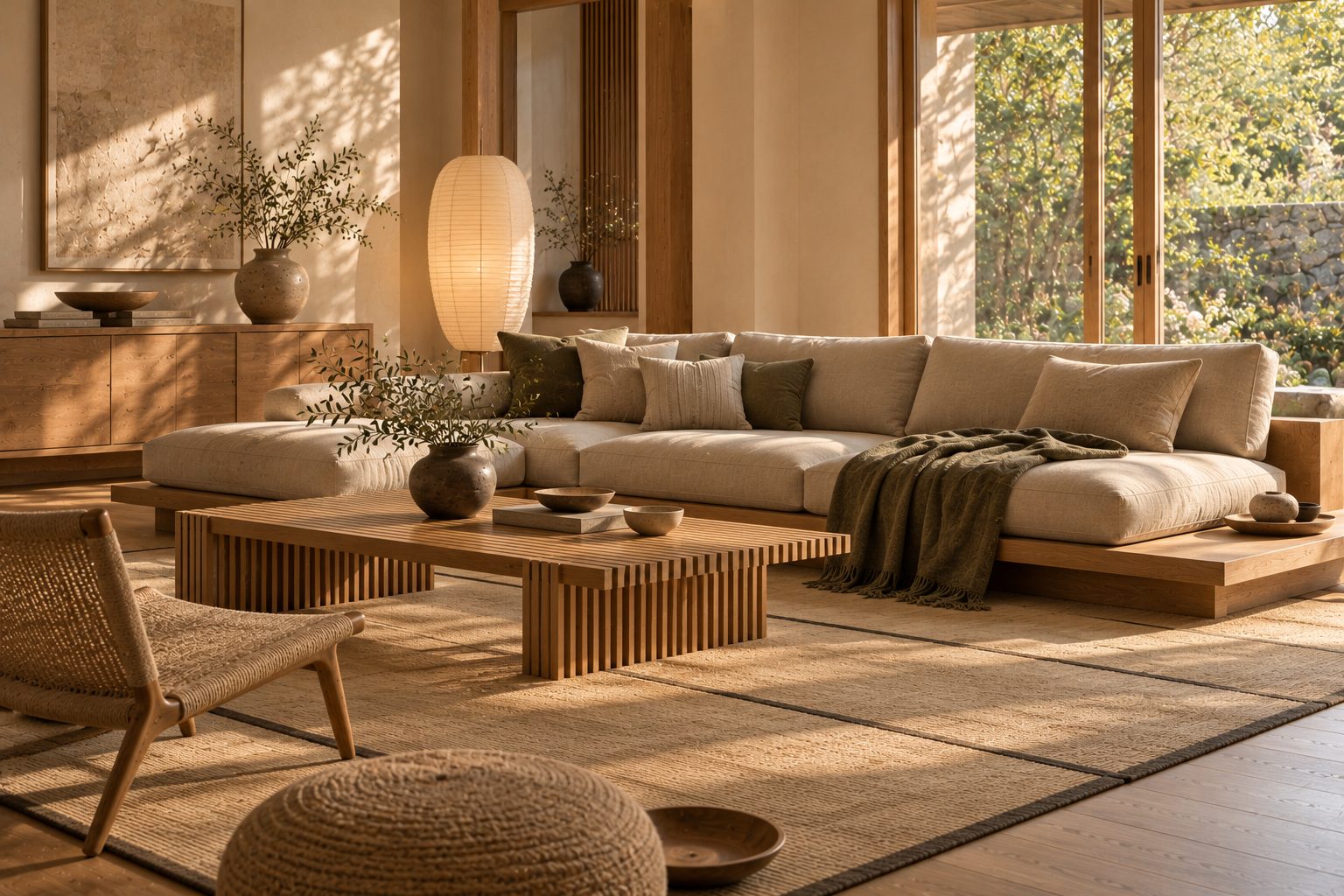
Buy upholstered Japandi furniture with low, tight or semi-loose cushions on a visible wood base, covered in linen, cotton, wool or a nubby but tightly woven blend rated at 25,000–40,000 Martindale. The wood frame should show; the fabric should be plain.
A Japandi sofa has a 15–17 in (38–43 cm) seat height and 23–26 in (58–66 cm) depth, often with a slim wood plinth or exposed legs. Colors are oatmeal, putty, mushroom, charcoal and soft clay. Skip shiny velvets and heavy pattern. Washable slipcovers make light linen practical; for the spec numbers, our upholstery fabric guide explains rub counts and pilling grades.
How do you arrange Japandi furniture in a room?
Arrange Japandi furniture with generous empty floor around every piece, low pieces grouped along one horizontal line, and a clear path of at least 36 in (91 cm) through the room. Negative space is part of the design, not leftover space.
In a living room, float a low sofa on a flat-weave wool or jute rug, put a 14–16 in (36–41 cm) coffee table 16–18 in (41–46 cm) in front of it, and keep the media console at the same low line, around 18 in (46 cm) high. One lounge chair in oak and paper cord or linen is enough; skip the matching armchair pair. In a bedroom, a platform bed 10–14 in (25–36 cm) high pairs with nightstands of roughly the same height as the mattress top, usually 18–22 in (46–56 cm), and one low chest instead of a tall dresser. Hide clutter in closed cabinets with push-latch doors or recessed pulls so surfaces stay almost bare.
Where to buy solid wood furniture
The best places to buy solid wood furniture for a Japandi room are small furniture workshops and independent makers, specialist solid wood furniture stores, and reputable factory-direct suppliers who state wood species and construction in writing. Local makers are ideal for a handmade dining table or bed. Vintage Scandinavian and Japanese pieces also fit well. Wherever you buy, ask the same questions: species, solid or veneer, moisture content, joinery and finish.
Mistakes we see with Japandi furniture
The mistakes we see most are rooms filled with cheap flat-pack "Japandi" pieces, too many wood tones, and furniture that is the right style but the wrong height. All three undo the calm the style depends on.
- Too many pieces: a Japandi room needs empty floor; remove one item for every new one.
- Wrong height mix: a low bed next to a tall nightstand, or a low sofa with a standard 18 in coffee table, looks off.
- Orange-toned finishes: glossy amber lacquer on oak fights the matte, quiet look.
- Black metal everywhere: one or two thin dark details are fine; industrial frames are not Japandi.
- Cheap rubberwood dining tables: they dent, cannot be refinished and wobble within a year.
Our verdict on buying Japandi furniture
Spend on the dining table and the bed, because those are the two largest wooden surfaces and the ones you touch every day. Buy them in genuine solid oak or ash with an oiled finish, even if it means waiting or buying in stages. Save on side tables, stools and shelves, where good veneer or a simple workshop piece does the job. Choose low proportions consistently, use one dark wood accent, and leave space around everything. Real Japandi furniture looks better in ten years than on the day it arrives, which is the whole point of the style.
Furnishing a whole home, a rental or a boutique hotel in Japandi style? Send your piece list and sizes to our furniture sourcing desk for solid wood quotes with wood grades, finishes and lead times spelled out.
Free toolRug Size CalculatorFind the right rug size for your room and furniture.Shop & source the look
Buy it today — or have it made
Retail links are affiliate links: we may earn a commission at no extra cost to you (disclosure). “Get it made” sends the item to our sourcing desk for factory quotes in custom sizes and finishes.
Frequently asked questions
What is Japandi furniture?
Japandi furniture is low, simple, solid wood furniture that mixes Japanese minimalism with Scandinavian comfort. It uses oak, ash or walnut in matte oiled finishes, rounded edges, visible joinery and plain linen or wool upholstery. Pieces sit 2–4 in (5–10 cm) lower than standard furniture and avoid ornament and shiny metal.
What wood is used in Japandi furniture?
White oak is the most common wood in Japandi furniture, followed by ash and beech for light tones and walnut or charred oak for dark accents. Most pieces are finished in matte hardwax oil or soap. Keep to one light wood for large pieces and one dark wood for a few accents.
Is solid wood furniture worth it?
Yes, solid wood furniture is worth it for tables, beds and chairs you use daily, because it can be sanded, repaired and re-oiled for decades. It costs more and moves slightly with humidity. For wide panels such as cabinet doors, thick veneer over plywood is a stable, sensible alternative.
How can you tell if furniture is solid wood?
Check the edge and underside: solid wood shows matching grain on the top, edges and underside, while veneer shows a thin seam and a composite core underneath. Real joinery, a heavy weight and slotted fixings under the top also point to solid wood. Ask the maker to confirm which parts are solid.
How much does a handmade solid wood dining table cost?
A handmade solid wood dining table typically costs $1,800–5,000 in the US in 2026 for a six-seat oak or walnut table, while mass-produced solid wood tables run about $900–2,500. Custom lengths, rare species and live edges add 10–25 percent and usually 8–14 weeks of lead time.
Some links may be affiliate links. Regulations and specifications change — always confirm with suppliers and qualified professionals.